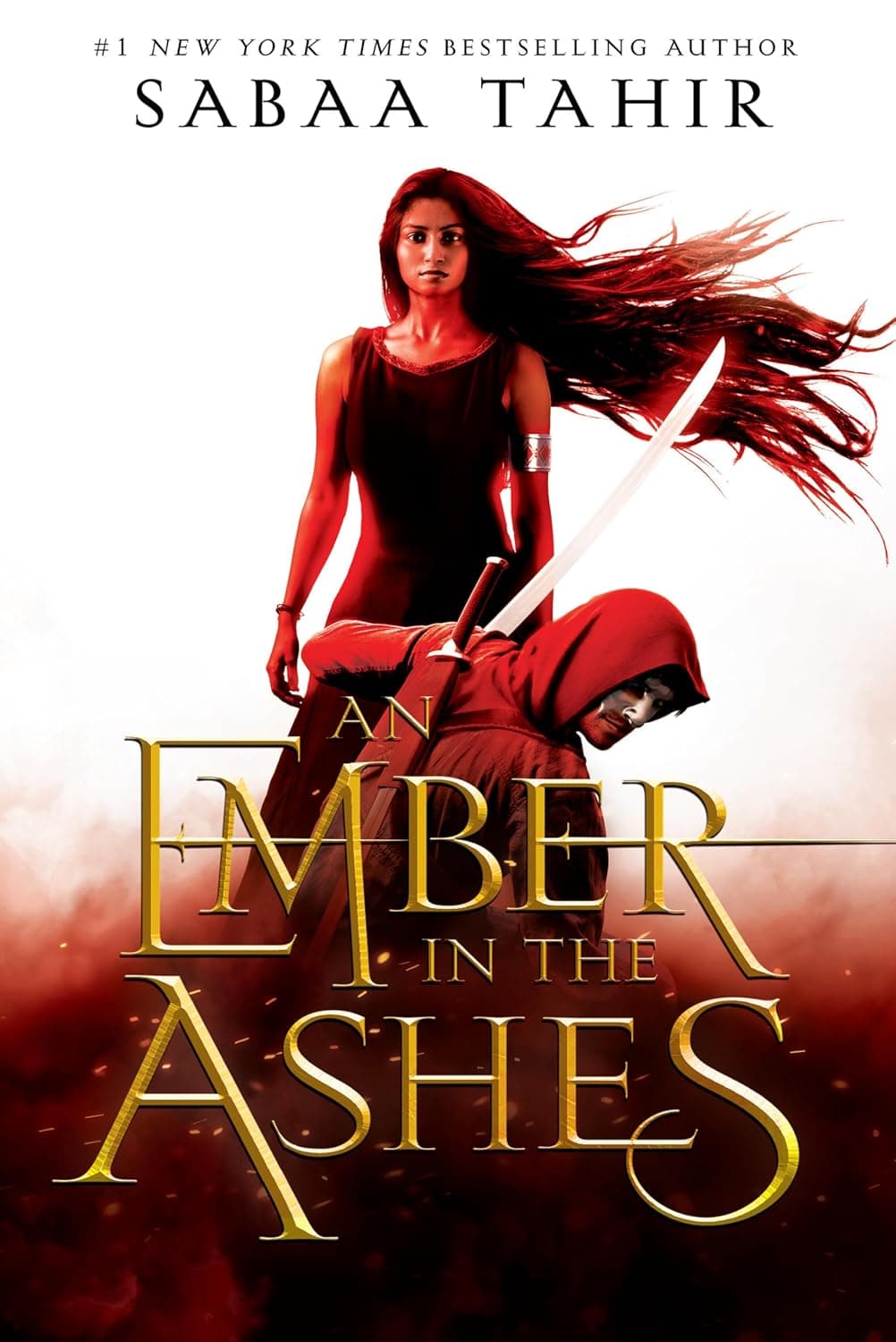
Opening
The First Trial thrusts Elias Veturius into a nightmare of his own making while Laia of Serra learns that pain can have teeth. Across deserts, forges, and the shadowed halls of Blackcliff, both choose who they are when terror closes in—under the cold gaze of The Commandant (Keris Veturia).
What Happens
Chapter XVI: Elias
Seven days before the deadline, Elias wakes in the Great Wastes with an Augur parchment naming the First Trial—the Trial of Courage—and a simple directive: reach Blackcliff’s belltower by sunset on the seventh day. The desert itself isn’t the test. The Augurs drag him into a brutal vision: a battlefield strewn with everyone he has killed—and everyone he will kill. The first face belongs to the thirteen-year-old Barbarian he once slew; others follow: Demetrius, Leander, his grandfather, even Laia. No matter how far he walks, the horizon resets. For five days, he wanders a looping purgatory, the dead whispering, his terror coalescing around the fear that he is becoming the Commandant’s monster.
When he sees Helene Aquilla lying among the corpses, certainty snaps the trap—he would never harm her. The illusion dissolves. The real Helene stands at the mountain’s edge, battered but alive. She confesses her own Trial—clawing free from a spire vulture’s nest despite a crippling fear of heights. Brief tenderness passes between them before they push for Walker’s Gap. In the narrow pass, Marcus Farrar and his twin Zak launch an ambush, bragging that the Commandant sent them. Elias cuts Zak down, but Marcus’s strike leaves Helene bleeding out. What follows is breathless: Elias sets a ruined guardhouse ablaze as a distraction, commandeers a merchant vessel, then thunders through Serra on a borrowed horse. He reaches the belltower at the echo of sunset drums and collapses with Helene in his arms, certain he’s too late.
Chapter XVII: Laia
Laia meets with Keenan, a sharp-eyed Resistance fighter who gives her practical lessons in spying and, unguarded for a moment, admits the Empire slaughtered his family. Her first errand is simple: deliver two letters from the Commandant. The second leads to the Weapons Quarter and the silent forge of master smith Spiro Teluman. Inside, the alignment of tools, blades, and sketches shocks her—they mirror the drawings that condemned Darin of Serra. This is the place her brother was watching.
Teluman initially refuses the Commandant’s commission. Then the forge curdles with cold. Ghuls—shadow-creatures that feed on sorrow—assault Laia, twisting her brother’s voice into a vision of torture. Teluman sees them too. He draws a scimitar and cuts the air, banishing the things to whatever darkness they crawled from. Rattled and curious, he tells Laia to inform the Commandant he will consider the offer. Back at Blackcliff, the Commandant discovers Laia opened the first letter. As punishment, legionnaires pin Laia while the Commandant heats a knife and carves a single letter into the flesh above Laia’s heart: K.
Chapter XVIII: Elias
In Blackcliff’s courtyard, Elias cradles Helene as the crowd thickens. His grandfather finds a pulse and calls for a physician. Elias confronts Cain, accusing the Augurs of letting the Farrars cheat. Cain denies it. He claims the Augurs can’t read the Commandant’s thoughts—her mind is cloaked in “darkness”—but promises to investigate and to heal Helene if they find proof of sabotage. As Elias and his grandfather carry Helene toward the infirmary, the Commandant intercepts them. The general names her traitor; she answers, cool as steel: “You picked your favorite, General. And I’ve picked mine.” Marcus, she makes clear, is hers.
Chapter XIX: Laia
Laia wakes to agony. Izzi finds her and, seeing the brand, tells a story with a missing eye: when she was five, the Commandant used a hot poker to punish Cook and marked Izzi forever. The confession stitches a fragile bond between the girls. Laia forces herself back to work, terrified of further punishment. One task sends her to the dunes below Blackcliff to gather sand for the Commandant’s bath. Grief and pain flood her. She collapses, sobbing.
The ghuls come. Drawn by her despair, they circle and mimic her pleas until she stumbles blind with fear—straight into a tall figure. Pale gray eyes flash beneath a Mask. It’s Elias, the same soldier who watched Marcus brutalize her.
Chapter XX: Elias
At dawn, Cain announces the verdict: Marcus wins the Trial. No proof of cheating surfaces. Zak arrives, gray with guilt, and begs Cain to save Helene. Cain reads Zak’s mind, sees enough to act, and explains that some minds—Zak’s, the Commandant’s—can shield themselves from Augur sight. When Cain steps away, Zak murmurs to Elias that the old tales of ghuls and jinn are true and that the Commandant “has ways” of knowing things. He admits he wants out from Marcus’s shadow. Cain orders both Elias and Zak off the grounds; their emotions hinder Helene’s healing.
Elias rappels to the dunes to clear his head. He hears sobbing and finds Laia, tormented by what looks like wind and sand—but he remembers the vision in the Wastes, where her body lay among his kills. He chooses to defy that future. He walks toward her, not as a Mask, but as someone who refuses to stand by and do nothing.
Key Events
- The First Trial begins, forcing Aspirants to face their deepest fears and reach Blackcliff in seven days.
- Elias endures a five-day illusion of a battlefield filled with his past and future victims and breaks it by choosing Helene over fear.
- The Commandant sabotages the Trial by sending Marcus and Zak to ambush Elias and Helene.
- Laia discovers Spiro Teluman’s forge matches Darin’s sketches—the first concrete lead on her brother’s mission.
- Ghuls are confirmed real when both Laia and Teluman see and repel them.
- The Commandant brands Laia with a “K,” marking her as property.
- Elias and Laia’s paths collide on the dunes, and he decides to help her.
Character Development
Both protagonists pivot from endurance to choice: fear still stalks them, but each claims a sliver of agency that will shape the rest of the story.
- Elias Veturius: Confronts not death but the terror of becoming a weapon like his mother. Breaking the battlefield illusion by refusing the possibility of harming Helene anchors his moral compass. His decision to aid Laia marks a conscious rebellion against a prophesied future.
- Laia of Serra: Survives dehumanization and supernatural assault yet continues her mission. She gathers vital intelligence about Darin, earns unexpected help from Keenan and Teluman, and endures the brand without surrendering her purpose.
- Helene Aquilla: Faces her phobia, survives Marcus’s attack, and reveals vulnerability beneath her Mask. Her bond with Elias deepens through shared trial and near-death.
- The Commandant: Wields cruelty as strategy—cheating in the Trials and branding Laia. Her mind resists Augur sight, positioning her as an opaque and dangerous power.
- Zak Farrar: Shows guilt and a desire to escape Marcus’s control, hinting at a conscience at war with fear.
Themes & Symbols
The arc centers on Fear and Courage. The Trial strips bravery down to choice: Elias rejects the identity of killer by anchoring himself in love and loyalty; Helene acts despite vertigo; Laia’s courage is endurance—bearing pain, facing ghuls, and continuing to gather intelligence for her brother. Courage here is not victory over danger but persistence through it.
The tension of Freedom vs. Oppression sharpens. The Commandant’s brand reduces Laia to property, a scar that literalizes imperial dominance over Scholar bodies. Internally, Elias and Zak crave escape—from the Empire, from family legacies, from a brother’s grip—showing how bondage can be psychological as well as political.
Ghuls operate as symbols of weaponized grief. Drawn to despair and echoing a victim’s own terror back at them, they turn private pain into external torment. Their return widens the novel’s scope: the world’s conflict isn’t only imperial—it’s haunted by ancient, resurgent forces.
Key Quotes
“You picked your favorite, General. And I’ve picked mine.”
The Commandant lays bare the corruption of the Trials and her personal allegiance to Marcus. The line reframes the competition as political theater and signals her willingness to break rules to shape the Empire’s future.
The Commandant’s mind is cloaked in “darkness.”
Cain’s admission establishes limits to Augur power and casts the Commandant as uniquely opaque—and therefore uniquely dangerous. It also justifies why proof of sabotage remains elusive.
The Commandant “has ways” of knowing things.
Zak’s warning confirms the reach of the Commandant’s surveillance and nods to supernatural channels of information. His fear underscores how thoroughly she controls those around her.
The “K” branded over Laia’s heart.
The single letter becomes a living symbol: ownership scarred into flesh. It compresses the novel’s meditation on oppression into an image that will persist—physically and psychologically—with Laia.
Why This Matters and Section Significance
These chapters reset the stakes. The First Trial exposes Blackcliff’s rot, with the Commandant openly steering outcomes. The confirmed existence of ghuls expands the conflict beyond politics into the supernatural. Most crucially, Elias and Laia’s stories converge: his decision to help her defies the Augurs’ prophecy and redefines him not as a Mask, but as a man who acts against cruelty. That choice forges the first link in an alliance that will challenge both empire and fate.