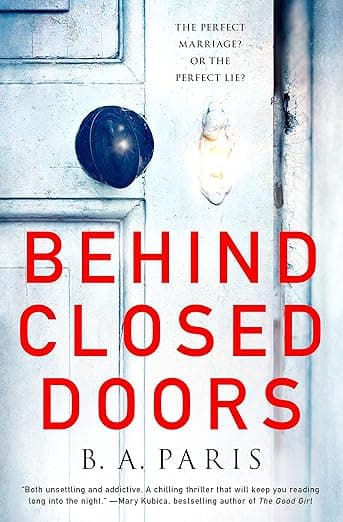
This collection of quotes from Behind Closed Doors explores the novel's central themes of psychological manipulation, the facade of perfection, and the terrifying power of fear.
Most Important Quotes
Jack's True Motivation
"You are not my reward, Grace, Millie is."
Speaker: Jack Angel | Context: Thailand, honeymoon (Past, Chapter 2), when Grace challenges Jack about his cruelty and he reveals his real target.
Analysis: This chilling confession pivots the narrative from a domestic-abuse thriller to a study in predation, revealing that Grace is a conduit to Jack’s ultimate goal—her sister, Millie. The line reframes Jack’s courtship as a long con, exposing premeditation and a hunter’s patience. It anchors the theme of Psychological Manipulation and Control, as Jack weaponizes Grace’s love to secure access to his preferred victim. The blunt possessive “reward” dehumanizes both sisters, distilling Jack’s worldview into transactional, chillingly clinical terms that define the book’s moral horror.
Fear as the Ultimate Weapon
"I hold my hands out in front of me and the shaking that I can’t control tells me what I’ve only just begun to realise but what Jack has known all along—that fear is the best deterrent of all."
Speaker: Grace Angel | Context: Locked in her room after Millie’s school visit (Present, Chapter 4), as she debates confiding in someone.
Analysis: Grace’s involuntary trembling functions as embodied metaphor: the body confirms what the mind resists, that terror can police behavior more effectively than locks. The sentence structure—cascading toward the final assertion—mirrors a dawning realization and underscores the theme of Fear as a Weapon. Jack’s genius lies in outsourcing violence to the imagination; the threat against Millie enforces compliance without constant force. The quote marks a turning point in Grace’s strategy, showing she must resist not only physical captivity but the internalized carceral state fear creates.
The Perfect Facade
"Since joining our circle of friends a month ago, I’m sure she’s been told over and over again that Grace Angel, wife of brilliant lawyer Jack Angel, is a perfect example of a woman who has it all—the perfect house, the perfect husband, the perfect life."
Speaker: Grace Angel | Context: Dinner party introduction of Esther (Present, Chapter 1), as Grace measures how outsiders perceive her.
Analysis: The anaphora of “perfect” builds a glossy surface that invites the reader’s skepticism, sharpening the theme of Appearance vs. Reality. Dramatic irony turns the line into a quiet scream: the public narrative of plenitude conceals private terror. The social performance isn’t ornamental; it’s infrastructural to Grace’s Imprisonment and Isolation, sealing her off behind admiration and disbelief. The sentence’s catalog of perfections mimics advertisement copy, suggesting how consumer fantasies of “having it all” can function as camouflage for abuse.
The Final Revelation
"'What colour was Millie’s room, Grace?' I can barely get the word out. 'Red,' I tell her, my voice breaking. 'Millie’s room was red.' 'That’s what I thought,' she says softly."
Speaker: Grace Angel and Esther | Context: Airport café after Jack’s death (Present, Chapter 10), where Esther quietly confirms she knows the truth.
Analysis: The color becomes evidence: “red” operates as symbol, confession, and code that punctures the Angels’ curated image. Jack’s contradictory claims—yellow in public, red in private—expose the seam where his lie frays, allowing Esther to see through the performance. Her gentle certainty enacts the theme of The Power of Perception and Credibility, restoring to Grace the belief she was denied. The spare dialogue, heavy with subtext, delivers catharsis without spectacle, proving that attention and memory can be forms of rescue.
Thematic Quotes
Psychological Manipulation and Control
Absolute Power
"No," he said. "You don’t. You have no rights at all."
Speaker: Jack Angel | Context: En route to the honeymoon (Past, Chapter 2), after Grace challenges his disappearance on their wedding night.
Analysis: Jack’s clipped negations enact linguistic domination, reducing Grace’s subjectivity to nothing with bare declaratives. The line codifies the marriage as a hierarchy, not a partnership, and inaugurates a regime of gaslighting and coercion. Its absolutism (“no rights at all”) maps directly onto Grace’s psychological captivity, advancing Imprisonment and Isolation as a mindset before it becomes architecture. The cruelty is procedural, not impulsive, revealing a methodical abuser who rewrites norms to erase consent.
The Perfect Prison
"Steel shutters," he explained. "Every window on the ground floor has been fitted with them. Even if you happen, by some miracle, to find a way out of your room while I’m at work, you certainly won’t find a way out of the house."
Speaker: Jack Angel | Context: After Grace’s first escape attempt in the new house (Past, Chapter 3), as Jack catalogs his security upgrades.
Analysis: The house—gifted as a romantic ideal—mutates into an engineered carceral space, literalizing the bait-and-switch at the heart of the plot. “Steel shutters” serve as concrete symbol of entrapment, converting domestic sanctuary into fortress. The measured, almost courteous explanation heightens the horror, combining civility with containment to sharpen Appearance vs. Reality. By anticipating miracles, Jack colonizes hope itself, closing off not just exits but the imagination of escape.
Appearance vs. Reality
The Ultimate Hypocrisy
"I have nothing but contempt for men who are found to be violent towards their wives," Jack says firmly. "They deserve everything they get."
Speaker: Jack Angel | Context: Dinner party conversation about his legal work (Present, Chapter 1), delivered before friends.
Analysis: This is textbook dramatic irony: the defender of abused women is himself the abuser. The firmness of his delivery reads as overcompensation, a rehearsed alibi designed to inoculate him against suspicion. The statement fortifies his public armor, making any accusation from Grace seem implausible within the social script he controls. Hypocrisy here isn’t accidental; it’s strategic, the camouflage without which his private tyranny could not thrive.
A Picture of a Lie
"In each one I am smiling up at the camera, the epitome of a relaxed and pampered woman very much in love with her husband."
Speaker: Grace Angel | Context: After the dinner party, when Esther is shown the Thailand holiday photos (Present, Chapter 1).
Analysis: The photograph becomes an instrument of narrative control, freezing a counterfeit truth that friends will trust over any spoken confession. Grace’s smile is performative, a survival mask that underscores the labor of deception. The line exposes how curated images fabricate reality, reinforcing Jack’s external myth while deepening Grace’s internal exile. Memory itself is weaponized—each photo a small cell in the larger prison of appearances.
Fear as a Weapon
The Scent of Terror
"Fear," he whispered. "There is nothing quite like it. I love how it looks, I love how it feels, I love how it smells. And I especially love the sound of it."
Speaker: Jack Angel | Context: Post-revelation monologue about his childhood and sadism (Past, Chapter 4), after confessing Molly’s fate.
Analysis: Jack’s synesthetic catalog turns fear into a sensual object, revealing not utility but appetite—the aesthetics of cruelty. By savoring fear across senses, he elevates terror to an art he longs to perfect, clarifying why he prolongs suffering rather than ends it. The whispering intimacy makes the scene perversely confessional, darkening the portrait of a predator who craves experience over outcome. It articulates the core of Fear as a Weapon: fear is not merely a tool for Jack, but the pleasure he seeks.
Millie as Leverage
"Each time you try to escape, whether by hammering on the door, or speaking to someone, or trying to make a run for it, it is Millie who will pay."
Speaker: Jack Angel | Context: Thailand hotel room rule-setting (Past, Chapter 2), immediately after Grace’s attempt to get help.
Analysis: Jack inverts protection into peril, converting Grace’s devotion into shackles. By threatening Millie, he exploits Love and Sacrifice to lock Grace into self-policing, ensuring obedience with a single, unanswerable ultimatum. The incremental list of “hammering,” “speaking,” “run for it” covers the spectrum of resistance, showing how thoroughly he anticipates and criminalizes hope. It’s psychological torture at its most effective: Grace’s fear for another becomes the cage she cannot see but cannot stop obeying.
Character-Defining Moments
Grace Angel
"I love Millie more than life itself and wouldn’t change her for the world. Just thinking about her gives me new resolve and I get purposefully to my feet."
Speaker: Grace Angel | Context: During the dinner party (Present, Chapter 1), as she checks herself and recommits to protecting her sister.
Analysis: Grace’s identity crystallizes around protective love; it’s the force that both imperils and empowers her. Jack targets that devotion, yet it also fuels Grace’s planning, patience, and courage, embodying Resilience and the Will to Survive. The phrase “new resolve” signals motion from despair to agency, a pattern that repeats as she turns endurance into strategy. The line reframes her not as passive victim but as caretaker-warrior, defining the moral center of the novel.
Jack Angel
"The knowledge that the father could instil such terror into another human being turned the boy’s fear of him into admiration and he began to emulate him."
Speaker: Jack Angel | Context: Confessional backstory to Grace (Past, Chapter 2), recounting his upbringing.
Analysis: This origin story replaces remorse with reverence, mapping the transmission of violence as a perverse apprenticeship. The key verb “emulate” reveals intention: Jack is not haunted by the past but inspired by it, choosing cruelty as craft. The detached third-person phrasing (“the boy”) suggests self-mythologizing, a calculated distance that helps him aestheticize harm. It clarifies his fixation on Millie as the next canvas on which to perfect the fear he worships.
Millie Harrington
"I like you, Jack," she says. "But I don’t like Jorj Koony."
Speaker: Millie Harrington | Context: After Jack denies her favorite restaurant (Present, Chapter 2), repeating a line that carries hidden meaning.
Analysis: Millie’s seemingly playful phrase is a cipher—her way of naming the “bad man” without triggering punishment, proving both memory and cunning. The code sustains a secret alliance with Grace, threading hope through surveillance. Her line is an act of everyday resistance, small yet steady, that keeps truth alive under pressure and embodies resilience. It also unsettles Jack’s control, reminding us that clarity can survive even within coercion.
Esther
"Oh, I’m sure she’d be able to find a few little imperfections. Wouldn’t you, Grace?"
Speaker: Esther | Context: Lunch with Diane and Grace (Present, Chapter 3), as Esther probes the Angels’ flawless image.
Analysis: Esther’s skepticism is surgical, inviting Grace to puncture the myth without exposing her outright. By insisting on imperfections, she disrupts the social script that protects Jack, advancing the slow dismantling of Appearance vs. Reality. The direct address—“Wouldn’t you, Grace?”—offers a lifeline disguised as banter, signaling perceptiveness without forcing a confession. Her role as the watchful outsider becomes crucial: she is the rare character who sees what others refuse to see.
Opening and Closing Lines
Opening Line
"The champagne bottle knocks against the marble kitchen counter, making me jump."
Speaker: Narrator / Grace Angel | Context: First sentence (Present, Chapter 1), as Grace prepares for a dinner party.
Analysis: A celebratory object produces a startle response, compressing luxury and dread into one sound and setting the book’s tonal paradox. The tactile specificity—glass on marble—grounds the moment in domestic beauty, while Grace’s jolt signals hypervigilance. The line inaugurates Appearance vs. Reality and foreshadows the anxiety that permeates every social ritual. It’s an elegant thesis sentence: this is a world where elegance masks danger.
Closing Lines
"'What colour was Millie’s room, Grace?' I can barely get the word out. 'Red,' I tell her, my voice breaking. 'Millie’s room was red.' 'That’s what I thought,' she says softly."
Speaker: Grace Angel and Esther | Context: Final exchange (Present, Chapter 10), when Esther confirms her suspicions.
Analysis: Returning to a single sensory detail, the novel closes with proof that observation can dismantle deception. “Red” condenses violence, secrecy, and truth, converting a private horror into shared knowledge. Esther’s soft affirmation validates Grace’s experience, loosening the vise of Imprisonment and Isolation and offering emotional release without spectacle. The quietness of the ending is its power: belief, not noise, ends the terror.