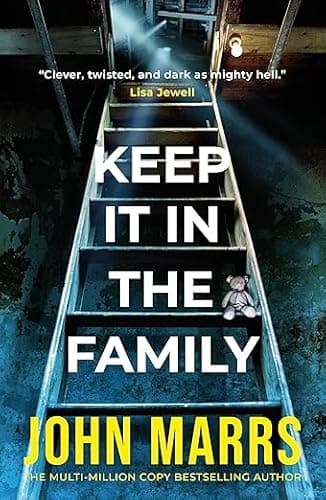
The peace of Mia and Finn Hunter's new home is shattered when a sinister message appears, plunging them into a nightmare far beyond their expectations. As they delve into the house's hidden secrets, the couple uncovers a horrifying truth that will forever alter their lives and challenge their understanding of evil. The idyllic facade crumbles, revealing a dark history that threatens to consume them.
Chapter 11: I Will Save Them
The tension begins when Mia discovers a chilling message carved into the nursery's skirting board: "I will save them from the attic." Finn fears for their unborn baby, but Mia's anxiety, fueled by her obsession with missing children, takes over. Dave Hunter dismisses it as a prank, reminding Finn of his imaginary sister, Tan-Tan, but Debbie Hunter seems unsettled.
Mia insists on investigating the attic, recalling the two packing cases they saw earlier. Despite Dave's reluctance to abandon his plastering work, Mia's determination is unwavering. She refuses to rest until she knows what lurks in the attic, setting the stage for a tense exploration. The cryptic message serves as a sinister hook, directly linking the house's history to the family's future, embodying the theme of The Past Haunting the Present.
Chapter 12: The Attic
Driven by Mia's insistence, Finn and Dave climb into the dark attic. The lightbulb immediately blows, amplifying the oppressive atmosphere. Debbie, uncharacteristically nervous, tries to dissuade them, but Mia is resolute. Ignoring her pregnancy and Debbie's warnings, Mia ascends the rickety ladder to witness the search. The initial search seems anticlimactic; the packing cases contain only old wallpaper and paint.
Just as they are about to give up, Mia notices a wall that appears to have been added after the house was built, concealing a hidden space. Dave suggests it was for insulation, but Finn, now equally curious, probes the wall. He dislodges a brick, revealing a secret room. Inside, they discover a horrifying scene: seven old-fashioned suitcases arranged in a V-formation, each marked with a red letter 'P'. In front of each suitcase is a shrink-wrapped bag of children's clothing. They pry one open, releasing a smell of decay, and find the mummified body of a child. The shock overwhelms Mia, causing her to fall backward down the ladder into darkness.
Chapter 13: One Year Earlier
The narrative shifts to a flashback from the killer's perspective, detailing their final murder. The narrator describes choosing a boy who resembles their brother, George Lewis. This murder is deemed a "selfish one," a departure from the killer's usual twisted justification of "saving" their victims.
The killer reflects on their long career and the reasons for stopping. Modern technology has made their methods too risky. They recount a "failed abduction" and the difficulty of finding suitably "impoverished" victims in an era where appearances are deceptive. The killer disdains modern methods like online luring, viewing it as "cutting corners." The chapter concludes with the killer performing their final ritual: carefully folding the child's body into a suitcase, sealing his clothes in a bag, and committing the entire scene to memory as their "swansong." This reveals the methodical and controlled nature of the killer, directly connecting to the theme of Manipulation and Control.
Chapter 14: Sonny
Mia awakens in a hospital, her memory hazy. Debbie is by her side, displaying an uncharacteristic warmth and concern. She informs Mia that she suffered a traumatic fall, resulting in broken ribs, a severely fractured wrist, and other injuries. She also had to have an emergency caesarean section. Their baby boy, though premature, is alive and healthy, with Finn in the special-care unit.
Debbie's comment, "despite what you did, my grandson is okay," subtly blames Mia, fueling her guilt. When Finn takes her to see their son, whom they name Sonny Hunter, Mia is overwhelmed. She sees the tiny, vulnerable infant and feels a profound sense of failure and detachment, believing she is a danger to him. The police arrive to take her statement, confirming the bodies are historical and all likely children. The chapter ends with a police press conference transcript, officially stating that the remains of seven children, who died in the late 1970s and early 1980s, were found in the house.
Chapter 15: The Crime Scene
Three weeks later, Mia and Finn return to their house for the first time. It is now a full-scale crime scene, cordoned off with police tape and surrounded by forensic tents. Finn carries the tiny Sonny in a sling on his chest. They are met by their family liaison officer, DS Mark Goodwin, who explains they cannot enter the house itself.
Instead, he shows them video footage of the ongoing investigation. The images are devastating. Their dream home has been systematically dismantled: floors are ripped up, walls are drilled with holes, and ceilings have been removed. The nursery where Mia found the message is now dotted with dozens of yellow evidence markers. The destruction of the house mirrors the destruction of their hopes and dreams. As Mia watches the footage, she feels a cold shiver, and when she instinctively reaches out to touch her sleeping baby, she pulls her hand back, unable to bridge the emotional chasm created by her trauma and guilt.
Key Events
- A chilling message is discovered in the nursery: "I will save them from the attic."
- A hidden room is found in the attic containing seven suitcases.
- The suitcases contain the mummified remains of children.
- Mia falls down the attic ladder, sustaining serious injuries.
- Sonny is born prematurely via emergency C-section.
- A flashback reveals the killer's final murder and reasons for stopping.
- Police confirm the remains of seven children who died in the late 1970s and early 1980s.
- Mia and Finn return to their house, now a crime scene, and witness its forensic dismantling.
Character Development
- Mia: Her anxiety is validated in the most horrific way. The trauma leaves her with physical injuries and deep psychological scars, manifesting as guilt and an inability to bond with Sonny.
- Finn Hunter: He transitions from soothing his wife's anxieties to grappling with unimaginable horror, supporting Mia and becoming a father under immense stress.
- Debbie Hunter: Her character becomes more complex, displaying maternal warmth towards Mia while subtly blaming her, hinting at manipulation.
- The Killer: Introduced in a flashback, the killer is revealed to be meticulous, experienced, and intelligent, providing insight into their twisted justifications and methods.
Themes & Symbols
- The Past Haunting the Present: The house's buried history derails Mia and Finn's future, physically and emotionally assaulting them.
- Family Secrets and Lies: The discovery of the bodies makes the Hunters inheritors of a dark legacy, transforming their sanctuary into a tomb.
- Nature vs. Nurture: The killer's mention of their brother, George, suggests a personal history influencing their pathology, juxtaposing innocence with violent corruption.
Symbols:
- The House: Transforms from a symbol of hope into a gruesome crime scene, representing the death of innocence.
- The Suitcases: Macabre symbols of the killer's crimes, concealing death and representing the compartmentalization of evil.
Key Quotes
"I will save them from the attic."
This chilling message, carved into the nursery skirting board, sets the stage for the horrifying discoveries to come. It serves as a direct link between the house's dark history and the family's future, immediately creating a sense of dread and foreboding.
"despite what you did, my grandson is okay."
Debbie's subtle blame towards Mia after Sonny's birth reveals a complex and potentially manipulative side to her character. The comment plants the seed of guilt in Mia's mind, contributing to her emotional turmoil and struggle to bond with her newborn son.
Significance
These chapters contain the story's primary inciting incident, shifting the narrative from a domestic story into a dark psychological thriller. The discovery of the bodies launches the central mystery and the police investigation. The perspective shift to the killer creates dramatic irony, making the reader aware that the killer is alive and has stopped killing, shifting the central question to how the killer is connected to the house and the Hunter family. Mia's fall and Sonny's premature birth establish the core emotional conflict of the story: Mia's struggle to overcome her trauma and bond with her child.
Analysis
John Marrs masterfully controls pacing and suspense. The tension builds with the cryptic message, escalates with the attic search, and culminates in the horrifying reveal. The use of a red herring—the packing cases—momentarily releases tension before the discovery of the hidden room.
The narrative choice to switch to the killer's perspective is a bold and effective technique, replacing tension with chilling dread. This shift provides crucial exposition, giving the reader a privileged position of knowing more than the protagonists. The juxtaposition of horror and birth is a key analytical point. The nursery, a symbol of life, becomes the site of atrocity. Sonny's birth is forever tainted by violence and trauma, defining Mia's psychological state. The destruction of the house is a powerful metaphor for the shattering of Mia and Finn's dreams.