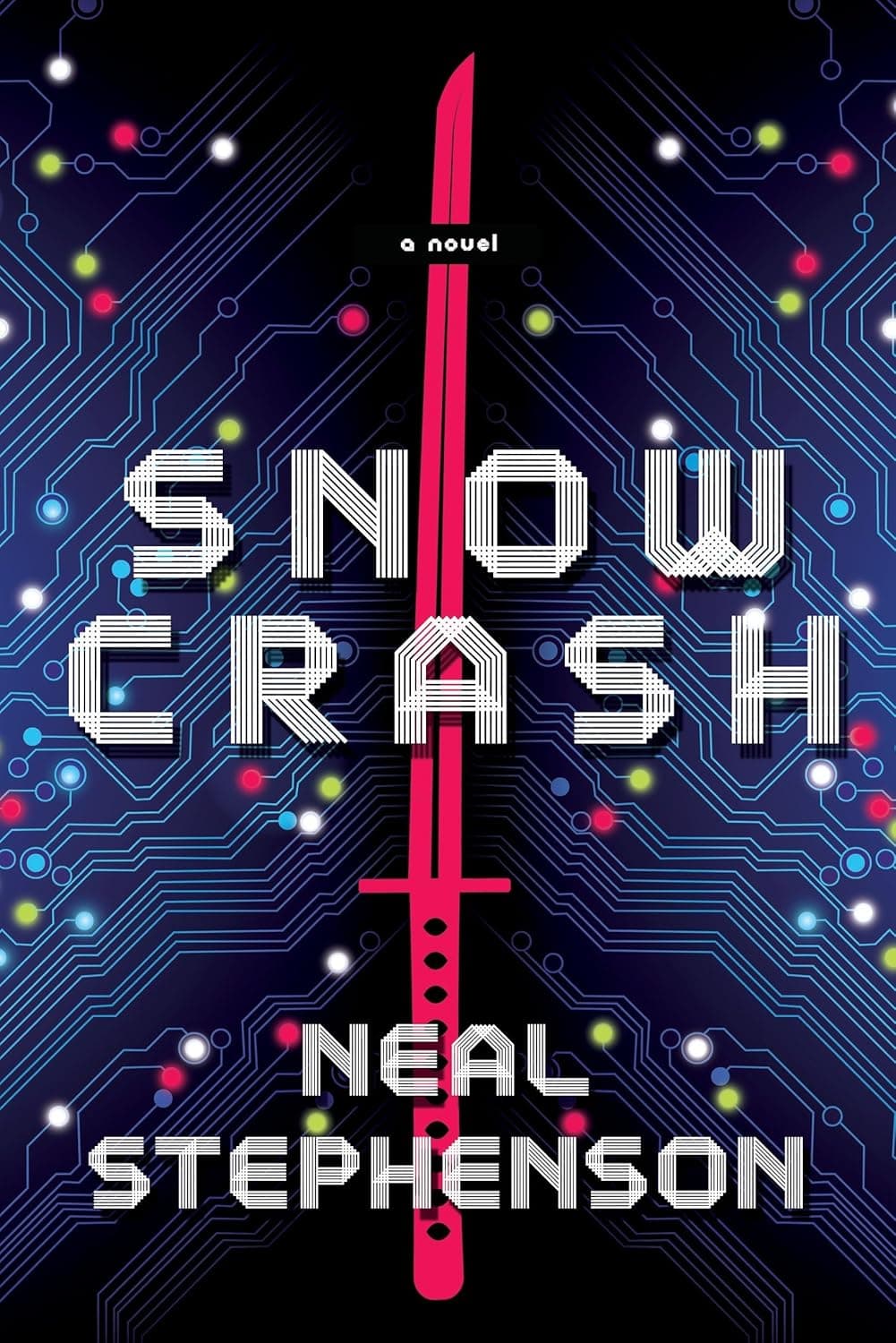
Opening
A kayak attack, a surfacing nuclear sub, and a railgun named “Reason” shatter the balance of power at sea as Hiro Protagonist and Y.T. head toward an inevitable collision with Raven. While Hiro arms up in the codeworld, Y.T. is pulled into Raven’s orbit—where history, vengeance, and charisma prove as lethal as any weapon.
What Happens
Chapter 46: The Submarine
Aboard the Kowloon, Hiro and Uncle Enzo’s crew watch their hostage float stall out—until a lone kayaker surfs a wave toward the Mafia speedboat. Hiro recognizes the man: Raven. He shoulders a launcher and blows the tow boat into a fireball, leaving the Mafiosi stunned and scrambling.
Then a black wall of steel rises beside the Russian hostages: a nuclear missile submarine. The Russians clamber aboard as Raven paddles over, lifts a translucent-headed harpoon in a wordless salute toward the Kowloon, and disappears below. The sub’s deck gun opens up, tearing the Kowloon apart. Hiro and the survivors abandon ship and scatter on life rafts as explosions walk the decks behind them.
Chapter 47: Poor Impulse Control
On the Raft, Y.T. slings fish slop in a Russian Orthodox cafeteria, numb with boredom—until a tall man with “POOR IMPULSE CONTROL” tattooed on his forehead meets her eyes and speaks in playful, commanding English. He calls himself an Aleut and lifts her over the counter as if she weighs nothing.
He guides her out of the orderly Russian sector into the chaotic, neon-sprawling Vietnamese quarter, where the crowd parts at his approach. He gives his name: Dmitri Ravinoff—Raven. Y.T. realizes she’s on a “date” with the killer Hiro warned her about. Everyone fears him; the Raft itself seems to make way. Isolation and dread creep in as she recalls her mom’s useless dating advice that has no application to a man like this.
Chapter 48: Flatland
Hiro drifts in a life raft with three of Enzo’s men: Vic the quiet sniper, Eliot Chung the Kowloon’s ex-skipper, and “Fisheye,” a man with a glass eye and an impossibly heavy suitcase. A heat sink trails behind, boiling the ocean—a telltale of a portable nuclear power source. Fisheye explains they meant to swap the captured Russians for Y.T., Mafia-style: personal relationships as the front for abstract policy. The bigger target is L. Bob Rife.
Hiro retreats to pure code. He drops into “Flatland,” the 2D substrate beneath Virtual Reality and the Metaverse, and quarantines the Snow Crash bitmap he took from The Black Sun like it’s radioactive. He writes SnowScan to shield his system, then forges an invisible avatar and resurrects his hyperfast motorcycle program. In this new battlespace, he needs stealth and speed. The chapter crystalizes Information, Language, and Viruses: code as contagion, countered by code-as-cure.
Chapter 49: Reason
Pirate craft close in. Fisheye insists on parley with the worst of them—a leader called Bruce Lee, rumored to wear a scalped-vest trophy. To bait them, Fisheye forces the naked Hiro and Eliot to stand exposed as the pirates jeer and catcall. Then the taunts turn to glossolalia; Eliot calls it a “Raft thing,” a sudden outbreak of tongues.
Fisheye pops open his nuclear-powered suitcase. Inside sits a miniaturized Gatling gun that spits hypersonic depleted-uranium splinters. He names it “Reason.” In seconds, it rips the pirate crew and hull to shimmering confetti; the blast’s recoil rockets their raft backward. The survivors commandeer a damaged yacht, get her limping, and point her at the Raft. New mission: extract Y.T. Hiro adds a second objective—rescue Juanita Marquez. It’s the operating logic of Anarcho-Capitalism and Corporate Sovereignty: disputes resolved by whoever brings the bigger private arsenal.
Chapter 50: The Last of the True Gentlemen
Raven takes Y.T. to a bar that’s all smoke, noise, and violence. There, he tells his story, grounding the novel’s sweep of Mythology, Religion, and History. He’s Aleut—a people crushed by Russian, Japanese, and American empires. His father, a POW, is blinded at Nagasaki and later irradiated again by U.S. tests on Amchitka. Raven is born after, the implication of mutation hanging unspoken in the air.
He recounts alcoholic years on oil rigs, near-death at sea, and rescue by the Russian Orthodox church on Kodiak Island—his turn away from the Western lifestyle toward faith and simplicity. Violence, he frames, is not random but righteous retribution against systems that annihilated his people. A call pulls him away mid-date; he promises to return, leaving Y.T. alone amid predators who fear him—and take courage in his absence.
Character Development
As the action escalates, inner trajectories sharpen: survival becomes strategy for Hiro, bravado curdles into vulnerability for Y.T., and Raven steps from shadowy hitman to myth-forged antagonist.
- Hiro Protagonist: From reactive castaway to proactive combat coder. He quarantines the Snow Crash bitmap, writes SnowScan, and upgrades his avatar toolkit, preparing to fight in both the Metaverse and the real.
- Y.T.: Streetwise confidence meets true menace. Her fascination with Raven’s charisma runs alongside growing fear, exposing the limits of adolescent invincibility.
- Raven: No longer a faceless killer; his identity, history, and creed refract his violence into ideological vengeance.
- Fisheye: Revealed as custodian of cutting-edge Mafia tech. His calm, matter-of-fact use of “Reason” illustrates a worldview where private firepower is policy.
Themes & Symbols
Power without states: The seas belong to whoever can finance and field the deadliest hardware. “Reason” embodies the endgame of privatized sovereignty—logic reduced to ballistics, policy expressed as muzzle velocity. The Raft, pirates, Mafia, and a nuclear sub share one grammar: capital plus technology equals authority.
Information as pathogen: Hiro’s Flatland work reframes the virus as a semiotic-biological hybrid. Treating Snow Crash like hazardous material—isolating, scanning, containing—collapses the boundary between words, code, and disease. Meanwhile, the pirates’ outbreak of tongues foreshadows language’s fragility and weaponization.
History as motive force: Raven’s story binds personal wrath to collective trauma. The Aleut saga—occupation, nuclear scarring, coerced faith—turns him into a living myth, a punisher born from empire’s fallout. His presence on the Raft fuses old annihilations with new ones, where the tools are different but the victims look the same.
Key Quotes
“POOR IMPULSE CONTROL”
Raven’s forehead tattoo is a warning label and a creed. It telegraphs unpredictability as power, instantly flipping social dynamics: everyone watches their step, because he has already announced he won’t.
“I’m an Aleut.”
This brief declaration grounds Raven’s identity in a colonized history. It reframes his violence as political and ancestral, not merely personal—every act he takes carries the weight of a people’s erasure.
“I call it Reason.”
Fisheye’s name for the gun satirizes Enlightenment ideals. In this world, “reason” doesn’t persuade; it perforates. Arguments end when one side brings a nuclear-powered rotary cannon.
“Flatland.”
Hiro’s term for the code substrate emphasizes that reality has layers. Mastery in this 2D realm determines survival in the 3D Metaverse—and increasingly, in the physical world it manipulates.
Why This Matters and Section Significance
These chapters converge the novel’s twin wars—kinetic and informational—on a single theater: the Raft. A submarine snatch-and-grab, a cafeteria “date,” and a railgun massacre braid the fates of Hiro, Y.T., and Raven while escalating the stakes from street-level hustles to nation-scale weapons.
Raven’s backstory supplies the moral architecture of the conflict. He is not just Rife’s muscle but a walking indictment of empire, turning the coming showdown into a clash between weaponized history and weaponized information. As Hiro finishes arming himself in Flatland and points his salvaged yacht toward the Raft, the novel positions him as the only combatant fluent in both grammars of power—code and steel.