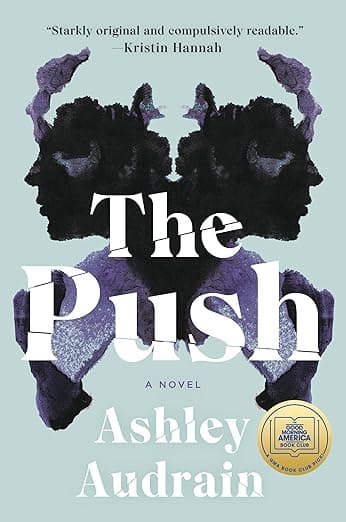
What This Theme Explores
The Dark Side of Motherhood in The Push interrogates the myth that instinctive, unwavering love is the default state of mothering. It asks what happens when a woman’s interior life collides with a culture that insists on maternal bliss, and when fear, ambivalence, or revulsion arise where joy is expected. It probes how generational harm can infiltrate the nursery, turning caregiving into a minefield of inherited dread. And it examines how external ideals—of the “good mother,” the happy family, the effortless bond—can warp a woman’s sense of self until love, guilt, and terror are indistinguishable.
How It Develops
From the opening pages, the novel filters motherhood through [Blythe Connor]’s sharp, confessional voice. Her first pregnancy stirs hope and dread in equal measure, a tension rooted in the failures of [Cecilia] and [Etta]. The brutal birth and Blythe’s immediate disconnection from her daughter [Violet] rupture the script of maternal bliss. Meanwhile, [Fox Connor] clings to the ideal of the glowing, capable mother and happy home, a posture that isolates Blythe further whenever her experience doesn’t match his expectation.
The middle of the story deepens this dissonance. Blythe moves through a world of moms who seem to be thriving, searching their faces “for lies” and finding none; her own needs and ambitions recede as Violet’s demands and Blythe’s haunting uncertainty swell. Moments of resentment and neglect—like letting Violet cry while she writes—become both coping mechanisms and sources of corrosive shame. The arrival of Blythe’s son [Sam] cracks open a second, competing truth: she does feel a sweeping, instinctual love, but only with him. That revelation doesn’t heal her—it sharpens the contrast with Violet and makes Blythe doubt her own nature.
In the final act, catastrophe strikes. Sam’s death detonates Blythe’s tentative stability, turning motherhood into a terrain of grief, self-recrimination, and suspicion. Violet’s chilling admission validates Blythe’s darkest fears and torpedoes the last of her self-trust, while the family structure collapses. The closing call from [Gemma]—a mother previously cast as effortless—extends the novel’s thesis beyond Blythe: the abyss within motherhood is not aberrant but latent, poised to surface wherever the pressure to be perfect meets the messiness of human need.
Key Examples
-
The Traumatic Birth: The narrative inaugurates motherhood not with wonder but with terror; Blythe experiences labor as a violence done to both her and her baby, a rite that offers no transcendence. Her wish for an ending—any ending—upends cultural scripts of childbirth as natural, empowering, or sacred.
I closed my eyes and I willed something horrible to go wrong. Death. I wanted a death. Mine or the baby’s. I didn’t think, even then, that we would survive each other. — Chapter 9-10 Summary
-
Alienation from Other Mothers: In playgroups and coffee shops, Blythe confronts the serene faces of women who attest that the struggle is “worth it.” Her inability to find the “crack” in their confidence heightens her isolation, making her feel monstrous for the feelings she cannot dispel.
“This is pretty hard some days, isn’t it? This whole motherhood thing.” “Sometimes. Yeah. But it’s the most rewarding thing we’ll ever do, you know? It’s all so worth it when you see their little faces in the morning.” I studied these women closely, trying to find their lies. They never cracked. — Chapter 11-15 Summary
-
Resentment and Neglect: When Blythe chooses to keep writing while Violet screams, the moment crystallizes the war between her creative self and her maternal role. Fox later reads it as betrayal, but for Blythe it represents the soul-cost of performing goodness while starving her own identity.
You let her scream for over an hour and a half... I had broken your trust. I had confirmed every doubt you quietly held about me. — Chapter 16-20 Summary
-
Loss of Self: Blythe’s reflection on her body as a mere “motor” exposes the economy of the home: what matters is what she can produce and provide, not who she is. The line reframes love as labor—unending, unseen, and exacting.
I remember one day realizing how important my body was to our family. Not my intellect, not my ambitions of a writing career... Just my body. — Chapter 36-40 Summary
-
The Final Turn: Sam’s death and Violet’s later revelation converge to confirm that Blythe’s dread was not a pathology but a perception others refused to validate. Gemma’s distress call about her son suggests the darkness is transferable; it stalks the institution of motherhood itself, not just one “broken” woman.
Character Connections
Blythe is the theme’s raw nerve. Her narration defies the sanitized mother-tongue, giving shape to feelings many women are told to repress. She becomes a test case for whether maternal love is innate or contingent—and what happens when there’s a mismatch between child and parent that cannot be wished away.
Cecilia and Etta anchor the generational dimension. Etta’s cruelty and Cecilia’s abandonment imprint motherhood with dread: if harm runs in the bloodline, loving well feels like defusing a family curse. Through them, the novel suggests that what looks like “instinct” may actually be history—trauma rehearsed, resisted, or repeated.
Fox personifies the culture that requires belief in the good mother to uphold the good family. His inability to accept Blythe’s experience isn’t mere blindness; it is an enforcement of norms that isolate women by making their pain unspeakable. He becomes an antagonist not through malice but through the refusal to concede complexity.
Violet sharpens the theme’s most uncomfortable edge: the child is not a neutral vessel for a mother’s love. Her unnerving behavior blurs the line between nature and nurture and forces the question—what if the bond doesn’t form, or forms as fear? The novel refuses to resolve whether Violet is made or born this way, insisting instead on the fallout of that uncertainty.
Gemma complicates the myth of the “better mother.” Initially presented as the antidote to Blythe, she becomes the proof that performance and reality can diverge violently. Her final call reframes perfection as a fragile facade anyone might wear—until it breaks.
Symbolic Elements
The Glowing House: The lit windows of Fox’s new family operate as a billboard for the ideal domestic fantasy. To Blythe, that brightness is both lure and wound—a spectacle of warmth she cannot enter, and a reminder that motherhood’s radiance can be a projection.
The Painting of Mother and Child: Blythe’s purchase is aspirational, a canvas onto which she projects the tenderness she briefly finds with Sam. When Violet defaces it and Fox hands it over, the painting records a triple betrayal: by the child, by the partner, and by the dream itself.
Mirrors: Blythe’s reflection—Cecilia’s face looking back—condenses the terror of inheritance. Each glance threatens to collapse the difference between who she is and what she fears she will become, making self-recognition itself an act of dread.
Contemporary Relevance
In an age of curated feeds and “gentle parenting” manifestos, The Push exposes the cost of perfection narratives. Its portrait of postpartum distress, maternal ambivalence, and invisible domestic labor resonates with ongoing conversations about mental health and the ethics of care. By dramatizing “mom shaming” and the pressure to be endlessly nurturing, the novel argues for structures—familial, medical, communal—that make space for struggle without equating it with failure. It insists that honest speech about the hardest parts of parenting is not disloyalty but prevention: a way to interrupt cycles of silence and harm.
Essential Quote
I closed my eyes and I willed something horrible to go wrong. Death. I wanted a death. Mine or the baby’s. I didn’t think, even then, that we would survive each other. — Chapter 9-10 Summary
This confession is the novel’s thesis in miniature: motherhood can be a site of mortal fear rather than transcendence. It shatters the sentimental script at the very threshold of parenthood and reframes everything that follows as survival, not celebration—forcing readers to confront how deeply myth and reality can diverge.