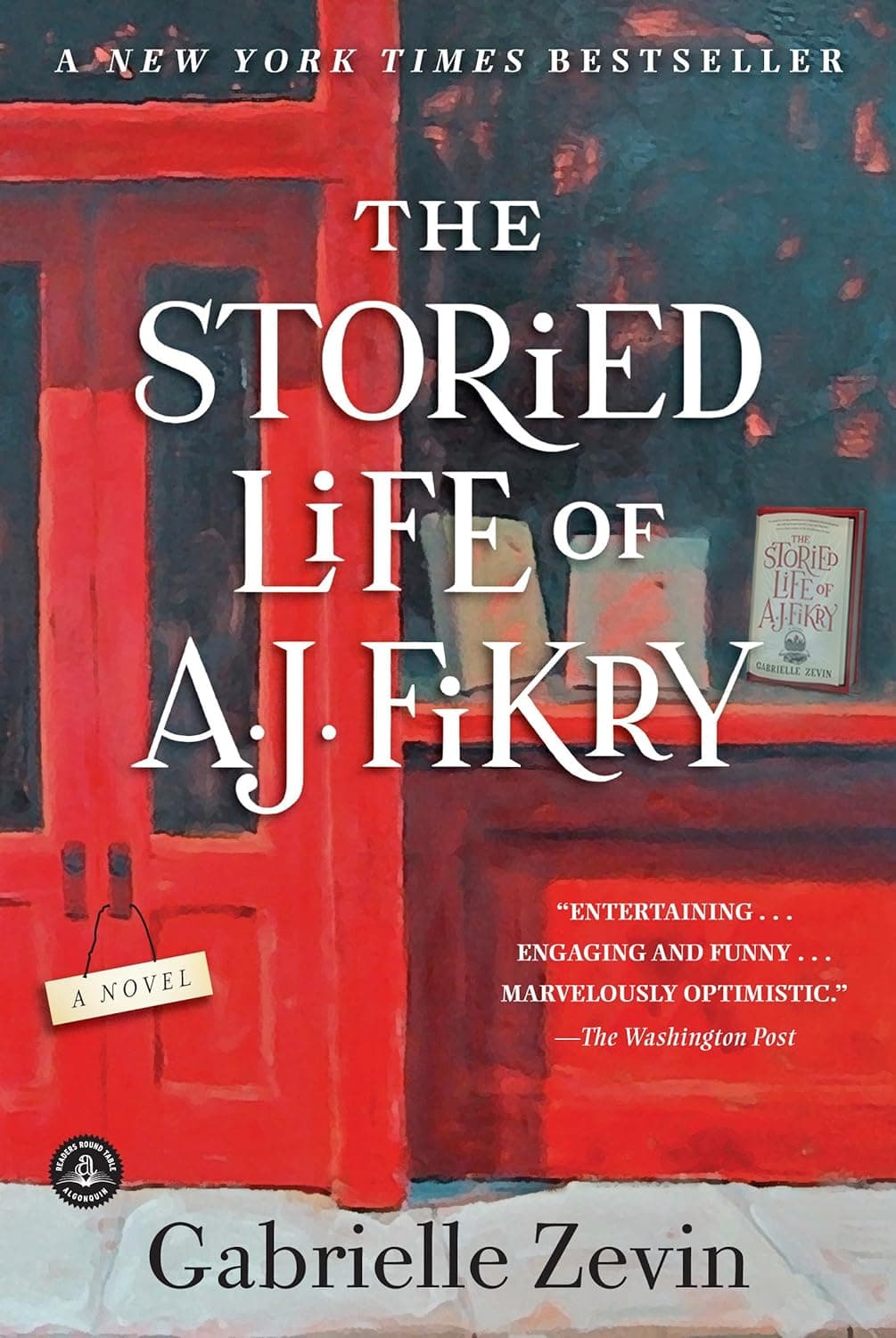
Here is a comprehensive collection of important quotes from Gabrielle Zvin's The Storied Life of A. J. Fikry, complete with detailed analysis.
Most Important Quotes
These quotes capture the central themes and emotional core of the novel.
The Bookstore's Ethos
"No Man Is an Island; Every Book Is a World"
Speaker: Narrator (describing the sign over the store) | Context: The store’s motto, first seen in the chapter “Lamb to the Slaughter” as Amelia approaches Island Books.
Analysis: Coined by A.J.’s first wife, Nic Fikry, the sign reads like a thesis for the novel’s meditation on Isolation vs. Connection. The aphorism simultaneously rebukes and beckons the early, self-exiled version of A. J. Fikry, whose grief has made him an “island.” Its paradox—people are separate, yet books open worlds—becomes the narrative’s guiding metaphor as the shop draws in the relationships that reshape his life. The line also gestures toward the communal infrastructure of reading, anticipating the novel’s insistence on the bookstore as a civic space and the sustaining force of The Power of Books and Connection.
The Ultimate Litmus Test
"People tell boring lies about politics, God, and love. You know everything you need to know about a person from the answer to the question, What is your favorite book?"
Speaker: A. J. Fikry (in his note to Maya) | Context: A.J.’s introduction to “A Good Man Is Hard to Find,” in the chapter of the same title, where he explains why Amelia’s taste caught his attention.
Analysis: Wry and a bit combative, this line distills A.J.’s creed that literary taste reveals a person’s truest self more reliably than proclaimed beliefs. The claim proves prophetic in his relationship with Amelia Loman: they don’t bond over small talk but over a dark, unfashionable story that exposes shared sensibilities. There’s gentle irony here—A.J. is misread at first by his own “cover,” yet his fidelity to books becomes the most accurate portrait of who he is. Stylistically, the brisk parallelism (“politics, God, and love”) and the punchy rhetorical question elevate the line into a credo for the novel’s bookish world.
The Nature of a Life
"We are not quite novels. We are not quite short stories. In the end, we are collected works."
Speaker: A. J. Fikry (in his thoughts) | Context: Near the end of his life in “The Bookseller,” as illness erodes his language, A.J. reframes a life through literary forms.
Analysis: A.J. turns criticism into consolation, rejecting neat arcs (novels) and contained moments (short stories) in favor of a miscellany that honors the mixed, uneven texture of experience. The metaphor dignifies fragments—grief, joy, missteps, and small triumphs—as pieces that cohere in retrospect, not by design. It allows him to see his history with Nic, his years raising Maya, and his love with Amelia as distinct but companionable entries in a single, humane anthology. The line’s elegant triad and gentle inversion of expectations give it the quiet authority of a final, earned insight.
The Purpose of Reading
"We read to know we’re not alone. We read because we are alone. We read and we are not alone."
Speaker: A. J. Fikry (in his thoughts) | Context: Also in “The Bookseller,” A.J. struggles to articulate reading’s meaning to Maya as words begin to fail him.
Analysis: This incantatory sentence captures the paradox at the novel’s heart: reading is both a solitary act and a bridge to others. The subtle variations—“to know,” “because,” “and we are”—create a rhythmic progression from need, to cause, to transformation, mirroring the way books move readers outward from isolation. It is the emotional culmination of A.J.’s arc, condensing the story’s faith in literature as a lifeline into one lucid refrain. The repetition functions like a benediction, leaving Maya—and the reader—with a portable definition of why stories matter.
Thematic Quotes
Love, Loss, and Second Chances
The Possibility of Late Love
"The Late Bloomer is a book about the possibility of finding great love at any age. Sounds cliché, I know."
Speaker: Amelia Loman | Context: Over lunch in “A Good Man Is Hard to Find,” Amelia explains why a memoir many would dismiss speaks directly to her hopes.
Analysis: Amelia’s admission of her susceptibility to “cliché” lays bare her open-heartedness and her willingness to be moved, qualities that become catalysts for change in the novel. The line foreshadows her own late-blooming romance with A.J., transforming what sounds trite into lived truth. It also exemplifies the book’s insistence that timing and text can align to script real lives, turning reading into a form of self-authorship. The gentle self-deprecation humanizes Amelia, framing her as someone who chooses hope even when it risks sentimentality.
The Nature of Grief
"Friedman gets at something specific about what it is to lose someone. How it isn’t one thing. He writes about how you lose and lose and lose."
Speaker: A. J. Fikry | Context: In “A Good Man Is Hard to Find,” A.J. tells Amelia why he reversed his opinion of The Late Bloomer.
Analysis: A.J.’s clarity here breaks through his habitual prickliness, translating his private bereavement into a language that can be shared. The anaphora of “lose and lose and lose” enacts the ongoingness of grief—the way absence recurs in successive recognitions rather than ending in a single event. Through this exchange, literature becomes the medium of mutual recognition, a way for two guarded people to risk intimacy. The moment marks an early thaw in A.J.’s isolation and dramatizes the book’s claim that stories help bear what cannot be carried alone.
The Power of Books and Connection
The Intimacy of Books
"They had only ever discussed books but what, in this life, is more personal than books?"
Speaker: Narrator | Context: In “Lamb to the Slaughter,” A.J. reconsiders his relationship with the late sales rep, Harvey Rhodes.
Analysis: The rhetorical question flips a common assumption—books as impersonal commodities—on its head, asserting taste as a form of autobiography. By realizing that a professional exchange concealed a friendship, A.J. begins to recognize the hidden ties that already knit his world together. The line’s understated irony broadens the novel’s argument that bookstores are repositories not just of texts but of relationships. It plants the seed for A.J.’s gradual embrace of community through the very thing he trusts most: reading.
The Bookseller's Final Lesson
"To connect, my dear little nerd. Only connect."
Speaker: A. J. Fikry (in his note to Maya) | Context: The last line of A.J.’s final note attached to Roald Dahl’s “The Bookseller,” in “The Bookseller.”
Analysis: Echoing Forster, the allusion transforms literary history into paternal counsel, distilling a life of criticism into one imperative. The affectionate address (“my dear little nerd”) softens the command, fusing intellect with tenderness and modeling the union of head and heart the novel champions. It completes A.J.’s arc from abstention to attachment, redefining “good taste” as the courage to reach for other people. As a legacy, it arms Maya with a purpose that transcends plot: connection as the work of a life.
Found Family and Community
The Role of a Godfather
"Basically, I’d be your backup, A.J. People should have backups."
Speaker: Chief Lambiase | Context: In “The Luck of Roaring Camp,” Lambiase offers to be Maya’s godfather, translating care into pragmatic terms.
Analysis: Stripped of ceremony, “backup” becomes a tender metaphor for chosen kin, articulating the ethic of redundancy that real community requires. The line cements the friendship between two men once defined by stock roles (the curmudgeon bookseller, the small-town cop), recasting them as co-guardians. Its plain diction carries moral weight: reliability, not rhetoric, makes family. In a book about second chances, Lambiase’s promise signals how support systems are built—quietly, deliberately, and by choice.
A Town's Embrace
"The mothers of Alice fear that the baby will be neglected. What can a single man know about child rearing? They make it their cause to stop by the store as often as possible to give A.J. advice and sometimes small gifts..."
Speaker: Narrator | Context: Also in “The Luck of Roaring Camp,” the town reacts to Maya’s arrival at Island Books.
Analysis: What begins as nosy condescension becomes, almost despite itself, a web of care, illustrating how communities form through imperfect motives that yield generous outcomes. The store shifts from marketplace to commons, its traffic of advice, gifts, and purchases weaving A.J. and Maya into Alice Island’s daily life. The ellipsis suggests an ongoing pattern, a rhythm of visitations that sustains both father and bookstore. This embrace enacts the novel’s central claim: families can be assembled, one small kindness at a time.
Character-Defining Quotes
A. J. Fikry
"I do not like postmodernism, postapocalyptic settings, postmortem narrators, or magic realism... I find literary fiction about the Holocaust or any other major world tragedy to be distasteful... I do not like children’s books, especially ones with orphans... Above all, Ms. Loman, I find slim literary memoirs about little old men whose little old wives have died from cancer to be absolutely intolerable."
Context: In “Lamb to the Slaughter,” A.J. unloads a barbed catalog of dislikes during his first, disastrous meeting with Amelia.
Analysis: This comic jeremiad reveals A.J. at his narrowest—taste as armor, gatekeeping as self-defense. The hyper-specificity, anaphora (“I do not like...”), and escalating scorn create dramatic irony: the very stories he rejects—orphans, widowers, grief—will soon define his redemption. His aesthetic rigidity mirrors a closed heart and a constricted version of the bookstore itself. The scene lays the baseline from which the novel measures his transformation into a man, and a bookseller, open to surprise.
Amelia Loman
"Her specialty is persnickety little bookstores and the particular breed that runs them. Her talents also include multitasking... houseplants, strays, and other lost causes."
Context: In “Lamb to the Slaughter,” the narrator frames Amelia’s temperament as she ferries to Alice Island.
Analysis: The sentence yokes vocation and disposition—Amelia cultivates difficult places and difficult beings—signaling her as the novel’s gardener of second chances. The playful inventory (“houseplants, strays, and other lost causes”) doubles as a character map that anticipates A.J. and Maya entering her care. The tone blends whimsy with precision, positioning her as both competent and tender. She embodies the book’s argument that optimism is not naivete but a practiced skill of stewardship.
Maya Fikry
"She knows that her mother left her in Island Books. But maybe that’s what happens to all children at a certain age... And your whole life is determined by what store you get left in. She does not want to live in the sandwich shop."
Context: In “What Feels Like the World,” toddler Maya invents a story to metabolize her abandonment.
Analysis: Maya’s mythmaking shows narrative as a survival tool: by turning loss into a rite of passage, she reclaims agency. The whimsical conceit—lives sorted by “what store you get left in”—doubles as a sly manifesto for the novel’s setting, elevating Island Books from backdrop to destiny. Her preference against the “sandwich shop” is humorous yet poignant, marking her early, instinctive kinship with books. The passage crystallizes how identity, in this world, is authored as much as inherited.
Chief Lambiase
"Turns out I really like bookstores... Bookstores attract the right kind of folk. Good people like A.J. and Amelia. And I like talking about books with people who like talking about books. I like paper. I like how it feels, and I like the feel of a book in my back pocket. I like how a new book smells, too."
Context: In “The Bookseller,” Lambiase describes his conversion from non-reader to dedicated patron to Ismay.
Analysis: Lambiase’s testimony is sensorial and communal rather than scholarly—texture, smell, conversation—echoing the novel’s sacramental view of the physical book and the spaces that house them. The repetition of “I like” builds an accumulating affection, charting how habit becomes identity. His arc validates the bookstore’s democratizing promise: there is a door for everyone, and it opens through welcome, not elitism. He becomes proof that reading is learned in company.
Ismay Evans-Parish
"I screamed at Marian Wallace. She was twenty-two, but she looked like a kid. ‘Do you think you’re the first slut to show up here, claiming to have had Daniel’s baby?’"
Context: In “The Tell-Tale Heart,” Ismay confesses to Lambiase the cruelty she inflicted on Maya’s mother.
Analysis: Brutal and unvarnished, Ismay’s admission forces the reader to witness how jealousy and humiliation curdle into harm. The retrospective framing invites moral complexity: she is both victim of Daniel Parish’s infidelity and perpetrator of her own worst impulses. Confronting this ugliness becomes a hinge for her path toward accountability and, potentially, renewal. The scene exemplifies the novel’s compassion for flawed people who only change by saying the worst thing out loud.
Daniel Parish
"Poe’s a lousy writer, you know? ... I loathe collectible books anyway. People getting all moony over particular paper carcasses. It’s the ideas that matter, man. The words."
Context: In “The Diamond as Big as the Ritz,” Daniel reacts to the theft of Tamerlane by belittling rare books.
Analysis: Daniel’s swaggering dismissal of material texts exposes a hollow intellectualism that insists on “ideas” while erasing the ways objects carry memory, attachment, and community. Calling books “paper carcasses” is a telling metaphor: he treats bodies—of literature, of relationships—as disposable shells. The speech throws his values into sharp relief against A.J.’s reverence for the tangible life of books. It foreshadows his failures as a partner and parent, where abstractions trump care.
Memorable Lines
The Definition of a Place
"A place is not really a place without a bookstore."
Speaker: Nic Fikry (as recalled by A.J.) | Context: In “The Tell-Tale Heart,” A.J. tells Maya why he and Nic left grad school to open Island Books.
Analysis: Deceptively simple, this line elevates the bookstore to civic necessity, asserting that culture and community require a physical commons. Over the novel, Island Books fulfills that charter: it becomes a site of arrivals, reconciliations, and rituals that bind Alice Island together. The sentence’s aphoristic snap has made it a slogan beyond the story, capturing the novel’s defense of the local. It reminds readers that places are made, and remade, by the rooms where people gather.
Opening and Closing Lines
Opening Line
"On the ferry from Hyannis to Alice Island, Amelia Loman paints her nails yellow and, while waiting for them to dry, skims her predecessor’s notes."
Context: The first sentence of “Lamb to the Slaughter.”
Analysis: Motion and makeover converge in this image: a ferry crossing and bright yellow nails announce change arriving by boat. The color signals Amelia’s sunny persistence, the trait the island—and A.J.—will need most. Skimming the predecessor’s notes signals a handoff, foreshadowing the novel’s cycles of succession and renewal. It’s a quietly cinematic entrance that frames the book as a story about fresh starts.
Closing Line
"Jacob walks down the history aisle and holds out his hand to the middle-aged man on the ladder. 'Mr. Lambiase, have I got a book for you!'"
Context: The final sentence of “The Bookseller.”
Analysis: The ending mirrors the beginning—another sales rep, another promise of connection—but the world has turned: the former non-reader now runs the shop. The aisle name (“history”) and the extended hand suggest continuity and welcome, emphasizing that the institution outlives any single proprietor. The line’s buoyant voice affirms the enduring loop of recommendation, discovery, and fellowship. It closes the circle while keeping the door open, promising more collected works to come.