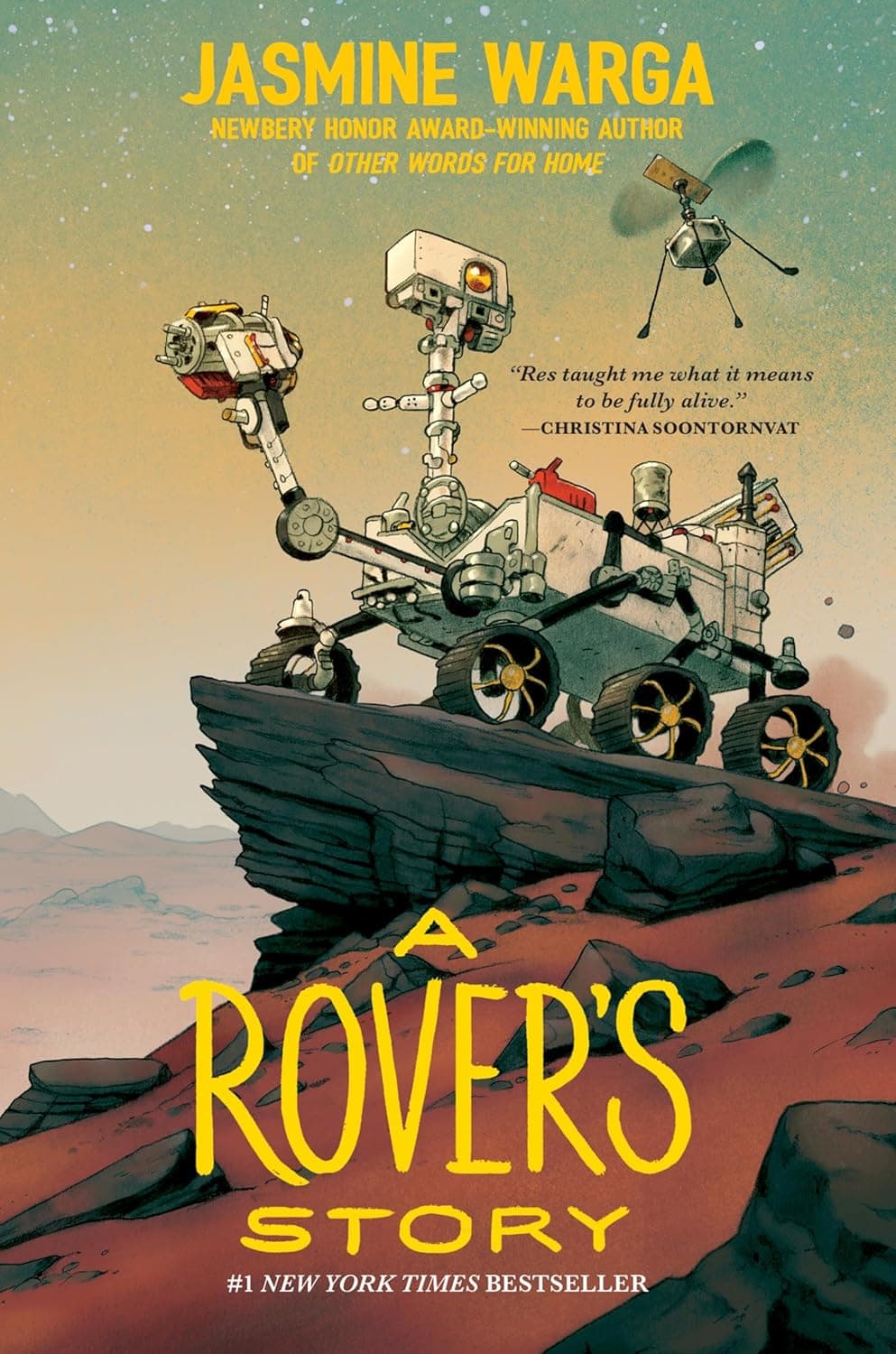
Opening
Blasted free of Earth, Resilience and his drone, Fly, race toward Mars without the promised landing code—and without the mentor Res expected to follow. As silence stretches between space and Earth, Sophie's letters keep a human heartbeat in the story while Res and Fly discover that survival depends as much on companionship as on programming.
What Happens
Chapter 36: Soaring into Space
After the booster falls away, Res and Fly float inside a sterile container that feels like the lab but colder, emptier. Panic spikes when Res realizes Journey isn’t on board. He had always assumed Journey would lead; instead, he and Fly are alone.
Fly urges trust in the “hazmats,” but Res hears Journey’s skepticism: humans are irrational. He reaches for the plan—and finds a hole. The new mission code never arrives. They are flying blind. When Fly asks how he knows the code will come, Res whispers the one name that feels like certainty: Rania. Unable to explain hope, he deflects with, “Beeps and boops,” his stand-in for the comfort Journey once provided.
Chapter 37: Dear Res,
In a letter brimming with joy, Sophie describes watching the launch at school; even Brian Woods cheers. On TV, Rania thanks her family, including Sophie's Sitti, in Arabic, and Sophie proudly translates for the class. Seven months to Mars sounds endless to her. Will Res get bored? Lonely? She wishes her dad could bake him cookies—even though Res doesn’t eat. Too excited to sleep, she ends with a string of exclamation points that reads like liftoff itself.
Chapter 38: Alone
Still code-less, Res steers using outdated instructions, trying to wear Journey’s logic like armor. He tells Fly that robots don’t hope, that emotions threaten the mission. Fly hears the contradiction: Res does hope. Talk of friendship makes Res think of Journey, Rania, and Xander. His knowledge feels “terribly insufficient.”
Then Fly notices what Res missed: Journey never had a drone. That detail rewrites Res’s assumptions—Journey was never meant for this flight. “I didn’t expect to be alone,” Res says. “You aren’t alone. You have me,” Fly replies. Their relationship shifts from rover/tool to partners, planting the seed of Connection and Relationships.
Chapter 39: Our Mission
Res pulls up a memory: Rania singing “Twinkle, Twinkle, Little Star” to Sophie over the phone. He sings to Fly, trying to transmit comfort the way humans do. Fly loves it and asks to learn the rest—then sings it better.
The lullaby becomes their tether, a shared ritual that calms fear and restores focus. Joined by the song, Res pictures Rania’s smile and finds resolve. “We will stay the course,” he tells Fly. Fly answers with the tune itself, a promise set to music.
Chapter 40: Dear Res, & Rational
Time passes. In her next letter, a now–seventh grade Sophie worries because Res has gone silent on NASA’s channels. Rania shows a public tracker: a lone blinking dot in space. Sophie's dad reminds her that his name is Resilience—explicitly invoking Perseverance and Resilience. Sophie repeats the name like a mantra.
Aboard the ship, no code arrives. Mars looms; landing is imminent. Worry hums through Res like one of Xander’s songs. When Fly asks what the outside looks like, Res realizes he has never wondered. Thinking about it makes Fly happy—he has learned emotions from Res’s system. Alarmed, Res orders him to “unlearn them,” insisting they must be rational, a core tension of Humanity, Emotions, and Logic. Fly counters that wanting to know what’s outside seems rational. Res begins to see that sending a rover with a drone wasn’t sentiment—it was strategy.
Character Development
Res and Fly evolve from a unit built for tasks into a team built for trust. Sophie's letters trace the distance between Earth and space—and bridge it.
-
Resilience
- Steps from follower to reluctant leader when Journey isn’t on board.
- Confronts the missing code and pilots on incomplete instructions.
- Admits to hope, sings to steady morale, and reframes emotion as a tool rather than a threat.
- Recognizes Fly as a partner, not a peripheral.
-
Fly
- Grows from instrument to companion—curious, observant, and emotionally attuned.
- Spots the “Journey never had a drone” clue that reshapes Res’s assumptions.
- Uses questions and song to maintain mission focus and connection.
-
Sophie
- Matures from giddy spectator to anxious, empathetic witness.
- Translates Rania’s Arabic on TV, taking pride in family and culture.
- Clings to the name “Resilience” as comfort when communication drops.
Themes & Symbols
These chapters stage a debate between humanity and machinery that Res cannot ignore. The tension between logic and feeling—captured in Res’s order to “unlearn” emotions versus his reliance on song—asks whether emotion is a flaw or a form of intelligence. In practice, emotion enables better decisions: singing calms, curiosity widens awareness, and hope sustains effort. Connection and relationship become mission-critical as isolation deepens; Fly’s “You have me” doesn’t just soothe—it creates redundancy of judgment, resilience under stress, and a shared ethic of care.
Perseverance and resilience shift from labels to lived experience. With no code and no guarantees, Res must invent procedures, draw on memory, and trust a partner. The absence of guidance exposes the limits of perfect planning and elevates adaptability as the true survival skill.
Symbols:
- “Twinkle, Twinkle, Little Star”: A portable piece of Earth that soothes fear, strengthens teamwork, and ties Res and Fly to Rania and Sophie.
- The Missing Code: A void that forces improvisation, creativity, and self-reliance—proof that mission success requires more than instructions.
- The Blinking Tracker Dot: Sophie's image of existential loneliness that the story immediately counters with relationship.
Key Quotes
“Beeps and boops.”
- Res’s playful mimicry of Journey becomes a coping mechanism—a way to gesture at feelings he can’t name yet. It signals his transition from strict logic to a more flexible, human-adjacent mode of thinking.
“I didn’t expect to be alone.” / “You aren’t alone. You have me.”
- This exchange marks the origin of the Res–Fly partnership. It replaces fear with a shared mission and reframes isolation as collaboration.
“We will stay the course.”
- Res articulates purpose after the lullaby restores calm. The line fuses emotion and logic: feeling generates the clarity required for disciplined action.
“Unlearn them.”
- Res’s order to purge emotions exposes his internalized fear that feeling will derail the mission. Fly’s pushback shows that curiosity and joy can be rational—and useful.
“His name is Resilience.”
- Sophie's father turns a name into an ethic. The reminder steadies Sophie and echoes the rover’s arc: endurance is not passive waiting but active, adaptive persistence.
Why This Matters and Section Significance
These chapters pivot the story from controlled testing to high-stakes, unguided exploration. The missing code reframes the mission as a trial of judgment, not just engineering. Sophie's letters anchor the cosmic in the intimate, while Res and Fly transform from a designed system into a chosen partnership. As Mars approaches and silence from Earth holds, the narrative declares its true subject: not technology’s perfection, but the courage, connection, and adaptability that make survival—and landing—possible.