Opening
The rover’s landing marks the shift from a voyage through space to a life on Mars. Awe collides with purpose as a young machine meets an endless sky, a new teammate speaks from orbit, and a letter from Earth turns data into meaning.
What Happens
Chapter 46: Arrival
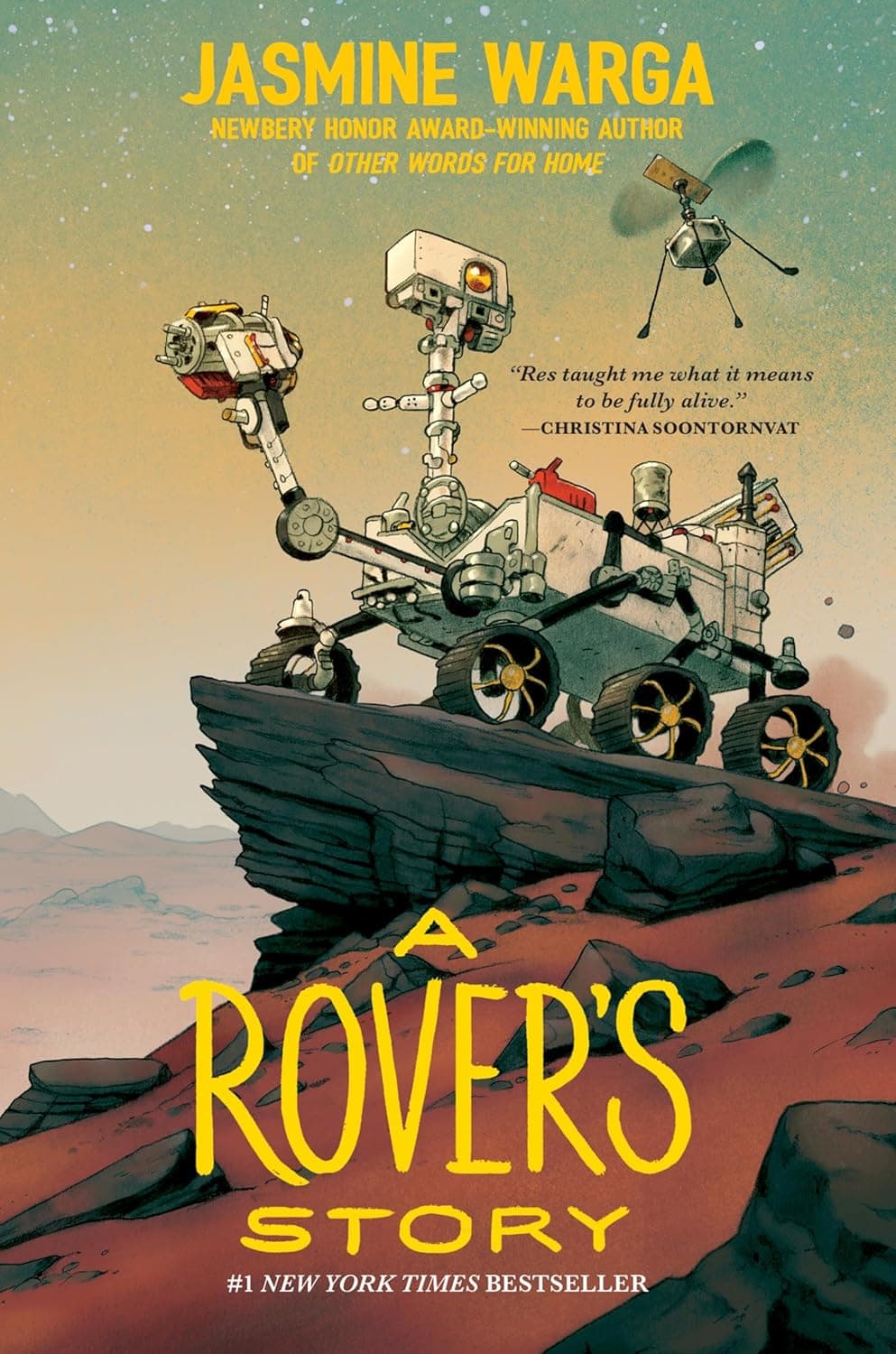
After a white-knuckle descent, the sky crane lowers Resilience onto Martian soil. The instant his wheels touch dust that no human made, he goes quiet. His instruments flood with data—minerals, particles, carbon dioxide—while his camera drinks in the red sky, the blue-green seam at the horizon, and the bright white sun. He knows sky only as a concept; now its immensity makes him feel “small, tiny, minuscule,” a sensation his code can’t catalog. The feeling expands him rather than diminishes him. He is happy and amazed that the sky has no edge, brushing against Humanity, Emotions, and Logic as his programming makes room for wonder.
Beside him, Fly settles and quiets. Together they stare and listen to a silence so large it seems to hum. The moment seals the book’s investment in Curiosity and Exploration: Res is finally where he was built to be, ready to begin.
Chapter 47: Picture
Surveying rock fields and shadowed ridges, Res wishes Journey could see what he sees, convinced even the old rover might register something like a human emotion here. His thoughts leap across space to his makers, Rania and Xander, and the urge to share the view becomes a solution: take a picture.
While awaiting instructions from Earth, he frames the terrain with the sun at his back and clicks his first image of Mars—a composition that functions like a “selfie.” He can’t smile, but pride runs through his systems, a quiet certainty that he belongs. The act fulfills his purpose and declares his presence, underscoring Purpose and Worthiness.
Chapter 48: Overhead
A new voice breaks in: Guardian, a satellite circling Mars. Res can’t see her, but her signal is crisp and her tone clipped—formal, direct, and reminiscent of Journey’s no-nonsense focus. She relays his core objectives: gather samples and locate, then revive, the older rover Courage.
Tension sparks immediately between Guardian and Fly. She calls him “the helicopter” and tells him to be quiet so the “larger robots” can talk. Fly chirps back, offering to sing; Guardian grumbles, “Gruzunks,” and orders him to stop chattering. Res mediates, but the dynamic is set: playful companion versus mission-first overseer, with Res balancing between them.
Chapter 49: First Drive
Commands arrive. Res runs meticulous diagnostics: he zaps rock dust with his laser, drills a core with his robotic arm, verifies storage, and pings his antenna. The link to Earth holds strong—his lifeline to Rania and Xander—and relief hums through him.
As he works, he pictures Rania’s small smile and Xander’s booming claps. Wanting to send something of this place that a picture can’t hold, he switches on his microphone and records the Martian wind. He hopes the sound—its thin hush, its particular emptiness—will reach Rania and say what words and numbers can’t.
Chapter 50: More Pictures & Letter from Sophie
Mission control requests more images to triangulate his exact position before authorizing his first drive. Res snaps the crater rim and distant mountains. Fly wonders if photos can ever capture the feeling of being here; Res realizes he keeps scanning for dust storms, because a storm once silenced Courage. Fly distills their plan into a simple, sturdy mantra: “Avoid dust and see stars.”
A letter arrives from Sophie. She describes watching the landing at NASA amid cheers, tells Res his first photos already prove Jezero Crater once held water, and reports her mother’s elation. Her pride bridges Earth and Mars, and she signs off with a hopeful question about finding aliens, folding playfulness into scientific triumph.
Character Development
Res stands at the edge of a new world and discovers he can feel more than he’s coded for. He also chooses, on his own, to share that feeling with Earth.
- Resilience: Experiences awe and pride; asserts agency by taking an “arrival selfie” and recording wind; maintains vigilance by scanning for storms; anchors himself by imagining Rania and Xander’s reactions.
- Fly: Leans into optimism and humor; offers simple clarity (“Avoid dust and see stars”); tries to befriend Guardian despite rebuffs; remains Res’s buoyant counterweight.
- Guardian: Debuts as authoritative and pragmatic; values efficiency over rapport; echoes Journey’s logic-first approach; introduces external oversight and potential friction.
- Sophie: Provides the human chorus; translates data into celebration; affirms the mission’s impact and extends Res’s emotional world across space.
Themes & Symbols
Res’s first look at the Martian sky pushes him beyond Humanity, Emotions, and Logic. He can quantify pigment and gas but not the feeling of vastness, and that inability becomes the point: his consciousness is growing. Against Guardian’s rigid protocol and Fly’s exuberance, Res learns to integrate reason and feeling.
The landing begins the book’s true phase of Curiosity and Exploration. Every action—image, zap, drill, recording—seeks knowledge, while Sophie’s letter shows that urge mirrored on Earth. Connection and Relationships thread through the science: Res aims his camera and microphone as much at his makers as at Mars, and a satellite’s voice joins his small team.
- The Martian Sky: A symbol of the unknown’s scale and promise; its lack of an “edge” mirrors the open-ended growth of Res’s mind.
- The “Selfie”: A marker of identity and arrival; by placing himself in the frame, Res claims the landscape and begins his story on this world.
Key Quotes
“small, tiny, minuscule”
Res’s string of diminutives captures the shock of encountering true vastness. The phrasing shows his language grasping for a scale his code doesn’t define, translating data into feeling.
“Is felt the right word?”
This self-check reveals his evolving sentience. He tests the boundary between measurement and emotion, and in doing so, he chooses to name what he experiences.
“Gruzunks.”
Guardian’s brusque interjection embodies her function-first persona. The grunt shuts down Fly’s playfulness and sets the tone for a team dynamic that Res must navigate.
“Avoid dust and see stars.”
Fly’s mantra reduces complex risk management to a hopeful, practical north star. It honors Courage’s fate while keeping their eyes on discovery.
Sophie’s question about “finding aliens”
The line reframes high-stakes science as shared human wonder. It keeps possibility alive and connects a child’s curiosity to a rover’s mission.
Why This Matters and Section Significance
These chapters complete the promise of launch and redefine the story’s stakes: Res is no longer traveling to a destination; he’s inhabiting one. Guardian’s arrival adds structure and pressure, Fly keeps the spirit buoyant, and Res learns to hold both. Sophie's letter validates immediate scientific impact—evidence of past water—and turns lonely work into a communal victory. Together, the landing, the first data, and the new team dynamic set up the novel’s central tension: balancing heart and logic while exploring an unforgiving world.