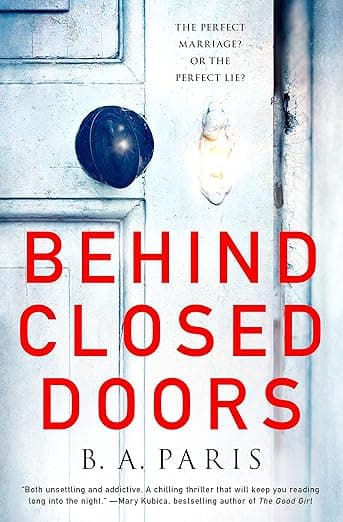
Opening
Chapters 11–15 plunge the story into a tense duel of wits where a wife learns to anticipate the sadism of her husband and quietly retools her tactics for survival. A sinister “help” message, a murdered dog, a failed plea to a doctor, a secret code with a sister, and a dinner-party lie build to a ticking-clock ultimatum that raises the stakes to a breaking point.
What Happens
Chapter 11: The Book Trap
Present. Locked in a stripped-down room, Grace Angel takes stock of how Jack Angel has removed her comforts—kettle, books, wardrobe—until she wears identical black pajamas and lives like a prisoner. A doorbell rings. She hopes for Esther, but Jack ignores it, underlining Grace’s total Imprisonment and Isolation. Later he brings a book, saying Esther dropped it off with a dinner invite, and orders Grace to read it before they see Esther again.
Inside, Grace finds lightly shaded words that form a message: “Is everything alright do you need help.” Hope spikes—then curdles. Knowing Jack’s meticulous checks, she realizes he planted the message himself. The “offer” is bait, a test to make her expose herself so he can punish her. The moment crystallizes Jack’s Psychological Manipulation and Control and the marriage’s warped Appearance vs. Reality: the charming husband in public, the jailer at home.
Chapter 12: The Price of Fear
Past. Returning from their Thailand honeymoon, Jack escorts Grace to the utility room where she finds her dog, Molly, dead from deliberate dehydration. Calmly, he lays out his creed: fear is his passion—how it looks, feels, smells, and sounds—staking his control on Fear as a Weapon and using Molly’s death to threaten what he’ll do to Grace’s sister, Millie Harrington.
Grief erupts into rage: Grace strikes Jack with a shovel and bolts for help, but he overpowers her and bans her from seeing Millie for three weeks. He parades her through their “dream” home—designed from Grace’s own wishes—now a gilded cage. Steel shutters seal the ground floor; communications will be controlled. The façade is perfect; the prison is absolute.
Chapter 13: The Perfect Liar
Past. Desperate, Grace fakes appendicitis to force a hospital trip. Jack calls a doctor to the house instead and unveils his pre-work: forged medical records from Thailand and a portrait of Grace as unstable and attention-seeking. When she snatches a private minute to say she’s a prisoner and that Jack even confessed to killing his mother, the doctor’s patronizing calm shows the trap has sprung. He leaves antidepressants and accepts Jack’s version, proving the chilling reach of The Power of Perception and Credibility.
Jack strips more “privileges.” Outwardly, Grace becomes compliant, calculating that obedience is the only way back to Millie. Inwardly, she abandons open rebellion and pivots to patient strategy.
Chapter 14: The George Clooney Game
Past. After five weeks, Jack allows a visit with Millie. Millie bristles at him, then cleverly engineers a private moment in a hotel restroom to tell Grace the truth: Jack pushed her down the stairs at the wedding because he didn’t want her as a bridesmaid. Terrified, Grace realizes open anger will endanger Millie.
On the spot, she invents a secret code rooted in Love and Sacrifice and Resilience and the Will to Survive: a “bad man” named “George Clooney” pushed Millie, and their private secret is that “Jack is George Clooney.” Millie understands instantly and plays along: “I like you, Jack… But don’t like Jorj Koony.” Jack, missing the subtext, relaxes. The sisters now share a covert lifeline in plain sight.
Chapter 15: Seventy-Five Days
Present. Grace and Jack dine with Esther and her husband, Rufus, and their friends Diane and Adam. Before leaving, Grace quietly sidesteps one of Jack’s petty dress tests. Champagne grants her a flicker of normalcy—until Jack, grinning, announces there are “seventy-five days” until Millie moves in, dropping a countdown that sends panic ripping through Grace.
When Diane and Adam announce a pregnancy, the pressure detonates. Grace breaks down sobbing. Jack slides into public savior mode, embracing her and announcing she recently miscarried—a devastating lie that wins the room’s sympathy and covers the outburst. In the car, his fury chills the air. He bans her from seeing Millie the next day—unless she accepts a punishment in the basement. Grace faces a brutal, rigged choice: disappoint Millie or submit to the cellar.
Character Development
Grace shifts from physical escape attempts to strategic warfare, learning Jack’s patterns and crafting covert defenses, even as the toll of terror cracks her composure in public.
- Grace Angel: Channels ingenuity into quiet resistance (the code with Millie), masks defiance behind obedience, and prioritizes protecting her sister over her own safety.
- Jack Angel: Reveals himself as a planner who worships fear, engineers airtight narratives, and delights in traps that force Grace to participate in her own humiliation.
- Millie Harrington: Proves keenly perceptive and courageous; she spots Jack’s danger, creates private space to confess, and becomes Grace’s secret ally.
- Esther: Emerges as a potential connection to the outside world but is co-opted as a pawn in Jack’s schemes, highlighting Grace’s isolation.
Themes & Symbols
Jack’s domination rests on perception and performance. He doesn’t just restrict movement; he scripts narratives that make others complicit, turning doctors and friends into unwitting shields. The domestic ideal—house, wardrobe, polite dinners—becomes a stage where appearances smother truth. Fear fuels the machine: Molly’s death teaches obedience, the book trap corrals hope, and the dinner-party lie secures public cover.
Love reframes the battle. Grace abandons swing-for-the-fences escapes to protect Millie, converting care into strategy. The secret code is both a promise and a plan, proof that resilience can live inside captivity and that survival sometimes looks like compliance while a deeper game unfolds.
Symbols and motifs:
- The book with shaded words: a counterfeit lifeline that weaponizes hope.
- Steel shutters and identical pajamas: the house as a fortress, identity erased.
- The “George Clooney” code: hidden truth nested inside performative politeness.
- “Seventy-five days”: a ticking clock that turns dread into a schedule.
Key Quotes
“I love how it looks, I love how it feels, I love how it smells. And I especially love the sound of it.”
Jack’s hymn to fear exposes his true desire: not sex or power for their own sake, but the spectacle of terror. It reframes every punishment as ritualized reinforcement of control.
“Is everything alright do you need help”
The shaded message in the book appears as salvation but is actually surveillance. It forces Grace to police herself, proving how psychological traps can be crueler than locks.
“I like you, Jack… But don’t like Jorj Koony.”
Millie’s line functions as camouflage and code. It keeps Jack complacent while binding the sisters in a private pact, a small victory that carries outsized strategic weight.
“Seventy-five days.”
The countdown distills Jack’s threat into a calendar, converting dread into a deadline. It accelerates the plot and clarifies what Grace stands to lose.
Why This Matters and Section Significance
This sequence cements the story as a psychological chess match rather than a simple escape narrative. Grace learns that brute force and open pleas fail in a world Jack has prearranged, and she builds subtler tools—a private language with Millie, a mask of obedience, an ability to read his traps.
The chapters also fix the stakes: Jack’s public persona shields him, the home is impregnable, authority figures are compromised, and the 75-day clock turns Millie’s move-in into an approaching catastrophe. The question is no longer whether Grace can slip the cage, but whether she can outplay Jack’s story before time runs out.