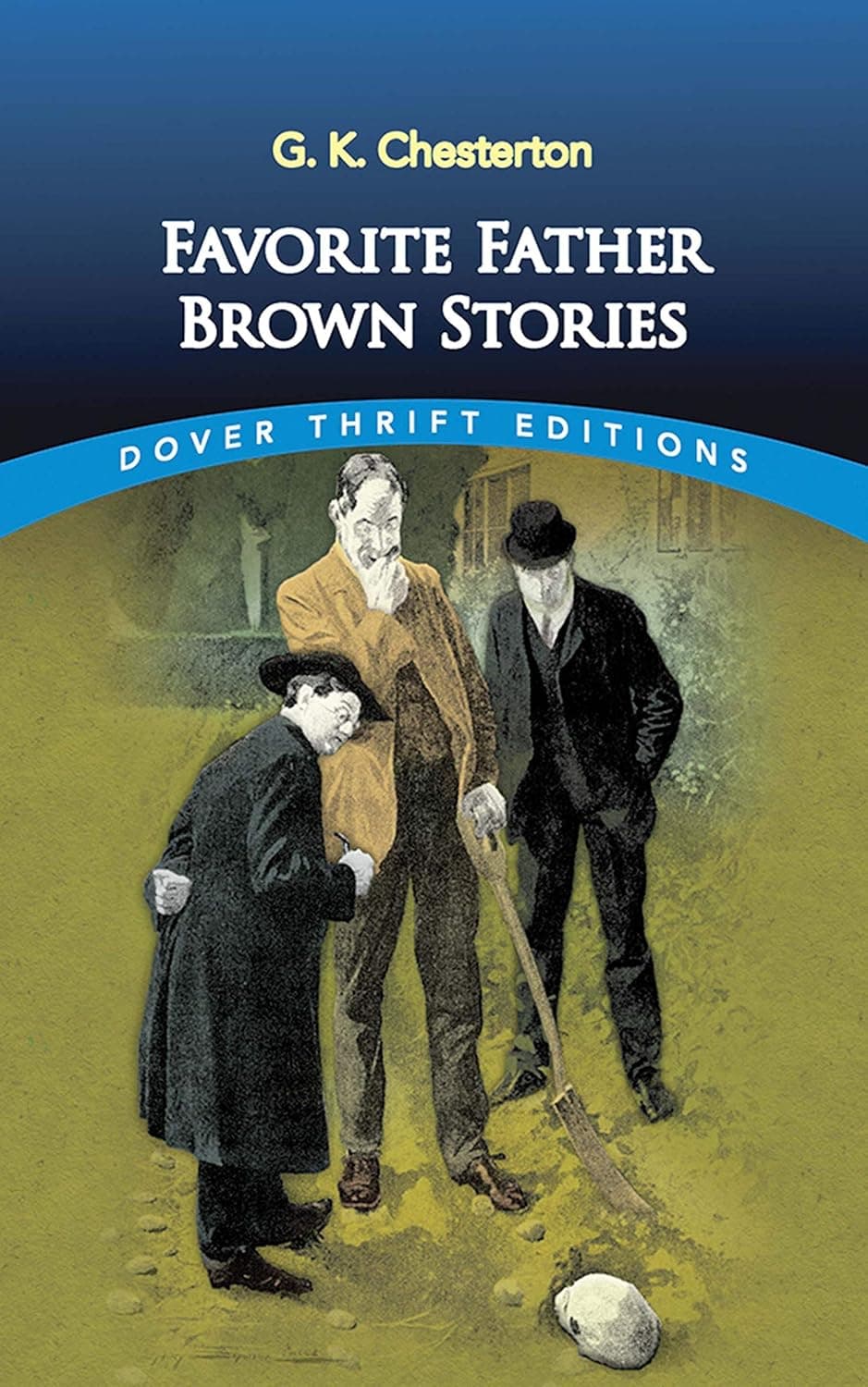
Chesterton’s mysteries read like parables: tightly plotted puzzles that open onto questions of faith, reason, sin, and sight. The unassuming priest-detective Father Brown solves crimes by knowing people rather than measuring footprints, using the confessional’s hard-won insight to reveal why a deed was done as much as how. Again and again, the stories argue that spiritual clarity cuts through worldly spectacle.
Major Themes
The Deceptiveness of Appearances
Chesterton insists that surface signals—status, costume, even eyewitness sight—are unreliable, a world of masks that only deeper perception can pierce. In “The Blue Cross,” the chase hinges on deliberate misdirection as the criminal Flambeau masquerades as a priest, while the “bumbling” cleric is the mastermind; in “The Sign of the Broken Sword,” the public hero General Sir Arthur St. Clare is exposed as a traitor; and “The Man in the Passage” literalizes the theme with mirrors that turn fear into self-reflection. The result is a moral epistemology: seeing truly requires humility and a suspicion of spectacle.
Reason and Divine Logic
Chesterton contrasts secular deduction with a holistic, spiritually informed logic—an inquiry that begins with the soul. Where Aristide Valentin prizes evidence, Father Brown catches Flambeau by diagnosing a theological slip and by staging small “soul tests” (the swapped sugar and salt) in “The Blue Cross.” Even the seemingly supernatural is demystified by moral insight: in “The Perishing of the Pendragons,” a sailor’s “oracle” and a map of the river converge to unmask a man-made fraud, showing how divine first principles illuminate material clues.
The Nature of Sin and Evil
Evil, for Chesterton, is not alien monstrosity but the ordinary logic of pride, greed, and self-justification—choices anyone could make. Father Brown’s confessional expertise lets him read criminal method as human pattern: St. Clare’s fall in “The Sign of the Broken Sword” is a gradual descent into treason concealed by public honor; in “The Sins of Prince Saradine,” the prince’s “genius” is a frigid manipulation of predictable hatreds; figures like Prince Paul Saradine and Major Putnam are respectable men who reason their way to cruelty. The stories insist that recognizing our shared fallenness is the first safeguard against it.
Humility vs. Pride
As a moral axis, humility clears the vision while pride fogs it. Father Brown’s smallness—social and personal—makes him invisible enough to see, and modest enough to enter another’s mind; Valentin’s brilliant self-reliance and St. Clare’s self-image blind them to truth until reality breaks their pride. The ending of “The Blue Cross,” where both detective and thief bow to the little priest, becomes a tableau of humility triumphing over worldly intellect and honor.
Supporting Themes
The Paradox of Faith
Chesterton delights in Christian paradox: the simple priest is the wisest; the student of virtue becomes expert in vice; belief renders a person more, not less, rational. These reversals reinforce divine logic and the deceptiveness of appearances, showing that truth often hides in apparent contradiction.
Justice and Redemption
Father Brown wants to save souls, not merely close cases. His moral defeat of Flambeau begins a redemptive friendship, contrasting spiritual justice with the police’s narrower mandate, and tying “reason” to mercy rather than mere punishment.
The Criminal as Artist
Criminals compose dazzling illusions; the detective is their critic. Valentin’s remark that “the criminal is the creative artist” frames Flambeau and Saradine as authors of elegant deceits, while Father Brown “reads” their style to reveal the plain moral fact beneath the flourish—where divine logic punctures appearance.
Theme Interactions
Humility → clear sight → resistance to deceptive appearances; pride → vanity and self-myth → vulnerability to illusion. Divine logic knits empathy, theology, and observation into one practice, making it the only reasoning that consistently navigates a world of masks. The nature of sin provides the engine behind every trick: pride generates the lie; humility uncovers it; and justice aims not only to expose the deed but to reclaim the doer. Thus, deceptive appearances test our sight; divine logic trains it; the study of sin supplies its content; and humility keeps the lens clean.
Character Embodiment
Father Brown The priest embodies humility, divine logic, and a sober view of sin. His methods—psychological probes, theological tests, patient empathy—model how spiritual first principles clarify tangled facts and pierce appearances.
Aristide Valentin The celebrated sleuth personifies the brilliance and blind spots of secular logic. His eventual deference to Father Brown marks an education in humility and an acknowledgment that evidence without moral understanding misleads.
Flambeau First the “artist” of crime and later a friend, he illustrates both the seductive creativity of deception and the possibility of redemption. Father Brown’s moral victory over him reframes justice as healing rather than mere capture.
General Sir Arthur St. Clare A national idol whose honor is a mask, St. Clare is pride incarnate—proof that public statues can cover private treason. His story expands deceptive appearances from personal disguise to collective myth.
Prince Paul Saradine An intellectual manipulator who turns others’ passions into weapons, Saradine represents evil as cool calculation. His “artistry” underscores the criminal-as-artist motif and warns how reason, severed from morality, curdles into malice.
Major Putnam Respectable and rational on the surface, Putnam typifies Chesterton’s ordinary sinner: a plausible man whose pride and self-justification lead to harm. He anchors the claim that evil is mundane—and therefore dangerously near.