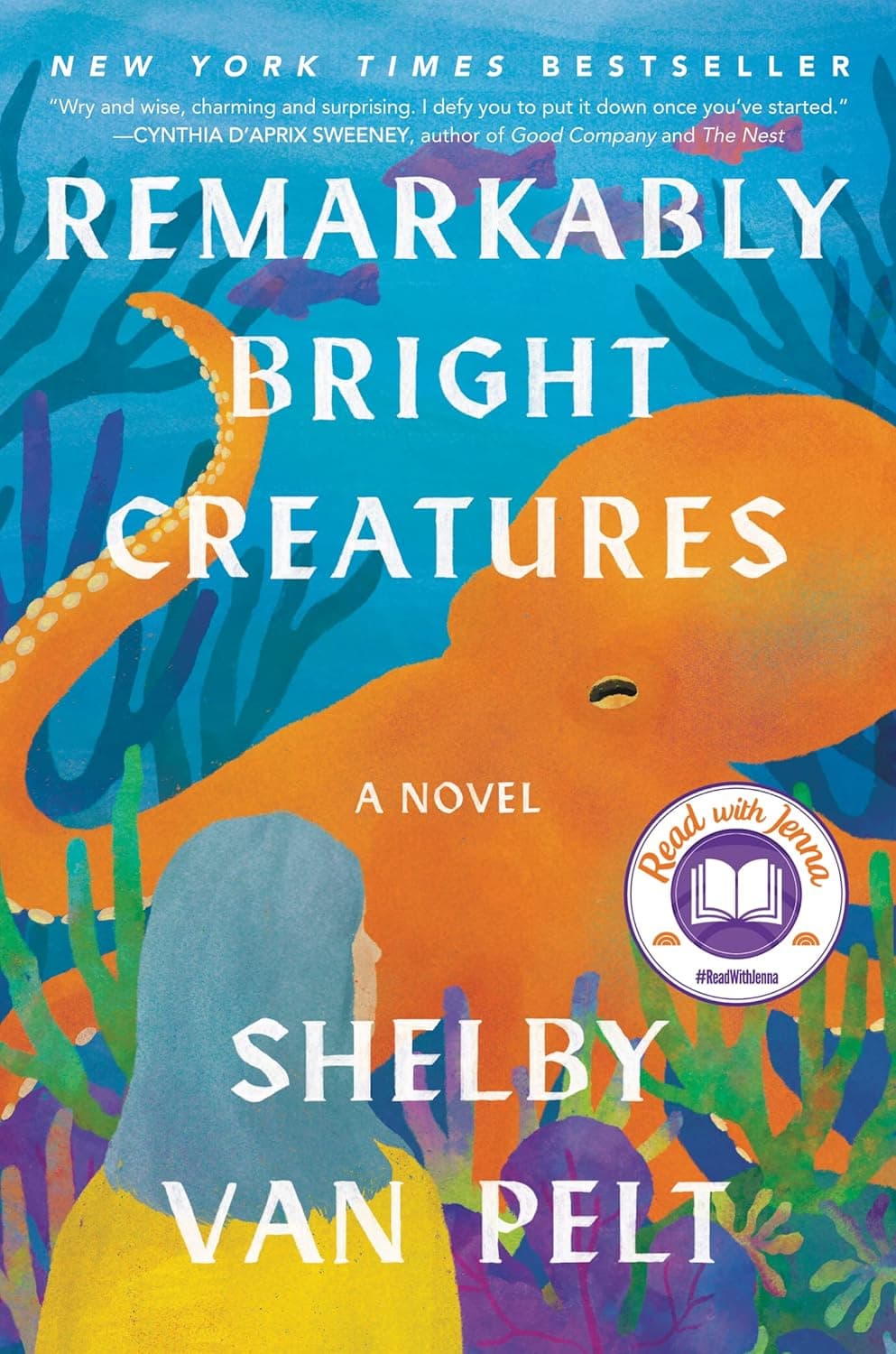
Opening
Revelations crest at the lowest tide as Tova Sullivan recognizes Cameron Cassmore as her grandson, frees Marcellus to the ocean he belongs to, and finally reframes [Erik Sullivan]’s (/books/remarkably-bright-creatures/erik-sullivan) death. Secrets surface, a family forms, and one life closes in dignity while others open to possibility.
The section turns grief into motion and isolation into kinship, bringing the story’s threads together with tenderness, clarity, and the hard-won promise of a new beginning.
What Happens
Chapter 61: The Very Low Tide
Sitting beside Marcellus in the yellow bucket, Tova studies Cameron’s cheek and sees Erik’s heart-shaped dimple. The truth lands: Erik fathered a child, and that child is Cameron. She collapses under the weight of the realization and allows herself to keen at last—a raw release that embodies Grief and Loss. She also understands that Marcellus knew, and that his intelligence is as deep as his quiet loyalty.
When she steadies, Tova chooses action. The aquarium tank is a prison; she decides to return Marcellus to the sea. The tide is extraordinarily low, as if the ocean itself has drawn back to expose everything hidden—mirroring Secrets and Uncovering Truth. The seventy-year-old hauls the sixty-pound octopus across the boardwalk, down the jetty, and speaks her farewell: gratitude for leading her to her grandson, and a promise not to disappear into Charter Village. She vows to watch over the next octopus.
At the edge, one of Marcellus’s arms twines around her hand as she tips the bucket; he releases her just before the pull can take her, and vanishes into dark water. The moment grants him what he has earned—Confinement and Freedom in its purest form—and reorients Tova toward a life she chooses, not one that happens to her.
Chapter 62: Every Last Thing
Tova sits on her pier bench and takes stock: Marcellus is free; she has a grandson; she will not move to Charter Village. Thinking of Erik, she realizes he would not have taken his life on the cusp of fatherhood. His death must have been an accident, and the idea offers a gentler peace.
Avery from the paddle shop rushes up, searching for Cameron. Tova explains he left for California, convinced Avery ghosted him; Avery counters that he stood her up. When Tova shares Cameron’s version—he stopped by to cancel—Avery realizes her teenage son Marco lied. Their talk offers a path to repair—Second Chances and New Beginnings made tangible.
Avery points to a spot on the railing where she once saved a distraught woman raving about a “horrible night,” an “accident,” and a “boom.” The word slams into Tova’s mind: the boom of a sailboat. Understanding crystallizes—Erik died in a boating accident, not by choice. The woman was almost certainly Daphne, Erik’s girlfriend and Cameron’s mother—final proof clicking into place.
Chapter 63: Expensive Roadkill
Cameron drives south, running on fumes and stubbornness, only to realize he left his phone on the van’s bumper. He pulls into a truck stop, finally sleeps, and when he wakes, he throws away his cigarettes like a quiet vow. Back on the highway, remorse turns to resolve as he drafts an apology in his head.
Crossing the Columbia River into Washington, he pivots. He is done running. He turns north to face what he broke and to “do things the right way.”
Chapter 64: The Dala Horse
Tova cleans her emptied house, plans unspooling into open space. Cameron appears at her door—apologetic, contrite, asking when he can ask Terry for his job back. Tova reveals she took his resignation note; Terry never saw it. The lifeline holds.
She hands Cameron Erik’s class ring and decodes the engraving—“Erik Ernest Lindgren Sullivan.” The truth strikes, and they fold into a long, shaking hug: grandmother and grandson, finally named. The emotional core—Found and Biological Family—beats strong.
Upstairs, Cameron’s eye catches a mismatched floorboard in Erik’s room. He pries it up to find a cache: fossilized snack cakes and, carefully wrapped in a tea towel, Tova’s broken Dala horse—repaired perfectly and hidden years ago. The quiet gesture proves Erik’s love and mends the old story Tova told herself about distance and blame. When Cameron asks how she ended up with the ring, Tova smiles: “Marcellus.”
Chapter 65: Day 1 of My Freedom
Marcellus narrates his return to the cold, dark, familiar sea. His body falters, but gratitude floods him—he is home, near the place he found the key and where Erik’s bones rest. He accepts the end with calm; Aging and Mortality comes for all beings, and he meets it on his own terms.
He thinks of captivity, of Tova, and of the new injured octopus that will replace him; he trusts Tova will make that life kinder. His last meditation lands where the book always aimed: humans can be “dull and blundering,” yet also “remarkably bright creatures,” a final nod to Intelligence in Unexpected Places and to the unlikely friendship that changed both their lives.
Character Development
Change surges through every storyline, turning loss into agency and drift into direction.
- Tova: Moves from contained sorrow to a cathartic reckoning; acts decisively by freeing Marcellus and canceling her move; reframes Erik’s death as accidental; embraces her identity as a grandmother and a future she chooses.
- Cameron: Stops fleeing, turns back, apologizes, and seeks repair; earns his name and history through humility; proves growth not by speeches but by steady, corrective action.
- Marcellus: Completes his mission—guiding Tova to truth—then claims his autonomy; closes his story with philosophical clarity and grace.
Themes & Symbols
Secrets surface as action. The chapters stage a cascade of revelations—Cameron’s parentage, the accident on the water, Erik’s hidden repair of the Dala horse—that transform guilt and ambiguity into meaning. In this light, Secrets and Uncovering Truth and Grief and Loss operate together: knowing the truth allows grief to move, and moving grief frees the living.
Freedom is literal and emotional. Returning Marcellus to the ocean consummates Confinement and Freedom, while Tova and Cameron shed isolation for kinship—Found and Biological Family—and choose renewal—Second Chances and New Beginnings. Finally, Marcellus’s calm farewell embodies Aging and Mortality, his closing reflection returning the book to wonder at Intelligence in Unexpected Places.
Symbols focus the emotion:
- The Dala horse: love repaired and kept safe until it can heal.
- The extreme low tide: the seabed of the past exposed.
- The open sea: home, dignity, and the natural end.
- The northbound drive: a moral change of direction made concrete.
Key Quotes
“boom”
The single word unlocks the riddle of Erik’s death. It reframes a narrative of despair into an accident at sea, releasing Tova from corrosive uncertainty and opening space for forgiveness—of Erik, of Daphne, and of herself.
“Erik Ernest Lindgren Sullivan.”
The engraving in the class ring functions as proof, lineage, and benediction. It anchors Cameron’s identity in fact, binds him to Tova, and converts abstract longing into family.
“do things the right way”
Cameron’s private promise marks his pivot from evasive impulse to deliberate repair. The line signals growth through conduct, not performance, and sets the tone for his return.
“remarkably bright creatures”
Marcellus’s final judgment of humanity threads humility with hope. It sanctifies Tova’s kindness, justifies his faith in people, and gives the novel its title as a credo about connection.
Why This Matters and Section Significance
These chapters deliver the story’s emotional summit and its moral landing. By freeing Marcellus, Tova claims her agency; by reinterpreting Erik’s death, she releases long-held pain; by naming Cameron her grandson, she transforms two solitary lives into a family. Cameron’s return and apology convert a pattern of flight into a practice of responsibility. Marcellus’s last swim grants him sovereignty and frames the book’s compassion—for animals, for the grieving, and for the fallible—as its brightest intelligence.
The section binds every mystery to a purpose: truth does not simply answer questions; it restores connection. In closing one life with honor, the narrative opens others to love and to the messy, luminous work of beginning again.