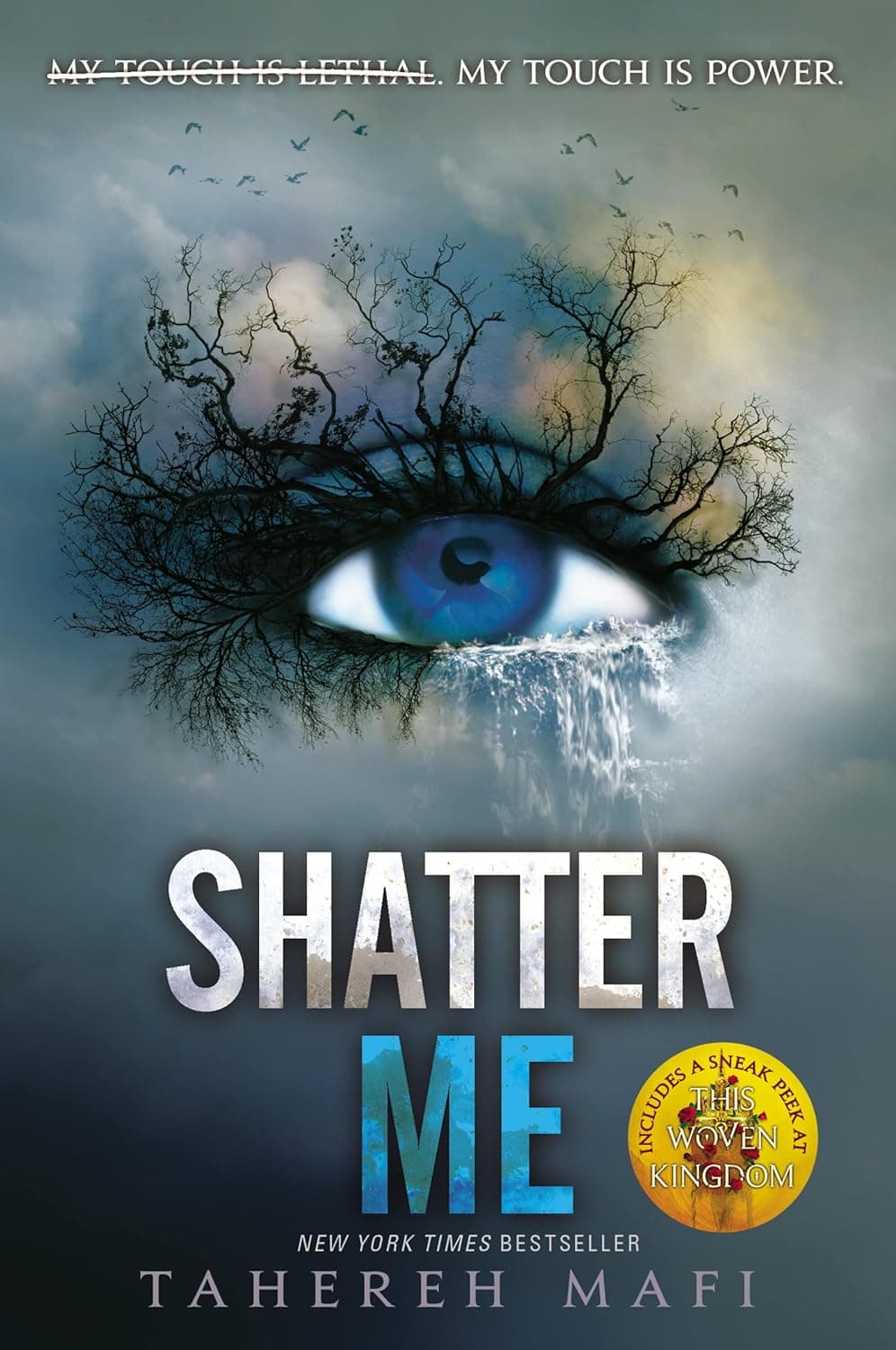
Opening
These chapters pivot from captivity to possibility. Juliette’s isolation cracks open—first with a hidden message, then with a revelation that rewrites the rules of her body and her future—while Warner stages a brutal spectacle to assert dominion and tighten his psychological grip.
What Happens
Chapter 16: A Pocket of Possibility
In her room, Juliette Ferrars reaches for the purple dress and remembers the cameras. She slips into the armoire’s shadow and her fingers find something familiar: her notebook. Realizing Adam Kent must have hidden it for her, she darts to the bathroom to avoid surveillance and discovers a new line at the end of her last entry—“It’s not what you think”—in someone else’s handwriting. She tears out the page and keeps it as proof that Adam is trying to help.
Warner enters without knocking. When she demands to know if he hurt Adam, he notes her obvious concern. A throwaway jab about his “poor mother” rattles him; he reacts with sudden fear and drops her hands like they burn. He escorts her to an unfamiliar exit and says, “Welcome to your future.”
Chapter 17: Sector 45
Warner leads Juliette into a sunlit courtyard between stark buildings. For a breath, the air and sky feel like freedom—until he produces a gold‑hilted gun and assures her it isn’t for her. At the terrace edge, she sees the entire force of Sector 45 assembled below in rigid formation.
With a small amplifier, Warner drapes an arm around Juliette and presents her as a “very valuable asset” to The Reestablishment. The soldiers flinch at his touch. At his cue, they execute a synchronized salute—one knee down, fist raised—a ritualized display of Power and Control. Then Warner calls on Delalieu to read charges against Private Seamus Fletcher: fraternizing with rebels and stealing supplies. Fletcher offers no defense. Warner licks his lips and shoots him in the forehead. The ranks do not move.
Chapter 18: You Disgust Me
Fletcher’s body hits the ground. The soldiers dissolve on command. Warner guides a reeling Juliette inside, remarking she “must eat more,” which snaps her rage awake; she shoves him and screams, “You disgust me.” He pins her, palms gloved against her face, and murmurs that life is bleak and sometimes you have to shoot first.
Back in her room, their fight intensifies. He insists her touch is not a disease but a rare gift—an “extraordinary ability”—and rages at her self-loathing, underscoring her struggle with Self-Acceptance and Identity. He says Adam will bring her to him in the morning for their “real work.” She tells him to go to hell. “I’m working on it,” he replies.
Chapter 19: I Can Touch You
Juliette can’t sleep—until she sees Adam already on her floor, silently handing her a pillow and blanket and telling her she doesn’t need to scream anymore. She falls asleep feeling safe for the first time in years. In the morning, she finds him bruised from Warner’s punishment. To speak privately, he turns on the shower full blast and pulls her in, clothes and all, letting the water swallow their words.
Pressed to the tile, he tells her the truth: he can touch her. He realized it back in the cell, when he reached for her during a nightmare and nothing happened to him. He touches her face and arms now to prove it, breaking the prison of her body and the pattern of Isolation vs. Human Connection. He promises to get her out. When he peels off his soaked shirt, she recognizes the white bird tattoo on his chest—the same bird from her dreams—binding her Love and Hope to him.
Chapter 20: I’m Nineteen
Buoyed by their secret, Juliette dresses in a tight olive-green outfit Warner provided and meets him for breakfast in a lavish blue room. He tries charm—“alarmingly beautiful”—but she refuses to play along.
He pivots to cruelty, cataloging her abandonment by everyone, even her parents, to position himself as the only person willing to empower her, an equal she’ll one day thank. Then he drops a final reveal with studied nonchalance: he’s only nineteen.
Character Development
Juliette’s world tilts from absolute solitude to the first real taste of choice. Adam’s quiet defiance and Warner’s curated violence force her to define who she is—and whose vision of her power she will accept.
- Juliette Ferrars: Moves from despair to defiance. Adam’s message and touch restore agency, and she begins imagining Freedom vs. Oppression as a real choice, not a fantasy.
- Adam Kent: Emerges as a covert ally. He preserves her voice (the notebook), risks punishment, and reveals his immunity, anchoring Juliette in safety and action.
- Warner: Grows more complex. He’s executioner, showman, and manipulator, but also reveals raw nerves (his mother), fervent belief in Juliette’s power, and his youth, hinting at a formative past.
Themes & Symbols
Warner’s spectacle and Adam’s intimacy stage a stark conflict between domination and connection. Public obedience is enforced through fear, ritual, and blood; private trust is built whisper by whisper, touch by touch. As Juliette learns she can be held, the story reframes her body from a weapon of isolation into a conduit for choice and belonging.
Juliette’s battle with identity sharpens under pressure. Warner names her power a gift to weaponize it; Juliette must decide whether accepting herself means becoming the tool he desires or claiming a different purpose. Hope, once abstract, becomes embodied—inked on Adam’s chest and alive in the simple act of being touched without harm.
- Symbols:
- The notebook: a tether to selfhood; Adam saving it validates her voice.
- The white bird tattoo: a living emblem of freedom and future, tying her dreams to a person and a plan.
- The gold‑hilted gun and choreographed salute: objects of spectacle that convert fear into order.
Key Quotes
“It’s not what you think.” A covert lifeline that flips Juliette’s narrative from paranoia to possibility. It reorients her attention toward hidden allies and coded resistance within enemy territory.
“Welcome to your future.” Warner frames control as destiny, selling captivity as inevitability. The line foreshadows his ongoing attempt to script Juliette’s identity and choices.
“You disgust me.” Juliette’s first unfiltered rejection of Warner’s moral universe. It marks a pivot from survival silence to open defiance, even under immediate threat.
“Sometimes you have to learn how to shoot first.” Warner’s ethos distilled: preemptive violence as rational order. It explains his methods and sets him in philosophical opposition to Juliette’s emerging ethics.
“I can touch you.” The foundational reversal of Juliette’s curse. It transforms her from untouchable to beloved, unlocking intimacy, strategy, and hope.
“I’m working on it.” A sardonic exit line that reveals Warner’s self-awareness and darkness. It blurs villainy with damaged humanity, complicating the power struggle ahead.
Why This Matters and Section Significance
These chapters reset the novel’s trajectory. Adam’s immunity converts Juliette’s survival story into a plan for escape and revolt, while Warner’s execution establishes the mortal stakes of resistance. The psychological duel between Warner’s imposed identity and Juliette’s self-definition now drives the plot, and the bird—once a dream—lands on a real chest, turning hope into a map.