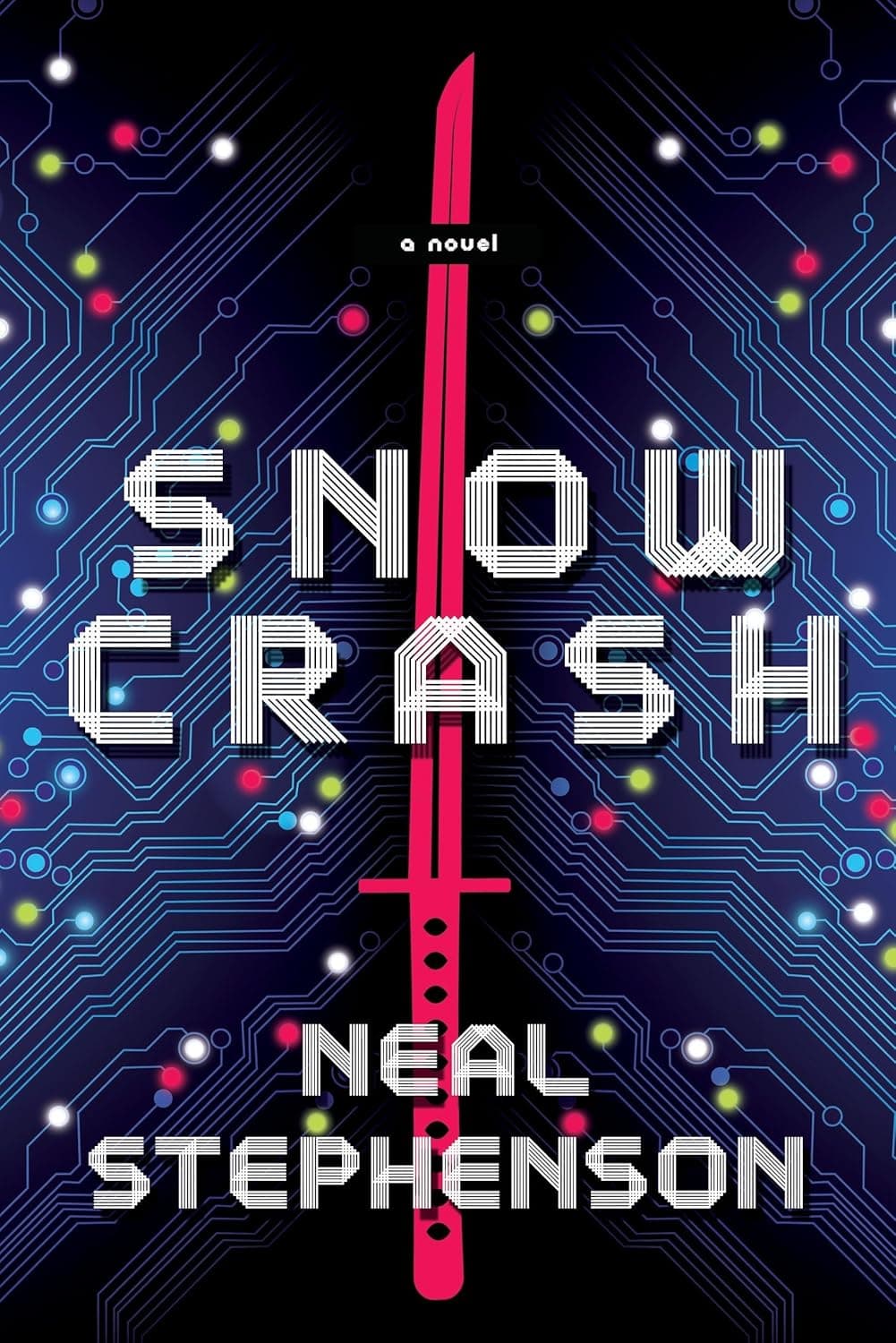
Opening
A risky delivery pulls Y.T. into the Mafia’s orbit just as a digital plague devastates the hacker elite. Across Los Angeles, power flows through franchises, burbclaves, and faith-branded storefronts while the same virus spreads in bodies and machines. These chapters braid street action and big ideas, pushing both Y.T. and Hiro into the heart of the Snow Crash conspiracy.
What Happens
Chapter 21
Reluctant but lured by high pay, Y.T. takes a delivery into Mafia-held Compton. The franchisee who hired her “helpfully” drops her at an off-ramp—a move that reads as a setup—so she converts his momentum into speed, skates through a Mafia checkpoint, and carves into Nova Sicilia, spraying dust onto the Young Mafia’s polished shoes. Inside, she meets the myth made flesh: Uncle Enzo, who turns out to be disarmingly warm, sharp, and funny.
The bag was empty by design—just a pretext. Enzo wants to thank her for the life-saving pizza run from the opening chapters without dinging his public “image.” He asks about her Fed-employed mom and swaps war stories: volunteering for Special Forces in Vietnam to spite his father, refusing helmets in the jungle to keep his hearing sharp. He calls today’s mafiosi “lifeless and beaten down,” then recognizes spark and “fiber” in Y.T., and gifts her his old dog tags—both protection and a bond. Y.T. leaves star-struck, newly allied to power she respects.
Chapter 22
Seconds later, a glass‑eyed Mafioso intercepts Y.T. with a handpicked gig: a job routed “person‑to‑person” through RadiKS by a Mafia gargoyle. She’s to collect a package in Griffith Park and deliver it to a Reverend Wayne’s Pearly Gates in Van Nuys. Skating up the I‑405, she clocks how weird her life has become since meeting Hiro Protagonist, and the chapter zooms out to the corporate patchwork of Los Angeles, a living study in Anarcho-Capitalism and Corporate Sovereignty.
She passes Mr. Lee’s Greater Hong Kong, Admiral Bob’s Global Security, and grim, fortified Fedland, where her mother works, sealed behind paranoia and checkpoints. Surrounded by franchised color, Fedland looks gray and joyless. With fresh intel on Uncle Enzo, Y.T. debates telling Hiro or CIC, but the Mafia’s trust—and Enzo’s personal touch—sticks. She decides not to burn the bridge she just built.
Chapter 23
Griffith Park is an open-air asylum. In a canyon ruled by the Falabalas—who babble in glossolalia—Y.T. pushes through chaos: unwashed figures mutter at a broken terminal, others belt “The Happy Wanderer” with eerie joy. It’s the first sustained look at Snow Crash’s human toll. A grubby “High Priest” in a lab coat hands her an aluminum briefcase and urges her to stay. She bails fast.
On the freeway, the glass‑eyed Mafioso reappears with a black semi. They need to “test” the case. Inside hums a fresh-from-R&D mobile lab: a ponytailed tech slots the briefcase into a cryo scanner for a “noninvasive” look. The Mafioso dodges specifics—only that the Mafia built it very recently. The message lands anyway: this outfit isn’t just muscle. It’s modern, inventive, and investing heavily in whatever this briefcase represents.
Chapter 24
The lens shifts to Hiro. At his U‑Stor‑It, he swings a rebar “redneck katana,” working out fury after crossing Raven. A military helicopter from his ex, Juanita Marquez, plucks him to a hospital where Da5id Meier lies strapped down, eyes unfocused, jittering, and speaking in tongues—the same babble as the Falabalas.
Hiro heads to Da5id’s house, now under military guard, and finds goggles and a system crumpled on the floor. He slips the goggles on. Only black‑and‑white static. The machine—and Da5id’s brain—have “snow‑crashed.” It’s proof the virus rides code. Later, on the roof with a beer, Hiro considers America as a franchised organism: a three‑ring binder as corporate DNA, cloning the same “loglo” everywhere so people can flee the chaos of “true” America. The monologue fuses culture, information, and infection into one theory of how societies replicate.
Chapter 25
Back in the Mafia semi, the scan is done. The glass‑eyed man returns the briefcase and hands Y.T. an envelope. Inside: a note from Enzo and snapshots of him eating pavement while learning to skateboard—self‑deprecating proof he sees her as a peer, not a pawn. Y.T. rides on to Reverend Wayne’s Pearly Gates.
The parking lot crunches with tiny glass vials like Raven’s. Inside, the church runs like any franchise—bored receptionist, swipe card, upsell. A customer pays and glides into the chapel already speaking in tongues. Reverend Dale T. Thorpe, sour with vomit, snatches Y.T.’s case. She follows him into an office where he opens a compact machine: he slots an ID card, inserts a vial, watches a countdown tick out on the cap, then inhales as it hits zero. He melts back, blank, eyes on Elvis. The receptionist drifts in, asking for her turn. Y.T. connects the dots: the aluminum briefcase is a portable drug factory and dispenser. The “church” is a front. And the sacrament—whatever it is—induces glossolalia.
Character Development
These chapters reset alliances and motives. Y.T. gains a protector and a purpose beyond a paycheck, while Hiro acquires a personal stake that turns curiosity into crusade. Uncle Enzo emerges as a paradox: a corporate gangster with an ethos, building unexpected bridges across generations.
- Y.T.: Still fiercely independent, she now carries Enzo’s dog tags and a complicated loyalty to the Mafia. The skateboard photos humanize power for her, deepening trust and belonging.
- Uncle Enzo: Not a stock mob boss but a charismatic strategist who recognizes talent and cultivates it. His Vietnam story frames him as rebellious yet principled, and his critique of young mafiosi reads like a call to standards.
- Hiro Protagonist: Grief and anger over Da5id sharpen his role as investigator. His rooftop “franchise virus” theory signals the analytic lens he brings to the plot’s biggest mysteries.
- Da5id Meier: From confident hacker to cautionary figure. His collapse is the first intimate, devastating look at Snow Crash’s reach.
Themes & Symbols
Snow Crash blooms as a study of Information, Language, and Viruses. The Falabalas’ babble and Da5id’s collapse show language itself behaving like code—executed on the human brain. Hiro’s “franchise as DNA” riff reframes culture as replicating information, spreading not just through networks but through norms, signage, and rituals. The virus exists in two interoperable stacks: meatspace and cyberspace, each priming and reinforcing the other.
The world’s operating system is [Anarcho-Capitalism and Corporate Sovereignty]—Fedland as fortified relic, corporations as nation-states, the Mafia as a tech-enabled service brand with R&D, and religion franchised into a glossy storefront. This shifts moral clarity: institutions that look “legitimate” may be inert; those labeled “criminal” can deliver order, loyalty, and innovation. Y.T.’s experience tests where safety and honor actually live.
Symbols crystallize the stakes:
- The aluminum briefcase fuses narcotics, machinery, and data—a portable exploit that compiles a drug like code.
- Enzo’s dog tags carry protection and initiation; they make Y.T. legible to power.
- The static in Da5id’s goggles is a visual null—total system overwrite for both machine and mind.
Key Quotes
“Person‑to‑person.”
- The Mafia’s business ethic rejects anonymous systems in favor of trust, favor, and face. It’s also how they induct Y.T.—a handshake into a network that can protect or control her.
“Covert operation.”
- The euphemism recasts delivery work as espionage. It reframes Y.T.’s gig economy skills as tradecraft and signals how blurred the lines are between business and black ops.
“Young Mafia” … “lifeless and beaten down.”
- Enzo’s generational critique positions him as a reformer within the institution. His respect for Y.T. implies the virtues he wants—initiative, nerve, improvisation—aren’t bound by age or rank.
“Snow‑crashed.”
- The title becomes diagnosis. Seeing the term on Da5id’s wrecked system bridges metaphor and mechanism, confirming the virus as both aesthetic (static) and attack vector (code).
“The Happy Wanderer.”
- The Falabalas’ cheerful chorus turns grotesque in context, exposing how the virus hijacks not just language but mood, ritual, and community.
Why This Matters and Section Significance
These chapters fire the starters’ pistol for both plots. Y.T.’s bond with Enzo pulls street‑level courier culture into alliance with a high‑functioning criminal corporation. Hiro’s discovery of Da5id’s condition personalizes the hunt for a cure and an exploit, setting him on a path through the Metaverse and beyond.
By revealing Snow Crash as both a drug and a digital payload, the story widens from local turf wars to a system‑wide breach—of brains, markets, and institutions. The Mafia’s tech lab hints at surprising allies against a larger antagonist, positioning Enzo’s organization as potential counterweight to L. Bob Rife. Together, these chapters connect skate wheels to server racks, showing how a single virus can route through every layer of this world’s stack.