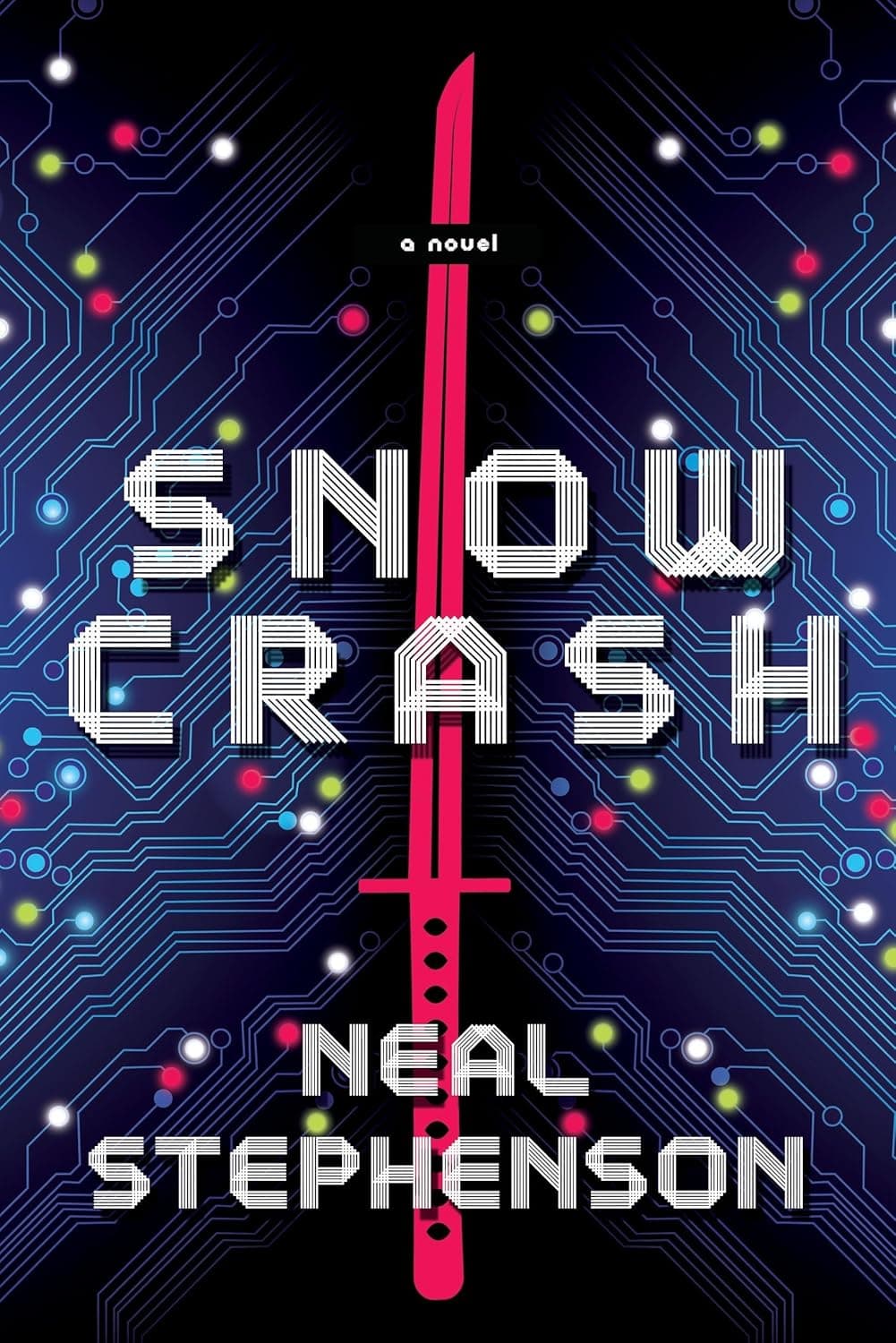
Opening
The novel pivots from mystery to revelation as Hiro Protagonist and Juanita Marquez expose Snow Crash as a multilayered weapon that fuses code, drug chemistry, and belief. As L. Bob Rife moves to weaponize the oldest stories on earth, Y.T. races through the gritty world of Long Beach with a cyborg partner, grounding Hiro’s high-concept discoveries in visceral stakes.
What Happens
Chapter 26: The Metavirus
At dawn on Da5id Meier’s roof, Hiro jacks into the Metaverse and meets Juanita in a private room at The Black Sun. Juanita—her avatar a plain, exact replica—explains that Da5id’s collapse isn’t a hardware failure but a software detonation: a “snow crash” in the wetware of the brain. The “static” Da5id saw is a dense binary stream injected through the optic nerve; hackers, trained to process binary, are uniquely vulnerable. Juanita calls it a “metavirus,” an “atomic bomb of informational warfare” that makes systems rewrite themselves into sickness, anchoring the novel’s Information, Language, and Viruses theme.
Juanita ties the bitmap to the street drug Snow Crash: a serum made from infected blood, spiked with cocaine, distributed through Rife’s church network. Virus, drug, religion—when Hiro asks which it is, Juanita snaps, “What’s the difference?” She sketches a history of religion as self-replicating information, invoking a Sumerian god, Enki, who once disrupted a primal language; Hebrew attempts at containment; and an early Christian movement she says viral forces hijack within weeks. She heads to Astoria for dangerous research and leaves Hiro with two leads: the “Babel stack” and the goddess Inanna.
As she logs off, a “Clint” avatar—the male counterpart to the “Brandy” who infected Da5id—appears in The Black Sun, carrying another deadly scroll. Hiro draws his katana, slices off the Clint’s arms, and stashes the fallen scroll in a hidden tunnel under the club to stop collateral infections. Spotting Y.T.’s black-and-white avatar outside, he shouts for her to tail the fleeing Clint, then retrieves the scroll via a Graveyard Daemon and secures it in his virtual workshop.
Chapter 27: Glossolalia and the Nam-shub
Y.T. checks in from the Metaverse: she’s on a monorail, shadowing the armless Clint. In Reality, she’s just finished a Mafia delivery to “Reverend Wayne’s Pearly Gates,” where worshippers “speak in tongues”—the same babble she heard from the infected in the park. The symptom bridges the physical drug, religious fervor, and the digital virus.
Back in his office, Hiro summons The Librarian to research the phenomenon. It has a name—glossolalia—and it spans cultures from ancient Greeks to Siberian shamans. The Librarian connects Christian glossolalia to Pentecost, prompting Hiro to dub it “Babel in reverse,” a pivot that pulls Mythology, Religion, and History into the investigation. The Librarian also outlines the Pharisees, Sadducees, and Essenes; the last treat possession as parasitic infection.
Hiro asks about “nam-shub,” a Sumerian incantation that exerts literal force. Sumerian is a linguistic isolate; only a handful can read it—five at Rife’s Bible College. Y.T. updates: the Clint disembarks at a remote Express Port beside a mile-high, twenty-mile-on-a-side black cube. Hiro pegs it as Rife’s data fortress, the Metaverse’s beating heart.
Chapter 28: The Nam-shub of Enki
Hiro steps into a new wing of the virtual Library: the mind of his dead colleague Lagos, mapped as a blizzard of hypercards—Biblical studies, Sumerian studies, neurolinguistics, and Rife intel—surrounding three artifacts: the Code of Hammurabi, an Asherah totem, and a clay envelope from Rife’s private collection that warns it contains the “nam-shub of Enki.”
At Hiro’s request, the Librarian translates. Once, humanity speaks a single language—until Enki “changed the speech in their mouths, put contention into it.” Lagos’s theory: the nam-shub isn’t allegory but a self-executing program, a neurolinguistic virus that triggers the historical Babel, an “Infocalypse” that fragments language forever and builds divergence into the human linguistic future.
To corroborate, the Librarian reads a letter from the scribe Sin-samuh to Enki: the writer is paralyzed, unable to speak or write, mind broken—and he blames Enki. It reads as a victim’s testimony from antiquity, a clinical snapshot of a brain hacked by a word.
Chapter 29: Ng’s Motorized Wheelchair
The scene flips to Y.T. at a truck stop, awaiting her Mafia driver. She first meets him in the Metaverse: Ng, ensconced in a French colonial villa with a geisha daemon attending him—wealth, power, and impeccable theater. Then Reality hits harder. Ng arrives in a custom armored truck; inside, he’s a quadruple amputee suspended in a life-support cocoon, a former helicopter pilot burned in the fall of Saigon. The truck is his “motorized wheelchair,” an extension of his body controlled by voice and daemons; the geisha’s massage is simulated, his mint julep delivered through a tube.
Their mission is surgical: drive into the Long Beach “Sacrifice Zone,” have Y.T. buy drugs, then simply throw them into the air. Ng’s “nonhuman systems” will do the rest. The job slices through the theory-heavy chapters, showcasing brutal, cybernetic pragmatism—and Y.T.’s composure inside it.
Chapter 30: Informational Hygiene
Hiro and the Librarian examine the Asherah totem. Asherah—consort of Yahweh—bears the serpent and tree, and she blurs into Eve (Hawwa) linguistically and mythically. Her cult’s prostitutes make a perfect epidemiological vector. Lagos hypothesizes a retrovirus—herpes-like—capable of rewriting neurons, hitchhiking on worship.
Enter the deuteronomists. They purge Asherah by centralizing worship in Jerusalem and hardening doctrine into text: the Torah. Hiro posits the Torah as a benign, self-replicating mental code that inoculates against malignant memes and wetware hacks—a program of “informational hygiene.”
The Adam and Eve story, scholars argue, is rewritten as political allegory: Adam as king, Eden as the northern kingdom, Eve/Asherah as a foreign cult whose influence invites Sargon II’s conquest. The parable warns King Hezekiah, who heeds it—reforming religion and fortifying Jerusalem’s water. When Sennacherib besieges the city, his army dies overnight of plague. Hiro’s chill reading: immune through text and biology, the Hebrews may have answered infection with counter-infection.
Character Development
The cast steps into sharper, riskier roles as intellect, faith, and machinery collide.
- Hiro Protagonist: Shifts from freelance hacker to methodical investigator. He curates Lagos’s archive, tests hypotheses, and takes decisive action in the Metaverse (disarming the Clint, quarantining the scroll).
- Y.T.: Professional, unflappable, and brave. She tracks threats across both worlds and adapts quickly to Ng’s unnerving setup and high-risk mission.
- Juanita Marquez: Emerges as a strategist with deep historical and linguistic insight. Her autonomy and willingness to confront danger reframes her as a co-architect of the resistance.
- The Librarian: Becomes essential infrastructure—vast recall, zero intuition—highlighting the gap between data retrieval and human synthesis.
- Ng: A study in radical cyborg resilience. His truck-body blurs man, machine, and vehicle, weaponizing disability into total control.
Themes & Symbols
These chapters crystallize the book’s governing idea: language, belief, and code are interlocking systems subject to infection and defense. The metavirus collapses boundaries between digital bitmap, blood serum, and religious practice. Babel becomes not a myth but a precedent for engineered mind-change—where an incantation can overwrite neural firmware. This is the engine of the novel’s exploration of Information, Language, and Viruses.
Mythology, Religion, and History function as a long war over cognitive security. The deuteronomists’ text culture operates like a vaccine, coding a community against parasitic cults. Meanwhile, the nam-shub/scroll stands as weaponized information—speech that alters brains. Asherah’s tree and serpent embody the primal, biological vector of belief. Ng’s van symbolizes extreme human-technological fusion: a fortress-body built to navigate an unsafe world.
The Metaverse itself—its clubs, archives, and data fortresses—serves as both battleground and lab, where Hiro tests, contains, and prototypes understanding, anchoring the theme of Virtual Reality and the Metaverse.
Key Quotes
“What’s the difference?”
Juanita’s answer collapses categories, asserting that virus, drug, and religion are just modes of information transfer. It reframes Snow Crash as a single phenomenon with multiple delivery systems, demanding a unified defense.
“Metavirus,” an “atomic bomb of informational warfare.”
By naming it, the chapter defines the stakes: a payload designed to make minds self-infect. The metaphor swaps bullets for bits and scripture, expanding the battlefield to cognition itself.
“Babel in reverse.”
Hiro’s gloss captures Pentecost as a counterprogram to Babel—a moment where language converges rather than fragments. It foreshadows the novel’s question: can a protective program (like the Torah or a counter–nam-shub) be written to restore coherence without tyranny?
“[Enki] changed the speech in their mouths, put contention into it.”
The nam-shub’s phrasing reads like a patch note for humanity. If words can alter neural architecture, then myth is specification—and spell—at once.
“Motorized wheelchair.”
Ng’s term underscores his philosophy of survival: integrate, control, and extend. The euphemism disguises a war machine synchronized to a human nervous system, emblematic of the book’s body-tech continuum.
Why This Matters and Section Significance
Chapters 26–30 stitch the novel’s mysteries into a single threat vector: Snow Crash is a cross-domain exploit that travels through screens, blood, and sermons. Rife emerges as a modern tycoon repurposing ancient power, while Hiro’s path clarifies—master the deep structure of language and myth or be rewritten by them. Y.T.’s boots-on-the-ground missions verify that the theory is not abstract; it’s lethal. Together, these chapters transform the story from cyberpunk caper into a speculative thriller about how information shapes, saves, and destroys minds.