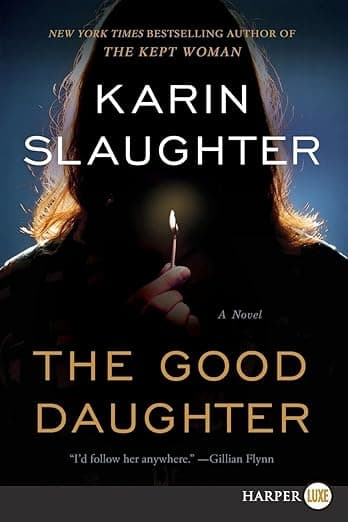
What This Theme Explores
In The Good Daughter, Justice, Morality, and the Law interrogates where legal correctness diverges from moral rightness—and what people owe one another when the two split apart. The novel probes whether due process can deliver compassionate outcomes in moments of profound harm, and what happens when institutions outsource justice to grief, rage, or convenience. It asks if righteous ends ever justify unlawful means, and at what cost to victims, communities, and the rule of law. Above all, it insists that legality, morality, and justice are overlapping but distinct, often forcing characters to choose which compass they will follow.
How It Develops
The theme takes root in 1989, when defense attorney Rusty Quinn secures the release of a wrongly convicted man and the community retaliates by firebombing his home. Their vigilantism—meant to correct a perceived failure of the courts—sets off a chain of unlawful “corrections” that culminates in a brutal home invasion by Zachariah Culpepper. From the start, the novel exposes the paradox: a lawyer’s principled defense of rights can ignite communal fury that obliterates the very norms justice requires.
Decades later, the tension resurfaces through Rusty’s daughters. Charlotte Quinn, now a defense attorney, tries to practice a “cleaner” law in juvenile and drug courts, hoping due process can level an uneven field. When a school shooting forces her to intervene as police prepare to beat the teen shooter Kelly Wilson, Charlie’s instinct is to protect procedure even in the face of atrocity. The scene crystallizes the book’s central friction: the law’s measured steps versus a community’s raw demand for immediate punishment.
The final movement strips the shine off institutional integrity entirely. Evidence reveals a revered lawman framed and killed an innocent man to close a case, while Rusty’s long-hidden choice to suppress Mason Huckabee’s confession—illegal, yet meant to shield his daughters from retraumatization—exposes a private ethics at odds with public duty. When Judith Pinkman bypasses courtrooms altogether and enacts her own irreversible judgment, the novel leaves its characters confronting a stark truth: when the system can’t—or won’t—deliver justice, people improvise, often at devastating moral cost.
Key Examples
-
Rusty’s creed and its backlash: Rusty’s insistence that every defendant deserves a defense results in a legally correct but locally intolerable acquittal. The town’s firebombing of his house literalizes how swiftly moral outrage can turn into unlawful retribution, punishing not just a lawyer’s stance but his family—collateral damage of “justice” unmoored from law.
-
The school hallway standoff: Charlie stops officers from brutalizing Kelly Wilson, insisting on photographing and processing the suspect properly. Her intervention illustrates the theme’s thorniest edge: defending the rights of someone who has done irreparable harm, because abandoning procedure now undermines any hope of a just verdict later.
-
Rusty’s hidden confession: By burying Mason Huckabee’s admission for nearly three decades, Rusty obstructs justice to protect his daughters’ privacy and safety. The novel neither absolves nor condemns him outright; instead, it shows the price of a father’s moral calculus—an innocent man’s name stays stained, a guilty man remains free, and the legal record becomes a lie.
-
Corruption as counterfeit justice: A celebrated officer-turned-prosecutor manufactures guilt and then “closes” the case with lethal force. His actions expose how power can mimic justice while sabotaging it, using the veneer of law to consecrate vengeance.
-
Sam’s procedural counterstrike: At Kelly’s arraignment, Samantha weaponizes procedural rigor to expose prosecutorial overreach. The scene reframes due process not as a loophole for the guilty but as a moral instrument for truth-telling, capable of disciplining bad-faith actors within the system.
-
Judith’s final verdict: After confessing her role in the shooting, Judith stages her own punishment through suicide. Her choice functions as the bleak endpoint of institutional mistrust: when faith in courts, community, and mercy collapses, only self-authorized judgment remains.
Character Connections
Rusty Quinn embodies the law’s highest ideals and its deepest compromises. He champions the unpopular defendant as a civic duty, then violates that same duty by hiding exculpatory truth to protect his children. Rusty personifies the theme’s central paradox: love and principle can pull in opposite directions, and even the most principled actors may decide that “right” requires breaking rules.
Charlotte Quinn tests the viability of due process in a world inflamed by pain. Her instinct to safeguard Kelly’s rights, despite personal revulsion, suggests a belief that justice derives from fair process, not from passion. Yet the revelations about her past force Charlie to recognize that procedure can’t heal trauma—and that moral repair sometimes falls outside the court’s jurisdiction.
Samantha begins as a believer in the state’s authority, but her evolution turns her into a strategic critic of its abuses. In court, she uses the law as a scalpel, exposing prosecutorial shortcuts; outside it, she confronts how official narratives can erase harm. Sam complicates the portrait of “the system”: she proves it can correct itself—but only when insiders choose ethical courage over institutional loyalty.
Ben Bernard lives the conflict from within. As an Assistant DA disgusted by corner-cutting, his decision to leak evidence is both unlawful and morally urgent. Ben’s choice captures the theme’s ache: sometimes the only way to serve justice is to step outside the law that is supposed to guarantee it.
Symbolic Elements
The Higgledy-Piggledy farmhouse: The Quinns’ ramshackle refuge, born of displacement after the firebombing, materializes the aftermath of failed justice—crooked walls, mismatched rooms, and a family trying to live inside the wreckage of other people’s “righteousness.” It is also the site of Gamma’s murder, fusing domestic space with legal abandonment.
The blind pass: Gamma’s relay-race mantra—place the baton firmly in your teammate’s hand—becomes a metaphor for institutional trust. When the pass fails, the team falters; when the law fails to “place” safety and fairness in citizens’ hands, people improvise, and chaos spreads.
Rusty’s dusty law books: Scattered, dog-eared volumes clutter the Quinn home like the law’s omnipresent but imperfect reach. They signify both aspiration and mess: principles are everywhere, order is nowhere, and life refuses to stay inside the margins of doctrine.
Contemporary Relevance
The novel’s conflicts echo current debates over police force, wrongful convictions, prosecutorial discretion, and public vengeance fueled by outrage. It cautions that bypassing due process in the name of moral certainty corrodes the very conditions that make justice possible, while also admitting that institutions can betray the people they claim to protect. By dramatizing whistleblowing, civil rights protections for the despised, and private ethics that collide with public duty, the story asks how communities can demand accountability without reenacting harm. Its answer is uneasy but necessary: law must be both principled and self-correcting, or people will seek justice elsewhere.
Essential Quote
“You guys need to stop this.” Charlie dragged her shoulder against the lockers as she walked closer to the lion’s den. “Take her to the station. Photograph her. Fingerprint her. Don’t let this blow back on—” ... “There’s a right way to do this. You all know that. Don’t be the reason this case gets tossed.”
This moment captures the novel’s insistence that justice is procedural as well as moral: the “right way” matters most when emotions run hottest. By defending a reviled suspect’s rights, Charlie isn’t excusing harm—she’s protecting the legitimacy of any verdict to come, reminding us that justice obtained unlawfully is not justice at all.