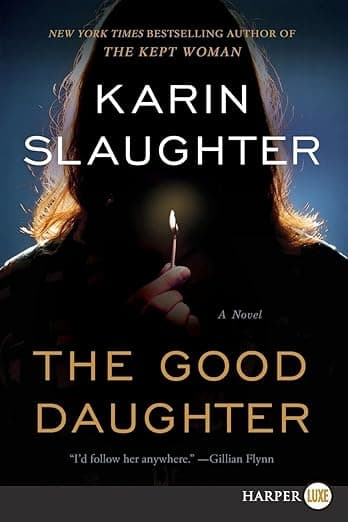
At a Glance
- Genre: Literary/legal thriller; Southern Gothic undertones
- Setting: Pikeville, Georgia; dual timelines in 1989 and twenty-eight years later
- Perspective: Close third person, primarily following the Quinn sisters
Opening Hook
One brutal night on a rural farm rips a family apart—and the town never recovers. Decades later, a school shooting drags old ghosts into daylight, pulling two estranged sisters back into the orbit of the father whose choices shaped their lives. As secrets surface and loyalties snap, the past proves as present as a pulse. The result is a thriller that races forward while looking backward, asking what survival truly costs.
Plot Overview
1989: The Night That Splintered the Quinns
The novel opens with a harrowing farmhouse invasion you can follow in the Chapter 1-5 Summary. Two armed men—Zachariah Culpepper and an accomplice—arrive to punish controversial defense attorney Rusty Quinn. They find only his wife, Gamma Quinn, and their teenage daughters, Samantha and Charlotte.
Gamma is murdered when she lunges for a gun, and the men drag the girls into the woods where a grave gapes open. In a desperate gambit, Samantha pushes Charlotte to run. A shot drops Sam into the grave; the men bury her, assuming she’s dead, while Charlotte flees through the trees, the night burning into memory and shaping everything that follows.
“Girl, I just blew your mama to bits. You really think you’re walking out of here alive?”
Twenty-Eight Years Later: Violence Returns
Charlotte, now a defense attorney in Pikeville, is at the middle school when a shooting erupts. The alleged shooter is Kelly Wilson, a troubled teen who kills the principal and a child. Charlotte, bloodied and shaken, clashes with police over their treatment of Kelly and witnesses a teacher, Mason Huckabee, take a bullet while trying to intervene. The tragedy mirrors the terror of her childhood, forcing her into memories she has fought to suppress. The immediate aftermath unfolds in the Chapter 6-10 Summary.
Convergence: Old Crimes, New Lies
The past surges forward when Rusty is stabbed—payback, many assume, for his decision to represent Kelly. Samantha, now a high-powered patent attorney in New York, returns home for the first time in years. The sisters’ brittle reunion turns into a reluctant partnership as they dig into Kelly’s case and find threads leading straight back to 1989.
Piece by piece, the truth emerges. Mason Huckabee—the wounded “hero”—was the second intruder on the night of the farmhouse attack, driven by vengeance after Rusty defended the man who assaulted Mason’s sister. Rusty discovered Mason’s role long ago and, to shield his daughters from another trial, brokered a hush arrangement: the Huckabee family’s money for silence from Zachariah’s son while Zachariah sat on death row. Meanwhile, the school shooting proves no simple horror. The principal’s wife, Judith Pinkman, manipulated the fragile, pregnant Kelly into a plan meant to eliminate her unfaithful husband and claim his lover’s baby; the child victim’s death was a shattering accident.
At the center of it all lies Charlotte’s unspoken truth: after Samantha was shot that night in the woods, Zachariah caught Charlotte and raped her. Rusty urged her to bury the memory, believing secrecy would spare her. The secret instead became the wound that defined her.
Reckonings and Release
The town reels as confessions surface. Judith dies by suicide after owning her role; Mason turns himself in; and the Quinn sisters, finally holding the full story, choose honesty over silence. Healing isn’t swift, but it’s possible—no longer a performance, but a practice. The closing movements are traced in the Chapter 16-20 Summary.
Central Characters
For a broader cast list, see the Character Overview.
-
Samantha “Sam” Quinn The sister who left—and remade herself. Brilliant, guarded, and fiercely competent, Sam survived a catastrophic brain injury and built a life defined by control. Returning to Pikeville forces her to reckon with anger she’s refined into ambition and pride she’s used as armor.
- Strengths: razor-sharp legal mind; grit; moral clarity when it counts
- Flaws: emotional distance; resentment; instinct to flee pain
- Arc: from avoidance to engagement, choosing connection over isolation
-
Charlotte “Charlie” Quinn The sister who stayed—and never stopped running toward the fire. A defense attorney like her father, Charlie projects toughness to conceal profound trauma and survivor’s guilt. Her courage often looks like recklessness, but it’s rooted in a hunger to make wrong things right.
- Strengths: empathy; tenacity; courtroom bravado
- Flaws: impulsivity; self-blame; secrecy
- Arc: from denial to disclosure, reclaiming her story
-
Rusty Quinn The “Attorney for the Damned.” Charismatic, exasperating, and unwavering in his belief that everyone deserves a defense, Rusty’s ideals cost his family dearly. His love is real; so are the unintended harms of his bargains and blind spots.
- Defining belief: justice requires advocacy—even for monsters
- Conflict: principle vs. protection; public mission vs. private fallout
- Legacy: shaped his daughters’ careers and their scars
-
Gamma Quinn The brilliant matriarch whose loss is the book’s original wound. A physicist with little patience for small-town niceties, Gamma’s ferocity and love imprint on her daughters long after her death.
- Symbolism: intellect, maternal ferocity, the life abruptly stolen
- Presence: a memory that sharpens rather than softens over time
-
Mason Huckabee The town’s revered teacher with a buried past. His double life—rescuer in the present, perpetrator in the past—embodies the novel’s moral tangles and the cost of secret-keeping.
-
Judith Pinkman Model wife turned architect of ruin. Her manipulation of Kelly reframes the shooting, exposing the quiet brutality that can hide behind respectability.
Major Themes
Explore further in the Theme Overview.
-
Family Trauma and Its Aftermath The novel tracks the long tail of a single violent night across decades, showing how grief calcifies into personality. Sam and Charlie’s estrangement, Rusty’s bargains, and the sisters’ divergent coping mechanisms reveal trauma not as a moment, but a system that shapes every choice.
-
Secrets and Lies Concealment becomes both shield and weapon. Rusty’s hush deal, Charlotte’s buried assault, and Judith’s deceit prove that secrecy can postpone pain but compounds it—distorting justice, love, and memory until truth finally ruptures the surface.
-
Survival and Resilience Survival is physical, but resilience is narrative—how you tell yourself what happened. Sam’s recovery and career, Charlie’s return to the courtroom after fresh violence, and their joint decision to speak aloud what was once unsayable mark resilience as active, costly, and brave.
-
Justice, Morality, and the Law The story sits in the uneasy space where legal outcomes and moral intuitions diverge. Rusty’s vocation insists that due process is nonnegotiable, yet the fallout—Mason’s impunity, Kelly’s manipulation—asks whether justice without compassion or accountability can ever be enough.
-
The Past's Influence on the Present Every present event—school shooting, stabbing, reunion—springs from 1989. The novel treats time as a closed circuit, illustrating how unexamined histories script current behavior until truth interrupts the loop.
-
Sisterhood and Familial Duty Sam’s shove into the darkness to save Charlie becomes the book’s moral template: protection through sacrifice. Their fractured bond hardens into solidarity as they choose each other over silence, modeling duty not as obligation, but as love in action.
Literary Significance
The Good Daughter expands the crime thriller into a meditation on aftermath. Karin Slaughter’s dual-timeline structure isn’t just suspense architecture; it’s a thematic engine, demonstrating how violence reverberates through memory, law, and family lore. Rooted in Southern Gothic textures—insular towns, public piety, private rot—the novel probes the gap between legal truth and lived truth, insisting that justice demands both. Its blend of propulsive plotting with psychologically precise character work makes it a standout of contemporary literary thrillers.
Critical Reception
-
Praise Critics lauded the intricate plotting, emotional stakes, and the fierce, nuanced portrait of sisters navigating trauma. The bond between Sam and Charlie is often cited as the novel’s heart, with Slaughter’s unflinching realism praised as necessary rather than gratuitous. Gillian Flynn put it simply: “I’d follow her anywhere.”
-
Interpretation Many read the book as an indictment of systemic failures and the private costs of public principle. Its graphic moments serve the psychological truth of the story, illuminating how violence imprints on bodies, choices, and communities. Memorable lines are collected on the Quotes page.