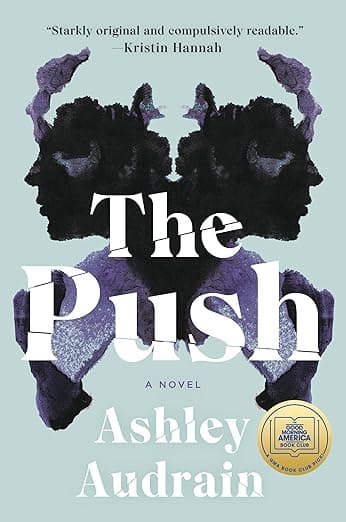
Opening
At the height of her double life, Blythe Connor crashes into the family she can no longer claim—and the fantasy she can no longer sustain. Across five chapters, a public unmasking, a weaponized confession, a generational flashback, a harrowing field trip, and a hollow affair strip Blythe down to her most isolating truths and force a radical reevaluation of her daughter, her past, and her story.
What Happens
Chapter 71: Anne, This is Fox
At a Wednesday-night mothers’ group, Blythe basks in the fragile safety of her alias, “Anne,” beside her friend Gemma. She believes she’s been seen—at last—as a competent, loving mother. When the meeting ends, Gemma points out her husband waiting outside. It’s Fox Connor, Blythe’s ex-husband, staring straight at her.
Blythe tries to flee, tugging scarf and hat into place as if twenty shared years can be disguised. Gemma insists on introductions. The air tightens. Fox wears the coat Blythe once bought him; his eyes are “bullets.” Blythe offers a gloved hand. He keeps his hands in his pockets, then, finally, takes hers, murmuring, “You, too,” without meeting her eyes. Gemma shifts with growing unease. Blythe splits from herself to survive the shame, then bolts—running from the collision of her two lives before the entire room sees the wreckage.
Chapter 72: The Truth
Blythe disappears from the group for a week, convinced Fox has told Gemma everything. A text breaks the silence: “Can we talk?” Over tea, Blythe apologizes first, calling her behavior “psychotic.” She braces for disgust. Instead, Gemma says, “I’m sorry about your son. I’m sorry you lost him.” She explains she only knows Sam Connor died in an accident; Fox never shared more.
Blythe seizes the opening. She tells Gemma the story she has clutched for years: that Violet Connor pushed the stroller into traffic. As Blythe watches, a “hairline crack” runs through Gemma’s composure. Blythe presses, asking if Gemma ever worries about her son, Jet, alone with Violet. The spell breaks. Gemma stands, drops cash on the table, and walks into the snow. Blythe stays behind with the fallout of her most devastating choice: she has used her truth like a blade.
Chapter 73: The House We All Used to Live In / 1972–1974
In the present, Blythe lives inside immaculate emptiness—hangers evenly spaced, surfaces sterile, her lover a detached literary agent who slips in and out of the house like a meeting on his calendar. He suggests she write marketable YA; he avoids her past; sex replaces intimacy. She stares at him through “wet, distorted glass,” trapped in a life so orderly it hardly holds a pulse.
The narrative flashes back to the 1970s. After Etta’s suicide, Blythe’s mother, Cecilia, is abandoned by her grieving father. She skips school, clings to poetry, and, after an elderly charge dies, steals the woman’s savings to make a new life in the city. There she falls for Seb, then slips into an affair with his friend Lenny, whose promises shimmer like escape. Pregnancy ends the fantasy. Seb is ecstatic; Cecilia wants an abortion. He threatens to send her back home if she refuses to keep the baby. Trapped and ashamed, like her mother before her, Cecilia stays—another woman folded into a lineage of ambivalent, unwanted motherhood.
Chapter 74: The Field Trip
Nearly a year later, Violet—now almost thirteen—mostly lives with Fox and Gemma. When a teacher urgently asks Blythe to chaperone a farm trip, she accepts, bracing for her daughter’s chill. On the bus, Blythe watches as the popular girls edge Violet out, petty and precise. For the first time, she sees Violet small, lonely, reachable.
At the farm, Blythe keeps her distance. In the baking barn, she realizes Violet is gone. Panic slams her back into the day she lost Sam. A teacher says Violet claimed a headache and that Blythe was taking her to the bus—but she isn’t there. Calls stack on Blythe’s phone. When she returns Gemma’s, Gemma says a truck driver found Violet at a highway rest stop; she’s already on her way.
On the ride back, Blythe finds a beaded bracelet abandoned on the popular girls’ seat. They refuse it. The truth is simple: Violet ran from humiliation. That night, Blythe calls to check on her. Gemma’s voice is flat. “Good-bye, Blythe.” The line goes dead, and the new family boundary hardens.
Chapter 75: The Shower
Time stretches. Blythe doesn’t see Violet. The agent-lover keeps visiting. He showers; she makes tea; he leaves. Their ritual is precise and vacant. Watching him through the glass, she recognizes the shape of her life: near, and untouchable. What remains is the silence after everyone else has chosen a different home.
Character Development
Blythe’s façade collapses, and she chooses action over passivity—first by detonating Gemma’s trust, then by confronting a version of Violet that doesn’t fit her long-held fear. Her certainty begins to fracture.
- Blythe Connor: Moves from covert longing to overt manipulation, telling a story that could protect her or condemn her. The field trip forces empathy; she sees her daughter as wounded, not only menacing.
- Violet Connor: Shifts from inscrutable and powerful to socially vulnerable. Her flight from bullying reveals fear, pride, and a desperate wish to belong.
- Gemma: Evolves from confidante to gatekeeper. Her compassion for Blythe evaporates after the accusation, and she aligns decisively with Fox and Violet.
- Cecilia: Her past clarifies the inheritance Blythe carries—abandonment, coercion, and motherhood accepted under duress.
Themes & Symbols
The section interrogates Perception, Reality, and Gaslighting. Blythe’s “Anne” persona manufactures warmth and belonging; her confession to Gemma blurs sincerity and strategy. The narrative keeps asking whose version of events holds: Blythe’s, Fox’s, or the one no one wants to name.
Nature vs. Nurture and Generational Trauma tightens its grip. Cecilia’s coerced motherhood mirrors Etta’s collapse and foreshadows Blythe’s ambivalence. The pattern repeats: women cornered by grief, men dictating terms, a child born into the residue of unloved choices.
The Dark Side of Motherhood runs through every scene—Blythe’s isolation inside domestic perfection, Cecilia’s devastation at pregnancy, the moment Blythe realizes Violet’s pain and cannot save her. The beaded bracelet—made by Violet, abandoned by the girls—becomes a quiet symbol of failed connection and the proof that power and loneliness can live inside the same child.
Key Quotes
“You, too.”
Fox’s bare politeness spares a public spectacle but confirms the private war. His refusal to meet Blythe’s eyes acknowledges their history while denying her the intimacy of recognition.
“Can we talk?”
Gemma’s text opens a door Blythe weaponizes. The gentleness of the invitation contrasts with the violence of the truth Blythe chooses to tell.
“I’m sorry about your son. I’m sorry you lost him.”
Compassion disarms Blythe before she strikes. Gemma’s empathy underscores how much Fox has withheld and sets the emotional stakes for the confession that follows.
“Psychotic.”
Blythe names her own behavior to seize control of the narrative. The self-indictment functions as both apology and preemptive defense.
“A hairline crack crawl through the ice.”
This image captures Gemma’s shifting belief in real time: the surface looks solid, but the fracture is already spreading underneath.
“Good-bye, Blythe.”
Gemma’s finality seals the family border. The sentence is a lock turning; there is no shared future on the other side of the line.
“Wet, distorted glass.”
Blythe’s view of her lover through the shower door doubles as her view of her life—close enough to touch, blurred beyond meaning.
Why This Matters and Section Significance
This sequence detonates the novel’s central illusion. Blythe’s “Anne” is exposed; her friendship with Gemma curdles into suspicion; her confession recasts her from victim to aggressor. Cecilia’s backstory deepens the inheritance at play, showing how trauma migrates mother to daughter. Most crucially, the field trip forces a new lens on Violet, destabilizing Blythe’s long-held certainty about who her daughter is. The story turns here from a single, consuming perspective to a contested reality—one in which love, fear, memory, and guilt are all unreliable narrators.