
Turbo AI vs. ChatGPT

Ishan Chawla
Student, Northwestern University

Brief Overview
Hi, I'm Ishan, a Northwestern student who uses AI tools every day. This comparison is a little different from a normal head-to-head because these two tools aren't trying to do the same thing. ChatGPT is a general-purpose assistant that can talk about anything while Turbo is a purpose-built study platform. This article doesn't try to find which is smarter, but which one a student should build their studying around.
To be completely transparent, I work at Turbo AI. Obviously I'm not neutral, so I'm doing what I did in my Turbo vs. StudyFetch and Turbo vs. Studley articles: showing you screenshots of everything and letting you judge the outputs yourself.
I. Test Setup
I ran the same coursework through both tools for each category, and will specify the different inputs at each step. For ChatGPT, I used GPT-5.6 Sol, and am on the paid "Plus" tier.
As usual, throughout, we'll keep a running tally of each platform's points.
II. Getting Your Material In
The first difference is how each platform ingests material.
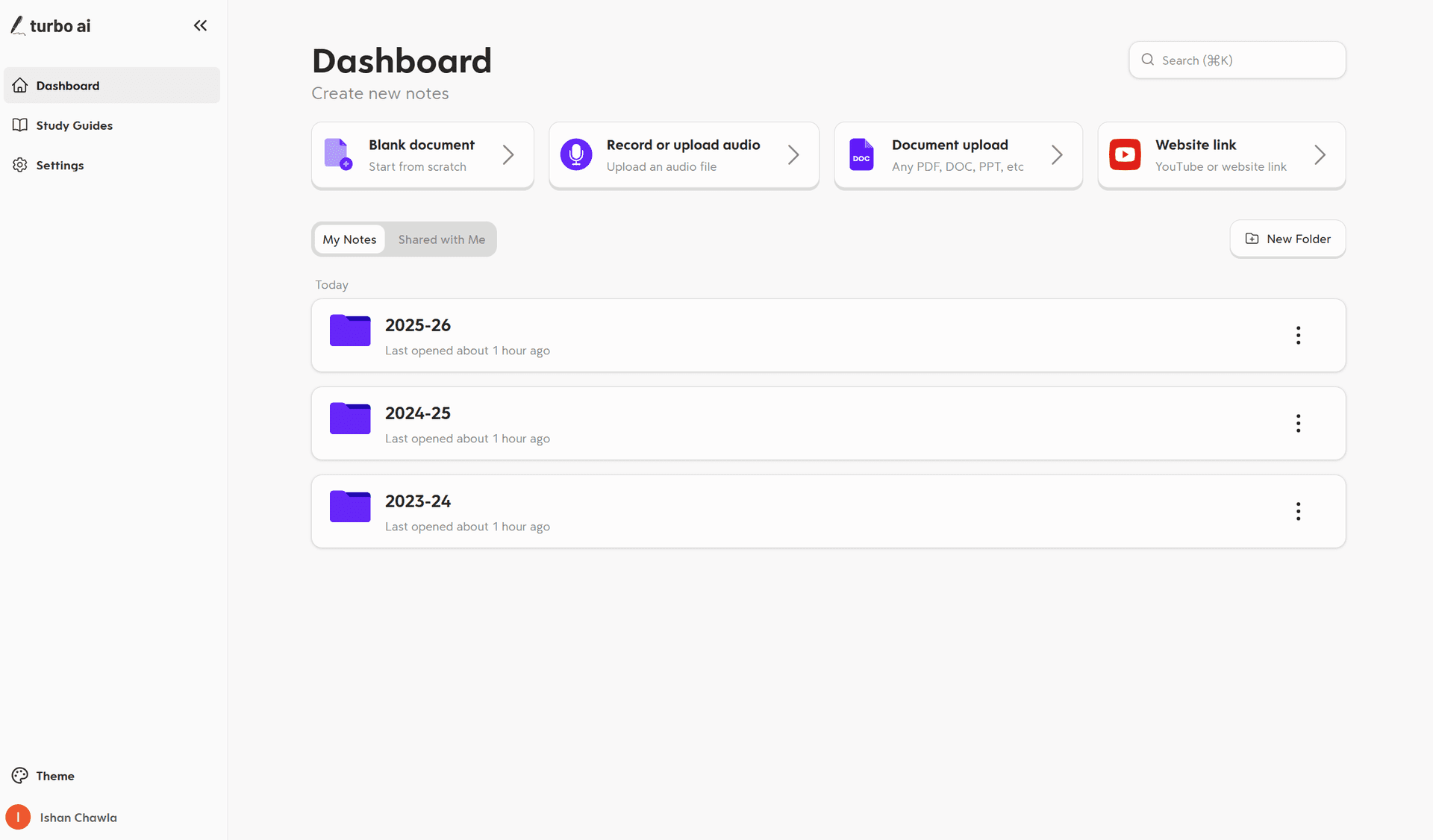
With Turbo, each item took one step: record or upload the audio, upload the YouTube link, upload the slides. Each automatically became its own folder with detailed notes. From there, you can create as many nested folders as your heart desires. Below, you can see that the first set of folders is organized by school year.
With ChatGPT, the slides and PDFs uploaded correctly. But, since ChatGPT is an all-purpose tool, you additionally have to prompt the LLM to summarize and create detailed notes for your content.
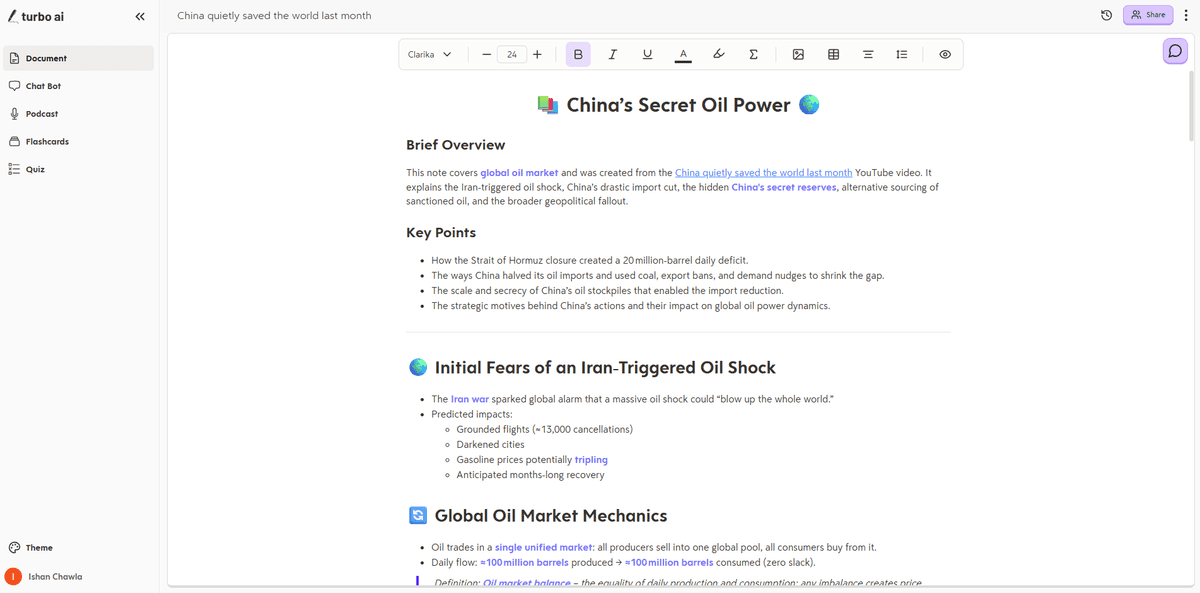
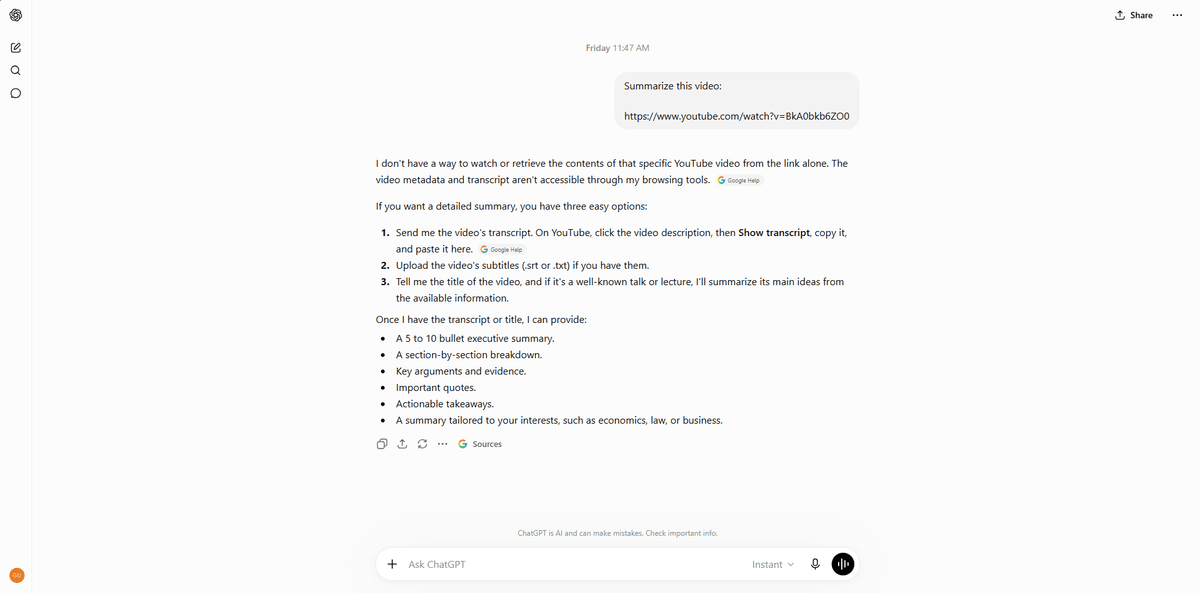
The lecture recordings and the YouTube video, however, were different. ChatGPT doesn't support audio transcription at a large scale the way Turbo does, and the YouTube video upload seems spotty. I uploaded a video on geopolitics, "China quietly saved the world last month" and ChatGPT was unable to summarize the video, despite it having a transcript.
Turbo's YouTube Video Output
ChatGPT's YouTube Video Output
When ChatGPT didn't work, I got curious how specifically Turbo executes this better than a leading AI company. So, I walked over to the engineering side of our floor and asked Nihaar.
He explained that we have a dedicated pipeline for accessing audio and transcripts from YouTube videos, allowing us to gather data on the video. In contrast, ChatGPT performs a simpler, surface-level scrape of the website, which frequently returns nothing.
Verdict: Turbo
III. Note Quality
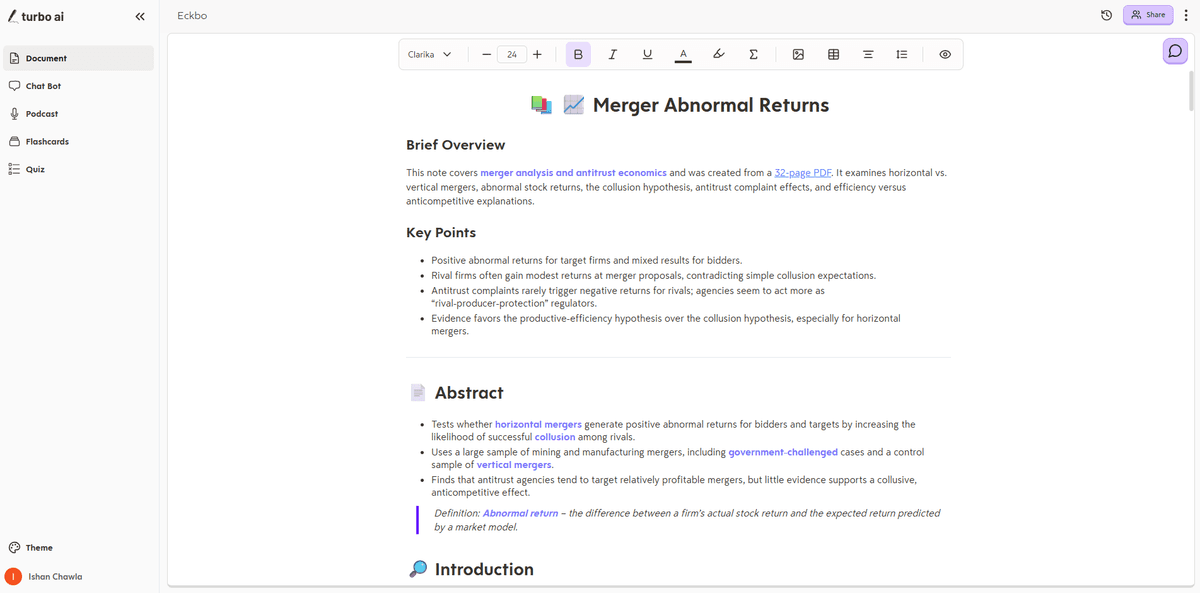
Both tools can summarize content, but I want to understand what the output looks like when the content becomes more difficult. I uploaded a research paper I reference in my senior thesis, a 32-page 1981 Journal of Financial Economics study on company mergers.
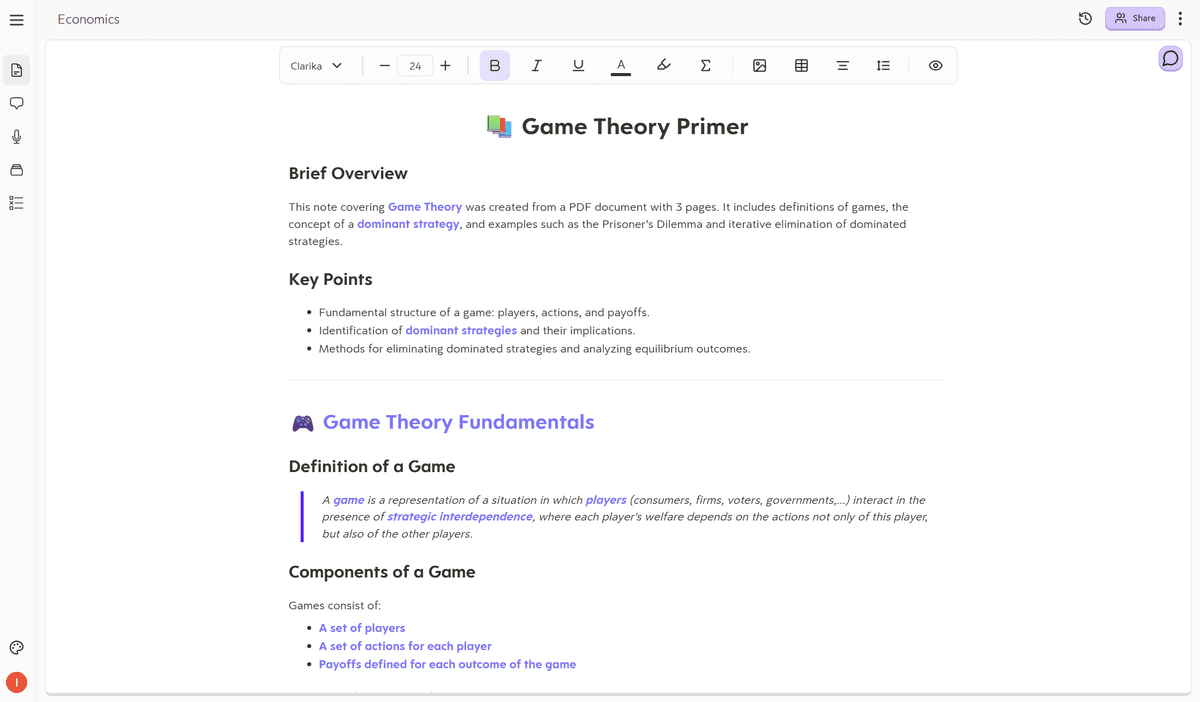
Turbo's Notes
ChatGPT's Notes
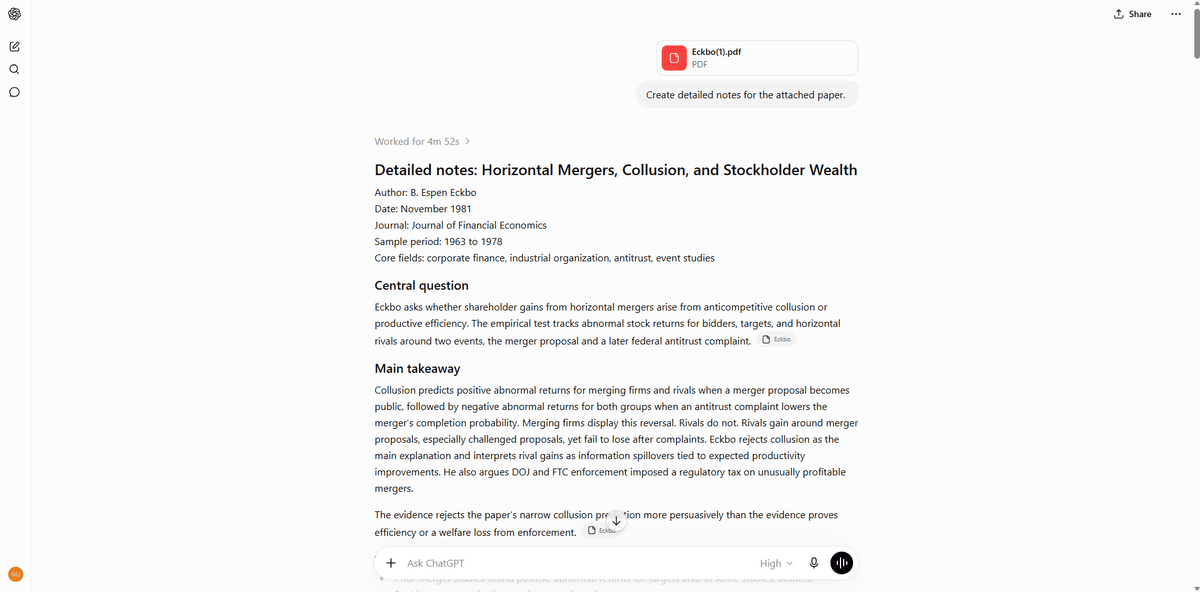
For studying, Turbo's output is the one I'd actually return to. The overview and key points tell me the paper's argument in thirty seconds, the definitions function like flashcards, the hypothesis table compresses the entire testable framework into something I could rebuild on an exam, and the paper's actual figures survive with captions explaining their significance.
One disclaimer, however, is that ChatGPT connected the paper directly to my own thesis plans with suggestions on which of Eckbo's methods to keep and which to modernize. If you're writing about a paper, this personalization is helpful, and not available on Turbo. But if you're studying, reviewing, or being tested, Turbo's version is the one built specifically for this job.
On a structural note, ChatGPT's output lives in a chat thread while Turbo's notes are organized in a notebook you can return to. Additionally, Turbo's notes are exportable into your external notebook, while ChatGPT's conversation thread is not.
Verdict: Turbo, for both note quality and organizational structure
IV. Explaining Concepts
ChatGPT can explain the limit definition of a derivative five different ways, at any level, with analogies. It's the best and most versatile explainer-on-demand ever built, and pretending otherwise would defeat my credibility.
Turbo's chat holds its own in context, and because it sits inside your notes, you can ask something specific without pasting anything, and it answers at the level of the material you're studying.
ChatGPT, however, offers more in the sense that you can quickly change between topics, connecting subjects across topics, and access more tools directly on the platform.
Verdict: ChatGPT
V. Study Tools: Flashcards, Quizzes, Podcasts
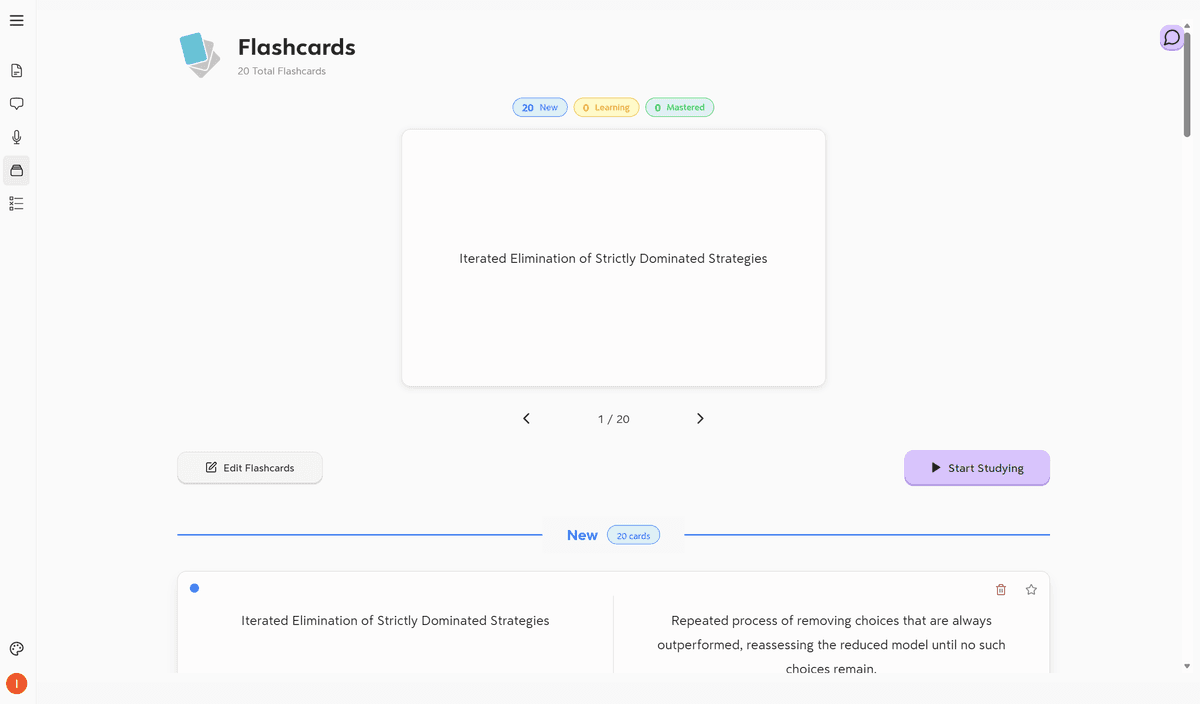
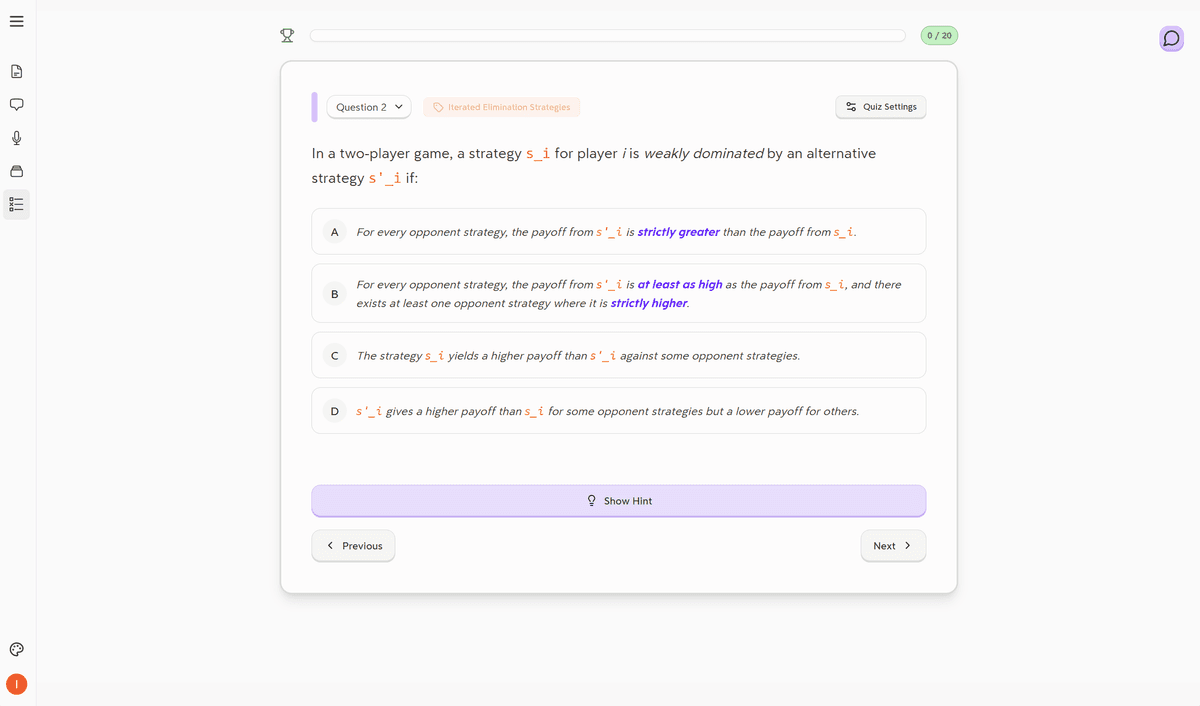
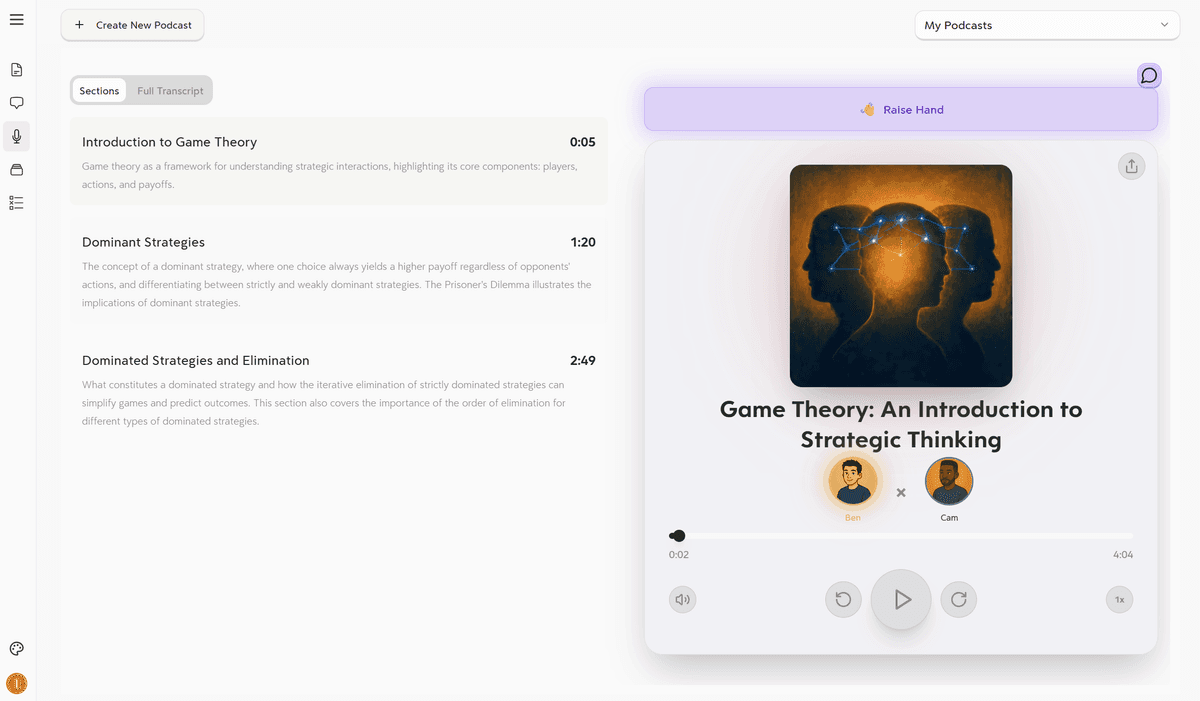
Turbo generates flashcards, multiple-choice quizzes, and a podcast from every upload. ChatGPT does not offer any of these features, and while it can generate flashcards or quiz questions with enough prompting, it does not offer an interface to give these tools to users properly.
Notes
Flashcards
Quiz
Podcast
Verdict: Turbo
VI. Everything That Isn't Studying
Once students reach beyond simply studying (drafting emails, searching the web, debugging code, brainstorming essay topics, planning a trip), ChatGPT pulls ahead. Its versatility is unmatched, and Turbo does not attempt to copy this generality.
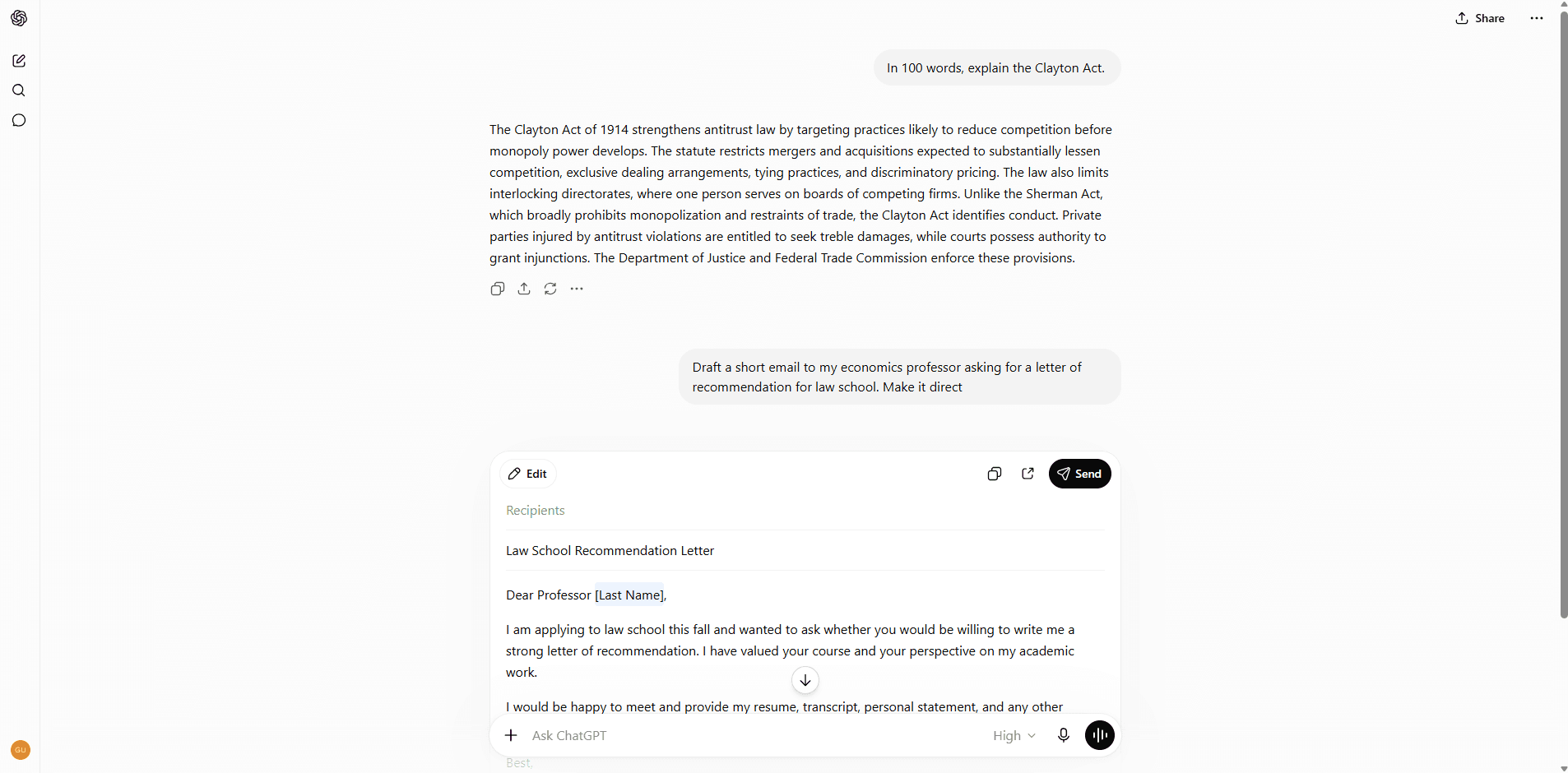
This is a plus for ChatGPT, and it's also why most of our students end up with both a general assistant and a specific study system.
Verdict: ChatGPT
VII. Pricing
Turbo runs $20/month billed monthly, or $10/month billed annually ($120/year). As of today, ChatGPT runs $8/month, $20/month, $100/month, or $200/month for the Go, Plus, Pro (5x), and Pro (20x) plans, respectively.
Most Turbo users bill monthly, and most ChatGPT users subscribe to the Plus plan, which are both $20/month.
Verdict: Tie
VIII. Conclusion
This wasn't a fight between a good tool and a bad one, or even two tools that try to accomplish the same thing, as was the case with the previous articles. ChatGPT is the best general assistant available to students, and earned its points for quick explanations and everything outside coursework.
But effective studying isn't a conversation, but a system. Materials go in, organized notes come out, review happens on schedule, and progress carries over from week to week. That's the job Turbo is built for, and it's the job Turbo won.
I would use Turbo for studying, and ChatGPT for general tasks. Your GPA and future benefit from knowing when to use the correct tool.
Ishan Chawla
Student, Northwestern University