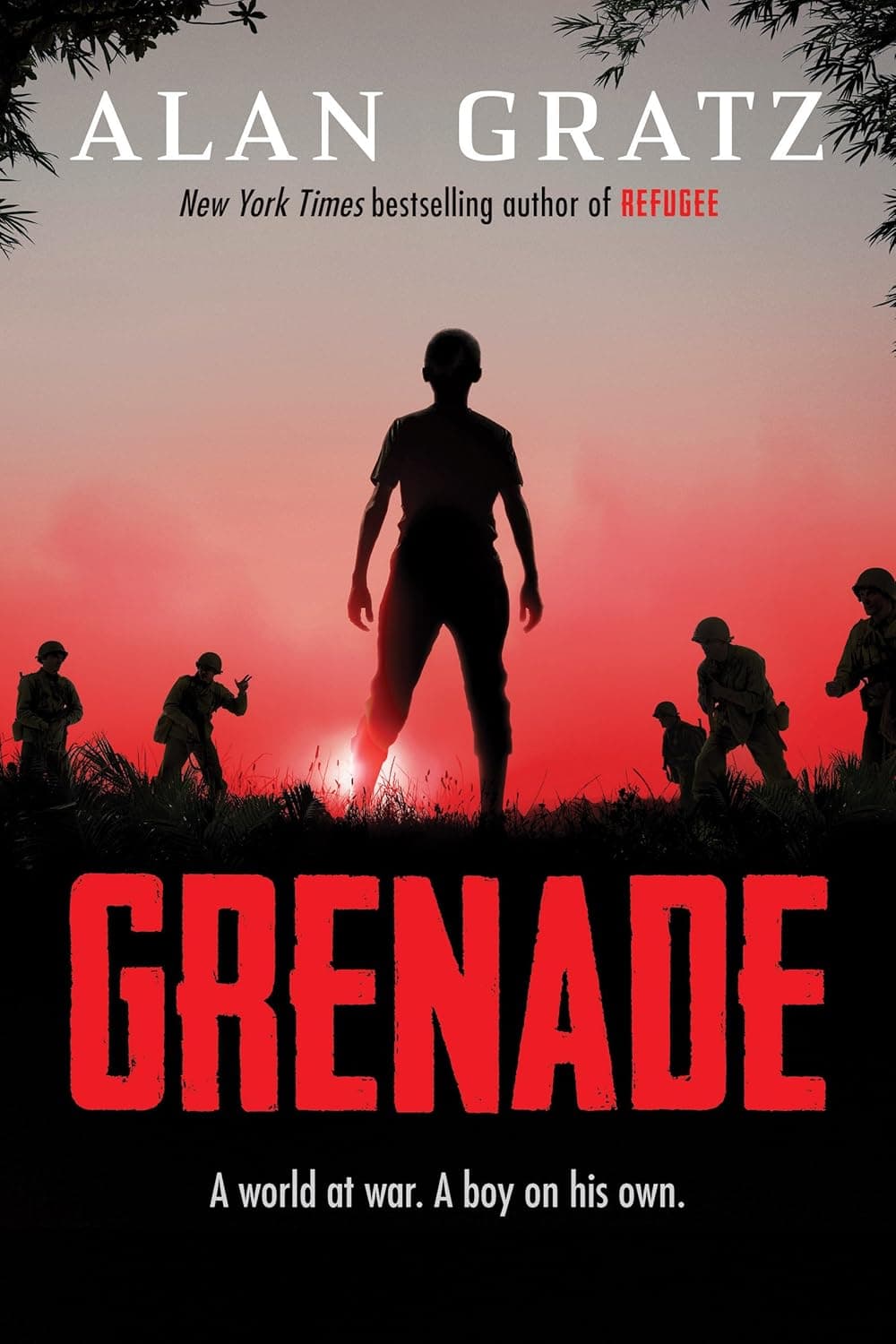
Opening
Hideki and Ray’s separate nightmares drive them toward the same shattered landscape—two terrified boys, shaped by orders and propaganda, sprinting straight into each other. These chapters collapse hero and enemy into mirror images, then force a brutal reckoning: the collision that ends Part One and the ghost that begins Part Two.
What Happens
Chapter 21: Sute-ishi
A Japanese lieutenant orders a final “Banzai!” and drives soldiers and civilians from a cave to die. Hideki Kaneshiro, clinging to Shigetomo’s mabui, refuses to surrender his life. The lieutenant fires into the dark; the deafening shots buy Hideki a second to scramble up a narrow air shaft, climbing over a mound of bodies, and slip outside as more bullets snap past him.
In a rain-filled crater, grief floods him. He sees Okinawa for what it is: a sute-ishi, a sacrificial stone. The Japanese army never means to save Okinawans—only to spend them for time. His faith in the Emperor, and in the cause, ruptures. He hurls away the sack of Imperial photographs and screams into the storm, renouncing the lies that raised him.
He moves to surrender, but the Americans torch a nearby cave without checking for civilians. When they spot him, they open fire. A Marine with “blazing, crazy” eyes swings a flamethrower toward him; Hideki’s uniform catches fire. He beats out the flames and runs. In his mind, both sides turn into monsters, and survival is the only law left.
Chapter 22: Human Bombs
The view shifts to Private Ray Majors, dug in on a ridge with his unit and Big John Barboza. A furious Japanese counterattack crashes against them. Ray cycles his M-1 in a numbing tempo—aim, fire, reload—until the sudden, awful quiet after the 15-minute firefight makes his hands shake more than the shooting did.
Civilians then appear out of the smoke: old men, women, children. A woman in a spotless blue dress hugs a baby. Ray’s stunned attention turns to horror: dynamite belts gleam beneath the fabric. The refugees are human bombs—an atrocity that distills The Horors and Dehumanization of War. Big John orders them to fire. Ray can’t. Big John shoots, and the blast staggers the Marines.
In the ringing chaos, Zimmer shouts, “Come on, Majors!”—using Ray’s real name, shattering his battlefield mask, “Barbecue.” A grenade clatters near Ray. Big John screams for everyone to run. Ray bolts, separated from his unit, terror roaring louder than the guns.
Chapter 23: Two Paths
The narrative tracks Hideki and Ray in parallel: each boy runs for his life, slipping through trees, vaulting corpses, ducking blasts. Each repeats the same mantra—keep going, stay low, don’t look back—while believing the enemy is beyond human.
Their routes converge at a stunted pine tree, the lone survivor in a moonscape of shell holes. The prose tightens, echoing phrases across both perspectives, until the boys sprint toward the tree from opposite sides, breathless and doomed to meet.
Hideki: He had to get as far away from the Americans as fast as he could. He had to run. Had to keep going. There was no going back. Only forward.
Ray: He had to get as far away from the Japanese as fast as he could. He had to run. He had to keep going. Stay low. Don’t bunch up. Run like hell.
Chapter 24: The Collision
They hit at the pine tree—Hideki skirting left, Ray skirting right—slamming into the mud. For a suspended heartbeat, they stare: a boy in a Japanese uniform and a boy in a Marine’s.
Training then devours thought. Ray snatches for his rifle; Hideki sparks a grenade fuse. A gunshot and an explosion split the air—Pakow! BOOM!—and both boys are blasted into unconsciousness. Part One ends in the same instant that binds their stories together.
Chapter 25: Rei
Part Two opens with Hideki coming to in the rain, ears ringing, scalp bleeding. Memory unspools: the cave, the flamethrower, the pine tree, the American boy. Nearby, the Marine lies still. The truth lands without glory, only with a “great yawning emptiness.” Hideki has killed him.
He apologizes, then turns the boy’s face into the mud so he won’t have to meet his eyes. Practical need pushes him to take the pack. Inside a makeshift shelter, he rifles through C-rations but hesitates to eat—poisoned, the propaganda once promised, a reflex of Propaganda and the Perception of the Enemy.
A waterproof pouch holds photos: the dead Marine as a younger kid with his father; Japanese soldiers and families; the picture from Hideki’s sister’s school—the one Hideki watched an American take while he played dead. This is the same Marine. He gropes for the name he heard shouted in battle: “Rei.” Hideki realizes Rei collects photos to protect the mabui of the dead, as Principal Kojima tried to guard the Emperor’s portraits. In Japanese, rei can also mean “ghost.” Cold creeps over him. He feels watched.
Character Development
These chapters strip away illusion and costume, forcing both boys to face who they are without the armor of myth.
- Hideki Kaneshiro: Rejects the Emperor’s cult and the army’s suicide orders, recognizing Okinawa as a sute-ishi. Attempts surrender, is nearly burned alive, and concludes both sides commit atrocities. After the collision, killing fills him with guilt, not triumph; the photos in Rei’s pack begin to rebuild his idea of the enemy as human.
- Ray Majors: His “Barbecue” persona collapses when Zimmer calls him by name. He freezes at the sight of a woman and baby used as a bomb, revealing a conscience that cannot obey impossible orders. His final split-second actions mirror Hideki’s—pure survival reflex—while the photos he carries testify to his empathy.
Themes & Symbols
War’s machinery consumes individuals. The Japanese lieutenant’s banzai command, the weaponized civilians, and the Marines’ flamethrower all enact The Horors and Dehumanization of War. The chapters flatten differences between “sides” by showing identical fear, identical flight, and identical dehumanization, culminating in two boys acting like soldiers because terror leaves no time to be anything else.
Propaganda and the Perception of the Enemy unravels in real time. Hideki’s refusal to die for the Emperor, his panic at “poisoned” rations, and Rei’s respectful photo-collecting expose how lies warp instinct and how small acts of care can counter them. Symbols reinforce this shift: the Emperor’s photographs represent false devotion; Hideki’s act of throwing them away marks liberation. Rei’s photos become a bridge—an archive of mabui that restores names, faces, and dignity. The stunted pine tree, a lone survivor, witnesses the novel’s central tragedy: two lives colliding because war leaves no room for meeting as humans.
Key Quotes
“Come on, Majors!”
Zimmer’s shout rips away Ray’s nickname and battlefield alter ego. The moment collapses the protective myth of “Barbecue,” exposing the scared teen beneath and pushing him into the panic that separates him from his unit.
“He had to keep going. There was no going back. Only forward.” / “Stay low. Don’t bunch up. Run like hell.”
The mirrored lines fuse the boys’ perspectives into one pulse of fear. By repeating the same survival script with different enemies, the narrative erases the hero/foe divide and sets up the inevitability of the collision.
“A great yawning emptiness.”
Hideki’s reaction to killing is emptiness, not pride. The phrase names moral injury—the psychic crater left when ideology meets reality—and signals the book’s turn from combat to consequence.
“Blazing, crazy” eyes
Hideki describes the Marine with the flamethrower using the same language as the Japanese lieutenant. The echo underscores how war produces the same frightening intensity on every side, making “monster” a mirror.
Sute-ishi—“sacrificial stone.”
This concept reframes the battle of Okinawa: the island and its people are expendable in strategy’s cold logic. Hideki’s recognition detonates his devotion to the Emperor and opens a path toward independent moral judgment.
Why This Matters and Section Significance
Chapters 21–25 mark the book’s hinge. Parallel arcs converge at the pine tree to show the war’s senseless symmetry: two boys, equally terrified, trained to kill, collide because propaganda and orders leave no other option. The gunshot and grenade end Part One; Part Two rises not with victory, but with a ghost. “Rei” transforms the dead Marine into a presence that will haunt Hideki’s choices, shifting the story from external firefights to an inner campaign—atonement, memory, and the struggle to see the enemy as human and the self as responsible.