At a Glance
- Genre: Young adult fantasy novella; companion to the Folk of the Air trilogy
- Setting: The faerie realm of Elfhame and the modern mortal world; past vignettes framed by a present-day quest
- Perspective & Structure: Cardan-centric vignettes with a present-day frame narrative; interspersed with embedded fables and illustrations
Opening Hook
A prince cast aside learns that stories can wound just as deeply as blades—and that sometimes the only way out is to rewrite the tale. High King Cardan Greenbriar, once a neglected boy in the stables of Elfhame, becomes the monster he thinks stories demand. Years later, his wife, High Queen Jude Duarte, pulls him toward something softer, riskier: love. On a hunt in the mortal world, old legends wake—and the past Cardan despises becomes the key to surviving the present.
Plot Overview
The novella moves between Cardan’s childhood and a present-day hunt in the mortal world. In the frame story, Cardan and Jude journey to meet a solitary fey named Bryern, who warns of a monster preying on local Folk. The road opens a door in Cardan’s memory—each new danger tugging him back through the stories that made him.
As a child sleeping in the palace stables, Cardan meets the troll woman Aslog of the West. She tells him a bleak fairy tale about a boy with a wicked tongue and a heart of stone, a boy who survives a gruesome trial to win a monstrous bride only to die the moment love softens him. “A sharp tongue is no match for a sharp tooth,” she says. The story lodges in Cardan like a thorn, teaching him that tales—and fates—are cruel, arbitrary, and most dangerous when you believe them. (See the Chapter 1-2 Summary.)
Disgraced and abandoned by his parents, Cardan is taken to Hollow Hall by his eldest brother, Balekin, whose lessons are beatings and humiliation. Cardan learns to turn vulnerability into spectacle: if he must be a villain, he will be a glorious one. The mask sticks. At court, he cultivates decadence and malice until cruelty feels like armor that burns hot enough to keep everyone away.
When Princess Nicasia of the Undersea arrives, Cardan’s refusal to flatter her intrigues her. With the charming manipulator Locke and their cohort, they form a clique that delights in elegant viciousness. Cardan finds power in fear—until he discovers Nicasia in Locke’s bed. The betrayal shatters the story he’s told himself about control. Locke’s taunt—I am tired of your stories—strips away Cardan’s performance and leaves raw fury. In a drunken rampage at the palace school, Cardan clashes with Jude and recognizes in her a refusal to break that mirrors the thing he’s longed for and denied.
Aslog crosses his path again with a second tale—this version about a boy with a wicked heart who breaks curses and finds a twisted happiness. Its new moral, “A heart of stone can still be broken,” rattles Cardan, hinting at a future that might bend without breaking. (See the Chapter 5-6 Summary.)
In the present, the monster Jude tracks is revealed to be Aslog herself, killing mortals and feeding them to her rival, Queen Gliten. Cardan, both wary and strangely responsible for the troll who once shaped him, slips away to face her alone—and falls into her iron-laced pit. Weakened and cornered, he does what he hates most: he tells a story. Cardan rewrites the boy-with-the-stone-heart tale on the fly, luring Aslog to listen, then tricks her into the pit as the sun rises. Stone begets stone—she is petrified at dawn.
Jude arrives to find him wounded but alive. Cardan, who never asks for rescue, admits he could not bear to be afraid for her. The frame closes not with a moral but with a choice: he will live in a story not written for him but with her.
Central Characters
“Some might think of him as a strong draught, burning the back of one’s throat, but invigorating all the same.
You might beg to differ.
So long as you’re begging, he doesn’t mind a bit.”
-
Cardan Greenbriar: A boy starved of tenderness who turns cruelty into theater. His wit and venom, honed under Balekin, are both weapon and shield. What begins as a performance calcifies into identity—until Jude’s refusal to bow gives him a different script. By the end, Cardan deploys his sharpness to protect rather than destroy, proving that intelligence and charm can be turned toward mercy without dimming his edge.
-
Jude Duarte: Through Cardan’s eyes, Jude is defiance distilled. Her mortality, her stubborn courage, and her refusal to be remade by fear draw him like a spark to tinder. She is his anchor in a world of glamours and lies, and the only person whose belief in him demands he become more than the villain he’s rehearsed.
-
Aslog of the West: Troll, storyteller, executioner, mirror. Her shifting fables bruise Cardan’s childhood and complicate his adulthood, revealing that stories can be both trap and key. Aslog’s own cycle of grievance and vengeance reflects Elfhame’s darker currents—and the danger of letting a story consume you.
-
Balekin: The architect of Cardan’s mask. His lessons are pain, his creed is dominance. He teaches Cardan that power and cruelty walk hand in hand, a creed Cardan must unlearn to claim a different kind of rule.
-
Princess Nicasia: A glittering temptation who prefers sharpness to softness. Her affair with Locke exposes the limits of Cardan’s control and catalyzes the self-loathing that he later learns to confront.
-
Locke: A connoisseur of narratives who toys with people as if they’re scenes to be staged. His manipulations push Cardan to reject the roles others script for him—and to become an author of his own.
For fuller profiles, see the Character Overview.
Major Themes
For a deeper dive, visit the Theme Overview.
-
The Power and Peril of Stories: Tales in Elfhame don’t just entertain—they prescribe destiny. Aslog’s fables wound Cardan into believing he must become what stories say he is, while Locke weaponizes narrative to manipulate the court. Cardan’s survival hinges on claiming authorship, turning a story into strategy—and a cage into a key.
-
Cruelty as a Defense Mechanism: Cardan’s viciousness isn’t innate; it’s armor forged by neglect and Balekin’s abuse. By performing the villain, he keeps intimacy—and thus harm—at bay. The novella peels back that performance to show the cost of wearing a mask too long.
-
Love and Redemption: Jude doesn’t tame Cardan; she challenges him. Her steadfastness reframes power as protection, not domination, opening a path from spectacle to substance. Love doesn’t erase his past but reorients his choices, allowing a different ending to an old tale.
-
Identity and Self-Perception: Prophecy, rumor, and self-loathing bind Cardan to a role that feels inevitable. The book interrogates who gets to define a person—the abuser, the chorus, the story, or the self. Cardan’s growth is the slow, stubborn work of choosing who he will be.
Literary Significance
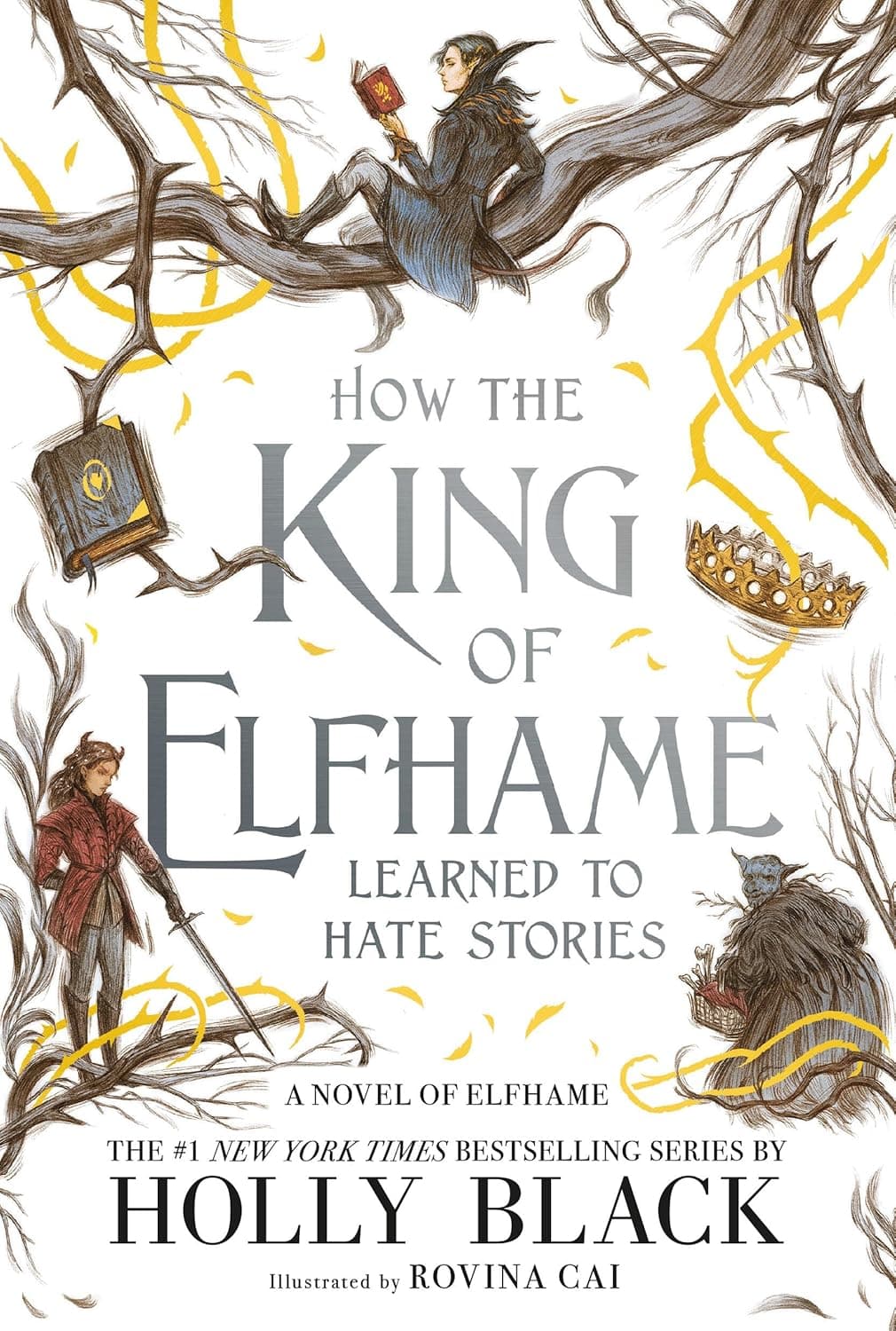
How the King of Elfhame Learned to Hate Stories enriches the Folk of the Air trilogy by reframing its most magnetic figure from the inside out. Instead of advancing plot, it deepens motive, showing how a neglected prince crafted a glamorous cruelty—and how that glamour could be redirected toward care. Holly Black’s lyrical prose, paired with Rovina Cai’s shadowed, sinewy illustrations, creates a hybrid of story and art that feels like a grimoire: tactile, intimate, and a little dangerous. As a companion novella, it exemplifies how YA fantasy can use side texts to complicate a central romance, sharpen moral ambiguity, and make a familiar world feel newly enchanted.
Critical Reception
Critics and fans praised the novella for its emotional precision and necessity within the series, calling it a satisfying lens on Cardan that reshapes The Cruel Prince. Reviewers highlighted the prose’s poetic bite and the illustrations’ gothic beauty, noting how seamlessly image and text converse. A finalist for the 2020 Goodreads Choice Awards for Best Young Adult Fantasy & Science Fiction, it’s widely considered essential reading for anyone invested in Cardan, Jude, and the perilous magic of Elfhame.