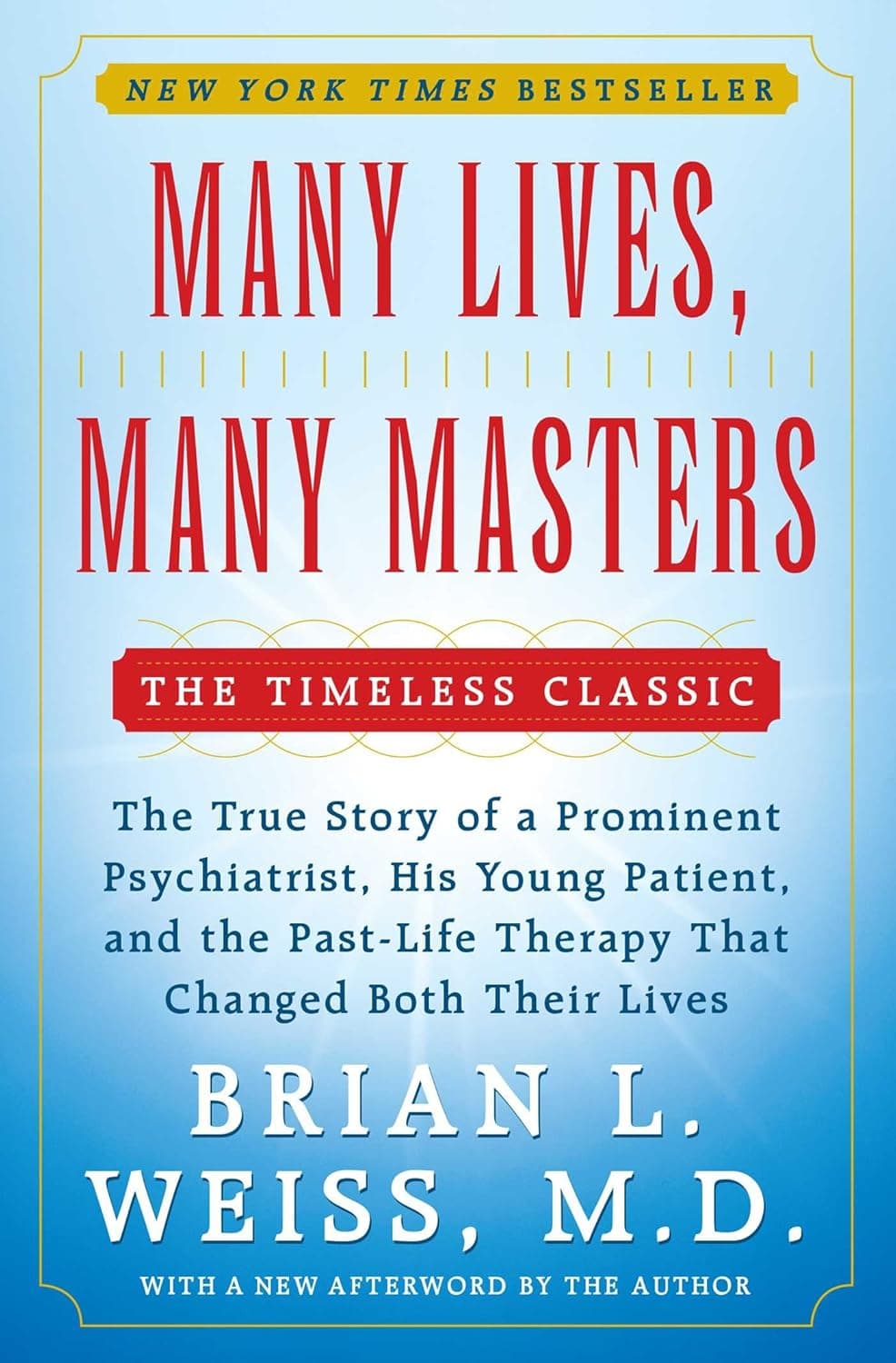
Catherine
Quick Facts
- Role: Central patient and protagonist whose therapy drives the book’s revelations
- First appearance: Chapter 1
- Age/Occupation: 27-year-old laboratory technician; part-time swimwear model
- Key relationships: Dr. Brian L. Weiss (therapist and eventual student), The Masters (spiritual entities speaking through her), Stuart (karmic love interest), Dr. Edward Poole (referring physician), her father (source of childhood trauma)
- Physical description: “An extraordinarily attractive woman” with blond hair and hazel eyes (Chapter 1); as her fears dissolve, she’s described as “radiant,” her serenity becoming outwardly visible
Who They Are
At the heart of the narrative, Catherine is both patient and catalyst. She arrives gripped by relentless phobias that conventional therapy can’t touch. Hypnosis unlocks vivid past-life memories and, between lives, messages from otherworldly teachers. Her regressions free her from fear; her transmissions reshape her doctor’s worldview. Catherine’s quiet sincerity—no background in metaphysics, no craving for attention—anchors the book’s most extraordinary claims in the ordinary: a patient simply trying to get well.
Personality & Traits
Catherine’s defining trait is the integrity of her experience: she doesn’t seek the mystical; it finds her. Her arc moves from paralyzing anxiety to grounded tranquility, with each past-life insight producing a measurable change in the present.
- Initially anxious and fearful: Terrified of water, choking, planes, darkness, and death; she even sleeps in a closet for safety (Chapter 1).
- Eager, disciplined patient: “Verbal, capable of insights, and extremely eager to get well” (Chapter 2); she consents to hypnosis despite fear.
- Simple, unassuming credibility: Raised conservative Catholic, “a relatively simple and honest person” (Chapter 8), lending weight to her precise historical impressions and consistent details.
- Emergent intuition and psychic acuity: Develops precognitive dreams and startling accuracy, including picking every horse-race winner to convince her skeptical father (Chapter 3).
- Transformed serenity: By the end, she radiates composure and meaning; the loss of her death-fear gives her life focus and calm.
Character Journey
Catherine begins as a mystery to herself: symptoms without cause, a life narrowed by terror. The first regression cracks the code—reliving a death by drowning as Aronda erases her aquaphobia. Session by session, this causal symmetry repeats: each remembered trauma maps to a present fear and lifts it. Then her healing deepens. In the “in-between” states after death scenes, she channels teachings from entities who call themselves the Masters. Catherine does not consciously recall these messages, yet their wisdom accelerates her recovery and reframes her life as a curriculum of the soul. By the final session, she has moved from survival to purpose, embodying the book’s vision of Spiritual Growth and the Purpose of Life—healing not as symptom relief alone, but as the soul learning through experience.
Key Relationships
-
Dr. Brian L. Weiss: Their bond evolves from standard therapy to a reciprocal apprenticeship. He guides her through regressions; she, in trance, teaches him—delivering verifiable knowledge about his family and a metaphysical framework that shifts his career and life. The power dynamic inverts: patient as healer, doctor as witness and student.
-
The Masters: Catherine is their conduit, not their disciple. In trance, her voice changes tone and cadence as the Masters deliver teachings on learning, death, and the soul’s continuity. The relationship is impersonal yet intimate: they use her body as a bridge between realms, while protecting her conscious mind from the burden of remembering.
-
Stuart: Their affair is painful and destabilizing in the present, but regressions reveal a karmic thread running through multiple lifetimes—including one in which he kills her. That knowledge doesn’t romanticize their bond; it contextualizes it. Understanding the pattern allows Catherine to loosen attachment and heal, an illustration of Karma and Interconnected Souls.
-
Dr. Edward Poole: His instant rapport with Catherine makes intuitive sense once a regression reveals he was her loving father in another life. The recognition recasts professional courtesy as an old, benevolent familiarity.
-
Her father: In this life, he’s a source of buried trauma and difficulty. Through regression and the Masters’ teachings, Catherine reframes him not as enemy but as a fellow soul playing a hard role in her education—making forgiveness possible.
Defining Moments
Catherine’s story advances through precise breakthroughs where memory, emotion, and physiology realign.
-
The first regression to Aronda (Chapter 2): She sees “white steps” and a rough sack-dress, then relives drowning as her child is torn away. Why it matters: Her aquaphobia disappears immediately, inaugurating the pattern—past-life cause, present-life cure.
-
Revelation about Dr. Weiss’s family (Chapter 4): In an in-between state, she relays specific, private details about Avrom (Weiss’s father) and Adam (his deceased infant son). Why it matters: This shatters Weiss’s skepticism and catalyzes his professional pivot, the book’s signature Transformation from Skepticism to Belief.
-
The sealed-cave death (Chapter 7): Catherine dies paralyzed and alone in a hot, dark cave. Why it matters: Her claustrophobia lifts, reinforcing the precise one-to-one mapping between remembered death and present symptom.
-
The anesthesia recall (Chapter 10): She remembers surgeons discussing choking risk during a past operation. Why it matters: Identifying this subliminal imprint instantly resolves her choking phobia and shows that not every fear is karmic—some are rooted in this-life suggestion.
-
The final session (Chapter 14): The Masters announce their teachings through her are complete and direct Weiss to rely on his intuition. Why it matters: Marks Catherine’s graduation from treatment and Weiss’s assumption of independent spiritual responsibility.
Essential Quotes
Her life had always been burdened with fears. She feared water, feared choking to the extent that she could not swallow pills, feared airplanes, feared the dark, and she was terrified of dying. In the recent past, her fears had begun to worsen. (Chapter 1)
This establishes the stakes: a life hemmed in by irrational terror. It primes the reader to measure the therapy’s success not by abstract insights, but by concrete relief from these paralyzing symptoms.
“I see white steps leading up to a building, a big white building with pillars, open in front. There are no doorways. I’m wearing a long dress ... a sack made of rough material. My hair is braided, long blond hair.” (Chapter 2)
The sensory specificity—architecture, texture, hairstyle—grounds her regression in vivid detail. Such precision undercuts the idea of vague fantasy and signals the therapeutic power of fully embodied memory.
“I drown; the water chokes me. I can’t breathe, can’t swallow . . . salty water. My baby is torn out of my arms.” (Chapter 2)
This moment fuses physical sensation with emotional trauma, linking death by drowning to her lifelong aquaphobia and choking fear. The immediacy of the language mirrors how the body stores and releases fear through relived experience.
“Our task is to learn, to become Godlike through knowledge. We know so little. You are here to be my teacher, I have so much to learn. By knowledge we approach God, and then we can rest. Then we come back to teach and help others.” (Chapter 3)
Here the Masters spell out the book’s pedagogy: life as a school, knowledge as spiritual ascent, service as the endpoint. The quote also foreshadows the role reversal in therapy—Weiss becoming the student through Catherine.
“Our body is just a vehicle for us while we’re here. It is our soul and our spirit that last forever.” (Chapter 10)
This encapsulates Catherine’s transformation: losing the fear of death by relocating identity in what outlasts the body. It also explains her new serenity—if the vehicle is temporary, the journey can be faced without terror.
Who Catherine Ultimately Represents
Catherine becomes a symbol of ordinary transcendence: someone without esoteric training who nonetheless accesses extraordinary wisdom. Her healing demonstrates that understanding our continuity beyond death dissolves fear and reorients life toward meaning. As a catalyst for Weiss’s awakening and a case study in experiential spirituality, she bridges clinical science and mystery—and does so with the quiet authority of someone who simply got better.