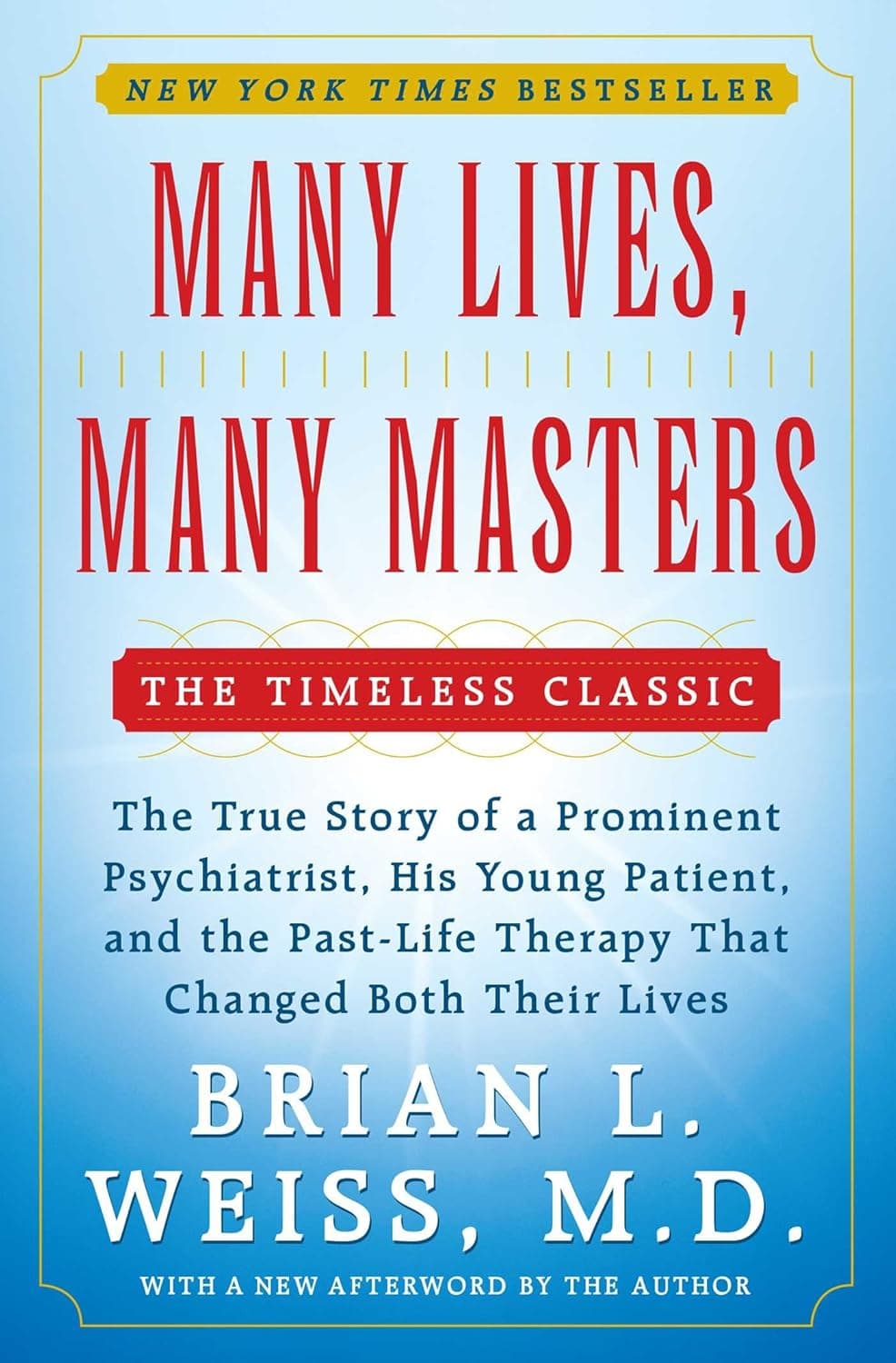
Many Lives, Many Masters transforms a single patient’s treatment into a sweeping meditation on what life is for and what lies beyond it. Through Catherine’s hypnotic regressions and Dr. Brian Weiss’s gradual awakening, the book weaves therapeutic breakthroughs with metaphysical claims, reframing fear, love, time, and identity as parts of a continuous spiritual education.
Major Themes
Reincarnation and Past Lives
The book’s bedrock claim is that the soul returns again and again to new bodies to learn, heal, and evolve. Past-life memories surface not as doctrine but as clinical data that unlock present symptoms: Catherine’s drowning as Aronda in 1863 B.C. explains her water phobia, Johan’s throat-slitting mirrors her choking fear, and Christian’s burned hand resurfaces as dream-fragments in the present (Chapter 1-5 Summary; Chapter 6-10 Summary). The “in-between state,” suffused with light, functions as a spiritual home where lessons are reviewed and future lives planned—suggesting continuity, not rupture, between incarnations.
Spiritual Growth and the Purpose of Life
Earthly life operates as a classroom for the soul, where love, charity, faith, and hope are learned through experience, loss, and repair. The Masters declare that knowledge and virtue draw us closer to the divine, after which we return to teach others; Catherine’s lifetimes model this ascent as she releases resentment and fear and gains compassion and balance. Dr. Weiss’s purpose expands accordingly—from psychiatrist to messenger—suggesting that personal healing is inseparable from sharing wisdom.
Immortality and the Fear of Death
Death becomes a threshold rather than an obliteration—one phase in an unbroken continuity of consciousness. As Catherine repeatedly re-experiences dying and the serene state beyond, her terror dissolves; Dr. Weiss, hearing from his deceased father Avrom and infant son Adam, likewise loses the dread of nonexistence (Chapter 11-15 Summary). The promise that “there is no end” reframes how one lives now—less fear, more meaning.
Transformation from Skepticism to Belief
Structured as a conversion narrative, the book follows a rigorously trained doctor from empirical doubt to spiritual acceptance. Crucial to this shift are verifiable details the Masters reveal—intimate facts Catherine could not know—that pierce Weiss’s methodological armor (as he declares in the Preface). By the end, he risks professional standing to advocate for a paradigm that better fits the evidence before him.
Karma and Interconnected Souls
Actions echo across lifetimes, binding souls in evolving constellations of care, conflict, and duty. Catherine recognizes recurring companions—her niece Rachel as past daughter Cleastra; Dr. Edward Poole as her father in two lives; Stuart as the warrior who once killed her—suggesting relationships are assignments designed for mutual growth. Karma is not punishment but pedagogy: we return to rebalance what we have set in motion.
Supporting Themes
- The Limits of Traditional Science and Medicine: Catherine’s stalled progress in standard therapy contrasts with her rapid healing in regression, highlighting where conventional models fall short and where spiritual frameworks restore efficacy. Even Adam’s death, the Masters say, was meant to show Weiss that medicine’s scope is limited.
- The Nature of Time and Consciousness: Time flows by lessons, not strictly by clocks; consciousness proves larger than the brain, persisting in superconscious states under hypnosis and in disembodied intervals between lives. This fluidity underwrites both reincarnation and moral learning.
- Love and Relationships Across Lifetimes: If karma explains friction, love explains constancy. Bonds with spouses, friends, and family—such as Weiss’s devotion to his wife Carole or Catherine’s instant rapport with Dr. Poole—read as the deep memory of souls traveling together.
Theme Interactions
Reincarnation and Immortality reinforce one another: if we return, death cannot be final, and if consciousness endures, multiple lives become plausible. Spiritual Growth provides the why of repeated lives, while Karma supplies the how—lessons advance through the very ties and consequences we create. Catherine’s case drives Weiss’s Transformation from Skepticism to Belief: clinical impasses yield to past-life data, which in turn demand a broader ontology. Together, these themes convert fear into purpose: immortality removes dread; karmic bonds turn conflict into coursework; and spiritual education makes suffering intelligible—and reparable.
Character Embodiment
Catherine: As patient and protagonist, Catherine embodies Reincarnation, Karma, and Spiritual Growth. Her specific lifetimes map directly onto present symptoms, and her calm after regression demonstrates how understanding immortality dissolves fear and frees compassion.
Dr. Brian L. Weiss: Dr. Brian L. Weiss personifies the Transformation from Skepticism to Belief. His professional rigor gives the narrative credibility; his grief for Avrom and Adam makes Immortality personal, while his decision to publish extends Spiritual Growth into service.
The Masters: Speaking through Catherine, the Masters articulate the metaphysical scaffolding—Immortality, the soul’s Purpose, and the moral logic of Karma. They knit Catherine’s memories into a coherent doctrine and redirect Weiss’s vocation toward teaching.
Stuart and Dr. Edward Poole: Stuart dramatizes karmic entanglement and the need to transform violence into understanding across lives. Dr. Edward Poole, a benefactor in this life and a father in others, illustrates how supportive bonds recur to advance shared lessons.
Thematic Development
- Problem and Failure: The book opens with clinical mystery—severe phobias unresponsive to standard therapy—positioning the limits of conventional medicine as the initial obstacle.
- Discovery of Reincarnation: Hypnosis unexpectedly surfaces past-life scenes, shifting the search from childhood trauma to multi-life causation and inaugurating a new therapeutic strategy.
- Entrance of Purpose: With the Masters’ teachings, themes of Spiritual Growth, Immortality, and Karma crystallize, and Weiss’s Transformation begins as personal revelations unsettle his materialism.
- Deepening and Integration: Successive regressions broaden the map of Catherine’s soul-group and lessons, while Weiss and Catherine incorporate this worldview into daily choices and relationships.
- Resolution and Universalization: By the Epilogue, Catherine is healed, Weiss is committed to public advocacy, and the message expands from case study to universal counsel.
Universal Messages
- Life has purpose: Each incarnation offers chances to learn, love, and refine the soul.
- We are immortal beings: Death is a passage; identity persists and reunions are real.
- Love outweighs materialism: What endures is what we’ve learned and the love we’ve given.
- We are connected: Our actions bind and teach us across time; compassion is a responsibility.
- Fear is a misunderstanding: Knowing our immortal nature frees us to live with courage and peace.