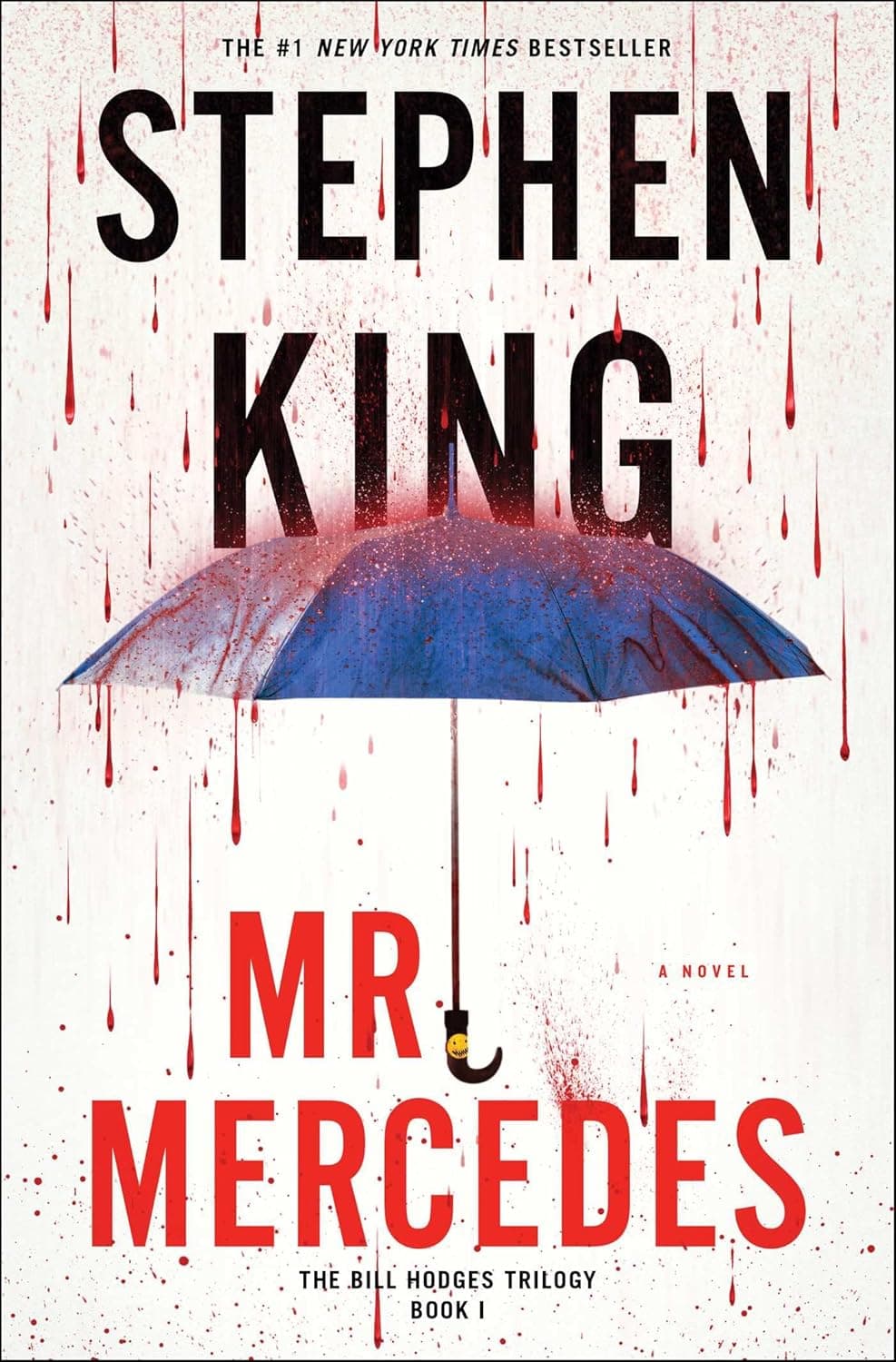
Opening
A retired cop closes in on the killer as clues finally align: a workplace lead, a grinning ice-cream disguise, and a weaponized memory of guilt. While an unrelated police sting implodes elsewhere, a makeshift trio drives a gray Mercedes straight to the suspect’s door, ready to turn his own terror back on him.
What Happens
Chapter 111: STORE PERSONNEL
K. William Hodges walks into Discount Electronix and quietly rattles the service desk. Freddi Linklatter, sardonic and sharp-eyed behind a game screen, sees the photo he slides across and instantly tags the face: Brady Hartsfield. To her, Brady is “peekee-yoolier,” and—more telling—“freaky about his mom,” a needle that draws Hodges’s attention like a magnet.
Anthony “Tones” Frobisher, the manager, adds that Brady called in sick with the flu. When Hodges identifies himself and asks for an address, Freddi beats her boss to the punch, keying through employee records to produce 49 Elm Street. As Hodges heads out, Freddi’s parting jab about Brady’s mother lingers, foreshadowing the warped domestic space Hodges is about to enter.
Chapter 112: The Ice Cream Man
Outside, Hodges is intercepted by a breathless Jerome Robinson and a tight-wound, determined Holly Gibney. Jerome drops the bomb that ties everything together: Brady works a second job as the Mr. Tastey ice-cream man, rolling through Hodges’s neighborhood on his route. The mask of a cheerful vendor crystallizes the novel’s portrait of The Banality of Evil—a killer hiding in plain sight, ringing a bell no one hears correctly.
The revelation sparks a brutal flashback. Hodges remembers Mrs. Melbourne, the neighbor he once dismissed, who said the ice-cream man was “suspicious” and “always around.” A wave of Guilt and Responsibility hits—would Janelle "Janey" Patterson still be alive if he had listened? Then Hodges notices their ride: Olivia Trelawney’s gray Mercedes. He decides to use it as a psychological weapon—an apparition Brady can’t ignore. Holly refuses to be sidelined, threatening to call the police if she’s left out. Hodges relents. The trio becomes a unit, headed for Elm Street.
Chapter 113: Toody and Muldoon
Across town in Lowtown, Officers Laverty and Rosario cruise past cornerboys who scatter on instinct. They trade easy chatter about lunch, the rhythms of patrol steady and unremarkable—until they clock a lone white guy slipping out of King Virtue Pawn & Loan with a florist’s box he can barely handle, parked crooked at a hydrant.
As the man fumbles for his keys, the box tilts and a tube slides into view—long, military, unmistakable. Laverty, an Iraq vet, knows the shape before his brain completes the word: RPG. In a heartbeat, lunch talk becomes a live-fire scenario.
Chapter 114: The Horse Has Left the Barn
Laverty and Rosario move. Guns out. Orders clear: drop the box, hands on the van. The suspect freezes, then obeys; the box splits to reveal a Russian-made antitank grenade launcher. Before the officers can process the win, the street floods with agents in ATF jackets, their operation snapping into place as if conjured out of the air.
Agent James Kosinsky breaks the news: the local collar has just blown a long-running federal sting on an illegal arms pipeline. “The horse has left the barn,” he says, resigned, and ushers the officers inside to gawk at a cache big enough to arm a neighborhood. The official case balloons to spectacle even as another hunt, smaller and more personal, accelerates elsewhere.
Chapter 115: A RICO Car
Hodges, Jerome, and Holly ease the gray Mercedes to the curb at 49 Elm. Hank Beeson, the neighborhood’s vigilant observer, drifts over. Hodges flashes an old badge and asks after Brady. Beeson says Brady isn’t home, but his mother’s car is in the drive—and he hasn’t seen her all day.
Why are “city cops” in a Benz? Holly fields it without blinking: it’s a “RICO car,” she says, seized from racketeers. Satisfied, Beeson retreats to his window perch. Hodges tells Jerome and Holly to stay put and steps toward the house. The place feels hollow, drained. From the passenger seat, Holly confirms the feeling: “There’s no one home.”
Character Development
The investigation hardens into pursuit, and the trio clarifies into a team defined by trust, improvisation, and shared risk. Personal stakes surge to the surface, reshaping tactics and resolve.
- K. William Hodges: Guilt over Janey turns methodical sleuthing into a relentless hunt; he weaponizes the gray Mercedes to unnerve his quarry and accepts Holly and Jerome as full partners.
- Holly Gibney: She moves from anxious bystander to assertive co-strategist, driving the Mercedes to the scene, issuing an ultimatum to stay involved, and coolly selling the “RICO car” cover.
- Jerome Robinson: His research cracks the surveillance mystery with the Mr. Tastey reveal; his urgency and loyalty anchor the team’s speed and focus.
- Brady Hartsfield: Absent yet vividly sketched through others—odd at work, fixated on his mother, and terrifyingly ordinary behind the mask of an ice-cream man.
Themes & Symbols
The narrative yokes intimate remorse to public threat. Guilt drives action—Hodges’s failure to heed a witness now feels like a hinge on which lives turned. That pressure refines his choices, pushing him toward bolder risks and a direct confrontation designed to seize the psychological high ground.
The ice-cream route refines the portrait of everyday monstrosity: the killer’s access depends on community trust and routine. The gray Mercedes, once a symbol of tragedy and shame, pivots into an instrument of counter-terror—a rolling reminder of the original crime turned back on its author. In the background, federal agents and their blown sting underscore the uneasy friction between nimble, personal pursuit and institutional machinery, cueing the question of Vigilantism and Justice Outside the Law. Freddi’s remarks about Brady’s mother hint at the roots of his pathology, tying his secrecy and rage to warped Dysfunctional Family Dynamics.
Symbols
- The gray Mercedes: grief transformed into leverage and intimidation.
- The Mr. Tastey truck: innocence repurposed as camouflage.
- The florist’s box: the banal container that hides catastrophic force.
Key Quotes
“Peekee-yoolier… and freaky about his mom.” Freddi’s language makes Brady memorable and unsettling in a single breath, nudging the investigation toward his home life. The line plants suspicion where the plot will soon go: the house on Elm Street and the relationship that formed him.
“Suspicious” and “always around.” Mrs. Melbourne’s dismissed observation returns as the keystone clue. It indicts Hodges’s earlier judgment and ignites the guilt that now propels him into riskier moves.
“Drop the box and put your hands on the van.” The clipped command captures the split-second pivot from routine patrol to high-stakes threat. It sharpens the contrast between the scripted precision of police procedure and the improvisation driving Hodges’s team.
“The horse has left the barn.” Agent Kosinsky’s wry verdict sums up institutional fallibility. The ruined sting becomes a thematic counterpoint, showing how even vast systems can fumble the moment.
“RICO car.” Holly’s quick lie signals her evolution from hesitant to decisive. It also threads legality into their vigilante posture, dressing a rogue move in the clothes of procedure.
“There’s no one home.” Holly’s intuition validates Hodges’s unease and paints the Hartsfield house as a stage set—emptied out, ominous, and ready for whatever act comes next.
Why This Matters and Section Significance
These chapters close the gap between suspicion and certainty. The surveillance mystery snaps into place with the Mr. Tastey reveal, and the gray Mercedes shifts from relic to weapon, telegraphing a strategy of psychological warfare ahead of the physical showdown. Holly’s emergence cements the trio’s dynamic just as official law enforcement becomes preoccupied and compromised elsewhere, isolating the protagonists by design. The result is a charged pivot from inquiry to confrontation, with guilt, disguise, and control at the center of the coming clash.