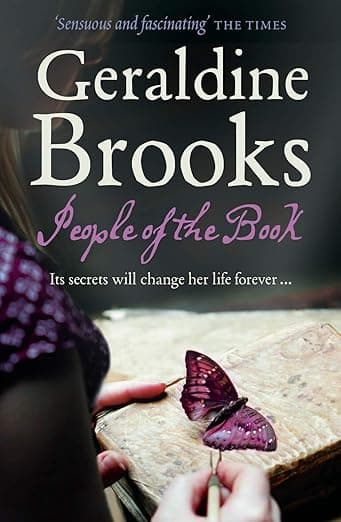
Opening
In London, conservator Hanna Heath unravels a buried family secret just as a forensic clue in the Sarajevo Haggadah points backward through time. The story then shifts to Zahra bint Ibrahim al-Tarek, a Muslim slave-artist in fifteenth-century Seville, whose love, loss, and art become the hidden heartbeat of the book. Across centuries, grief and creation braid together, exploring Love, Loss, and Family and Identity and Belonging.
What Happens
Chapter 9: London, Spring 1996
At the Tate, Hanna stares at a painting by Werner Sharansky—her father. The shock that he is a recognized artist, a truth her mother Lola concealed, cracks her composure. She breaks down, mourning the relationship she never had and raging at the theft of that knowledge. Retreating to a friend’s cottage in Hampstead, she forces herself back to work on the Haggadah catalog, vowing to write a “gripping narrative” honoring the “people of the book,” and recommitting to The Power and Endurance of Stories and Artifacts.
The investigation continues. An express letter from Frau Zweig in Vienna contains a nineteenth-century photo of a woman wearing an earring that is clearly one of the Haggadah’s missing silver clasps. Hanna sends a white hair from the manuscript to Scotland Yard; Clarissa Montague-Morgan explains that without a root, DNA is impossible, but she will test it. Hanna repeatedly tries to reach Ozren Karaman in Sarajevo. When a friend finally answers, Hanna learns that Ozren’s son, Alia, has died of an infection—and that Amitai Yomtov, Hanna’s Israeli colleague, has been to Ozren’s apartment under suspicious circumstances.
Shaken, Hanna books a flight to Bosnia, telling herself she needs to learn what Amitai is doing, even as her concern for Ozren drives her. The choice embodies Courage and Moral Choice amid grief and political volatility. Just as she finalizes her plans, Clarissa calls back: the white hair is from a cat—and it carries particles of strong yellow dye, a rare finding that forges a direct bridge to the next chapter and The Relationship Between Past and Present.
Chapter 10: A White Hair (Seville, 1480)
The narrative shifts to Zahra, a gifted Muslim artist enslaved in the household of Netanel ha-Levi, a Jewish doctor in Seville. In flashback, Zahra remembers the attack on her family’s pilgrimage caravan, her father’s murder, and her own sale—disguised as a boy—to Hooman, a master illuminator. When Hooman discovers she is a girl, he rapes her and dispatches her to the emir’s palace to paint for his new Christian captive-wife, Nura (Isabella). Isolated together in the harem, Zahra and Nura develop an intimate, tender bond. Ordered by the emir to paint Nura naked, Zahra refuses, transforming her art into a private act of protection and defiance.
As al-Andalus destabilizes, Nura—pregnant and fearful for her brother Pedro and her unborn child—makes a brutal calculation. To protect those she loves, she “gifts” Zahra and Pedro to Netanel ha-Levi, trusting his standing will keep them safe regardless of who takes the city. Zahra feels abandoned yet understands the logic. In the doctor’s home, she is treated kindly, her true name restored, and her artistry valued as she illustrates medical texts, a quiet reconnection to her father’s world.
Seeing the doctor’s deaf-mute son, Benjamin, struggle to understand ritual and story, Zahra begins a secret project: a painted book to teach him the Passover narrative—an act of cross-faith care and the seed of the Sarajevo Haggadah. She uses her last precious pigments, including saffron’s vivid yellow, and the finest tools she knows: single-hair brushes fashioned from the white hairs of Hooman’s cat. She paints the plagues; for the death of the firstborn, she renders a dark shape over children’s mouths, inspired by iconoclasts’ defacements—resolving the future mystery of the “insect wing.” Finally, she paints herself into the Seder scene and signs with a single cat-hair stroke, stitching her life into the book forever and embodying Religious and Cultural Coexistence and Conflict.
Character Development
Hanna’s professional rigor collides with personal loss, pushing her past detachment and toward human risk. Zahra’s voice reveals an artist whose craft becomes survival, rebellion, and love.
-
Hanna Heath:
- Faces the truth about her father and the depth of her mother’s secrecy, stripping away her emotional armor.
- Reframes scholarship as storytelling, aiming to honor lives behind artifacts.
- Chooses to fly to Sarajevo, signaling expanding empathy and a willingness to act in morally fraught terrain.
-
Zahra bint Ibrahim al-Tarek:
- Endures enslavement, rape, and separation without relinquishing her moral core or artistic integrity.
- Turns her art into protection for Nura and education for Benjamin.
- Claims authorship and presence by inserting herself into the Haggadah, quietly asserting agency across faiths.
Themes & Symbols
The chapters fuse scientific analysis with intimate testimony, collapsing distance between centuries. The material trace—a cat hair dusted with yellow dye—opens Zahra’s world to the reader, dramatizing how physical remnants carry human stories across time. In London, Hanna’s grief exposes the costs of secrecy and the fragile bonds of kinship; in Seville, Zahra’s compassion for a Jewish child and love for a Christian woman illuminate a fleeting, dangerous space where cultures meet. Through both strands, the Haggadah becomes a vessel for memory, proving that art and objects outlast their makers and continue to speak.
Symbols:
- The white cat hair: A tangible thread to Zahra’s brush and studio, literal evidence of her hand and the life inside the manuscript.
- The butterfly wing clasp: A fragment repurposed as jewelry, mirroring the book’s scattered caretakers and the piecemeal nature of historical recovery.
- The “insect wing”: Zahra’s Angel of Death taking breath from the firstborn—an artist’s solution to teaching a hard truth to a child, misread for centuries.
Key Quotes
“I cannot think the doctor or his God will be offended by my pictures.” Zahra articulates a higher ethic of care: art in the service of understanding transcends boundary lines. Her confidence reframes sacred art as a shared human language and justifies her transgressive authorship.
She is determined to make it a “gripping narrative” that honors the “people of the book,” Hanna renounces sterile scholarship in favor of story. The phrase marks a pivot from conservation to witness, aligning her work with the lives—often marginalized—embedded in the Haggadah.
Why This Matters and Section Significance
These chapters reveal the Haggadah’s origin and resolve key mysteries—the cat hair, the yellow dye, the “insect wing”—while delivering a profound twist: its illuminator is a Muslim woman. The revelation powerfully reframes the manuscript as a testament to interfaith care and the survival of a silenced artist’s voice. Juxtaposing Hanna’s forensic present with Zahra’s lived past transforms clues into a life story, deepening the stakes of Hanna’s journey. Her flight to Sarajevo and the shadow of Amitai Yomtov set up ethical choices ahead, while Zahra’s signature in paint and cat hair secures her legacy, asking the reader—and Hanna—to see the book not only as an object of study, but as the enduring record of love, loss, and courage.