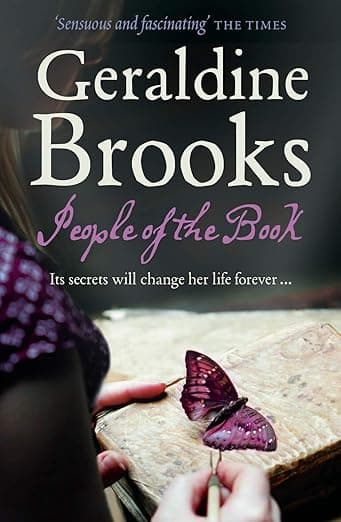
Opening
In Boston, Hanna Heath confronts a shattering family revelation just as her investigation into the haggadah yields a pivotal forensic clue. Centuries earlier, in 1492 Tarragona, a quiet daughter risks everything to save a child and a book as Spain moves to expel its Jews. The past leaves a literal trace on the page that Hanna can read five hundred years later.
What Happens
Chapter 7: Boston, Spring 1996
Over dinner with Raz, Hanna vents about the haggadah’s unsolved mysteries, especially the bloodstain. Raz spins romantic backstories; Hanna counters with her mother’s maxim to “look for a horse before you go searching for a zebra.” Raz observes that the book, having survived the Inquisition, the Nazis, and the Balkan wars, stands witness to humanity’s habit of demonizing “the other.” Outside, he makes a clumsy pass—his wife is out of town, so why not sleep together? Hanna snaps, furious at the betrayal, and goes home, where she later dreams of Ozren Karaman, the librarian from Sarajevo, with aching tenderness.
A phone call jolts her awake: her mother has been in a serious car crash. At the hospital, Hanna learns Delilah Sharansky, the 81-year-old driver, has died, and her mother—spleen ruptured—needs emergency surgery. After a successful operation, Hanna watches the formidable neurosurgeon, groggy and vulnerable, drift in and out. By morning, her mother’s brusque authority returns. She orders Hanna to attend the shivah for Delilah Sharansky. When Hanna asks why, her mother says, “Delilah Sharansky was your grandmother.”
Reeling, Hanna hears the story she has never been told. Her father, Aaron Sharansky, an acclaimed Australian artist, fell deeply in love with Sarah Heath. When a benign brain tumor threatened Aaron’s vision, Sarah referred him to her mentor for risky surgery. He died from post-op complications. Sarah was four months pregnant. Grief and guilt silenced her; her daughter’s resemblance to Aaron was too painful to bear. Hanna attends the shivah, meets her uncle and cousins for the first time, and feels simultaneous belonging and fury at years stolen. She presses on with work, flying to London. On the plane, she opens Raz’s note: the salt crystals on the haggadah are sea salt, not rock salt—a precise clue that points to the next chapter of the book’s journey.
Chapter 8: Saltwater (Tarragona, 1492)
In Tarragona, David Ben Shoushan, a pious sofer, buys a set of luminous miniatures from a deaf-mute refugee and plans to bind them into a haggadah as a wedding gift for his wealthy nephew. The gift will honor the family, secure patronage, and improve the dowry of his shy daughter, Ruti Ben Shoushan, whom he calls “Sparrow.” News shatters their household: David’s estranged son, Reuben—now Renato after converting to marry his Christian wife, Rosa—has been seized by the Inquisition for “Judaizing.”
While Renato is tortured, Ruti’s hidden life comes into view. Outwardly meek, she studies Kabbalah in secret and trades sex with Micha, a married bookbinder, for access to forbidden texts. Out of pity and love, she returned Renato’s old phylacteries to him. Desperate to save his son, David strips the silver from his wife’s cherished ketubah case to adorn the haggadah, hoping its splendor will move his wealthy brother Joseph to pay a ransom. Joseph arrives with worse news: the monarchs are set to issue the Alhambra Decree, expelling all Jews. Every coin he has is pledged to one last, unlikely bribe.
Broken by torture, Renato identifies “Sparrow” as the one who gave him the phylacteries. Soldiers storm the bindery. Micha lies to protect Ruti; she flees. Failing to find her, the soldiers beat David to death. Ruti hides in a childhood cave and discovers Rosa there, terrified and in labor. The baby boy seems stillborn; Rosa, numb with trauma, is relieved. Ruti carries the infant out to bury him—but he breathes. In defiance and love, she takes the child to the sea and immerses him, converting him to Judaism. Saltwater splashes the haggadah in her satchel. Ruti resolves to escape Spain with the baby and the book, naming the boy for her father.
Character Development
Across these chapters, grief redraws family maps and reveals hidden strength. Private histories spill into public choices, pushing characters toward acts of loyalty, betrayal, or courage.
- Hanna Heath: Gains a father, a grandmother, and an entire lineage in one blow, which recasts her cool professionalism as a shield against lifelong abandonment. She chooses work over bedside vigil—her familiar coping strategy—and claims the sea-salt clue as a lifeline back to meaning.
- Dr. Sarah Heath: Her authority cracks to reveal a woman driven by love and ruinous guilt. The admission that her own referral led to Aaron’s death reframes her coldness as self-punishment.
- Ruti Ben Shoushan: Transforms from overlooked daughter to guardian of a child and a culture. Her clandestine studies and affair lead to a defining act of Courage and Moral Choice.
- David Ben Shoushan: Pious, proud, and rigid, he still sacrifices family treasures to save a son—too late. His death becomes the crucible for Ruti’s resolve.
- Renato (Reuben): A converso crushed by torture, he betrays his sister to stop the pain, embodying moral ambiguity under duress.
- Raz: A romantic and incisive observer who can read the big picture—and still fail intimacy and loyalty in the moment.
- Micha: Complicit and protective at once; his lie buys Ruti time to flee.
- Ozren Karaman: Appears only in Hanna’s dream, signaling her longing for connection that her waking life resists.
Themes & Symbols
The chapters braid Love, Loss, and Family with Identity and Belonging. Hanna’s origin story reframes her life’s solitude as the aftermath of a great love curtailed by tragedy; her sudden kinship echoes the fragile, contested belonging of the Ben Shoushans as Spain declares them strangers. Both timelines show how love motivates risk—Sarah’s choice to refer Aaron to the best surgeon; David’s dismantling of a cherished heirloom; Ruti’s rescue of a condemned child.
The haggadah embodies The Power and Endurance of Stories and Artifacts. It carries David’s script, Ruti’s flight, and a film of sea salt across centuries, turning private grief into evidence. Saltwater becomes a double symbol: tears and purification, loss and birth. On Ruti’s page, the sea writes itself into the book, a briny residue of faith that science can later read.
Key Quotes
“Look for a horse before you go searching for a zebra.”
Hanna cites her mother’s credo to resist romantic speculation. The line captures the book’s tension between empirical method and historical imagination—and foreshadows how a simple, testable clue (sea salt) will unlock a complex past.
“Delilah Sharansky was your grandmother.”
This blunt sentence detonates Hanna’s identity. It collapses distance between professional inquiry and personal history, forcing Hanna to confront the cost of her mother’s secrecy and the sudden existence of a family she never knew.
The book survives to witness humanity’s urge to demonize “the other.”
Raz’s observation reframes the haggadah as moral witness, not just artifact. It links inquisitors, Nazis, and nationalist militias in a grim pattern that the book endures—and that the narrative aims to expose.
Why This Matters and Section Significance
These chapters shift Hanna from detached conservator to implicated heir. Her discovery electrifies the investigation: the haggadah is not only her project but the vessel of her newly found lineage. The sea-salt clue carries us back to Ruti’s act at the shoreline, where defiance, grief, and love coalesce into a ritual that leaves a measurable trace.
Saltwater anchors The Relationship Between Past and Present. A few drops on a page become the bridge between a girl’s midnight flight in 1492 and a conservator’s lab in 1996. Ruti’s rescue of a child and a book ensures that story and bloodline outlive empire, turning survival into inheritance.