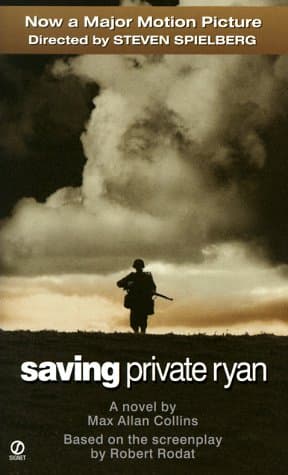
Opening
June 6, 1998. At the American cemetery in Normandy, an elderly veteran breaks from his family and falls to his knees before a hill of white graves, overcome by memory. The scene unfolds through his seven-year-old grandson Jimmy’s eyes, whose innocence sharpens the weight of what the old man carries—and what those fields of crosses mean. The pilgrim is later revealed to be Private James Francis Ryan, and this moment frames the story that follows.
What Happens
An elderly man—“Grandpa”—walks with his extended family through the St. Laurent Military Graveyard in Normandy. As they enter a “tunnel of green” hedgerows, he suddenly quickens his pace. The family breaks into an anxious pursuit, as if trying to “recapture him.” The hedgerows give way to a vast, geometric field of graves. The old man stops as though striking an “invisible brick wall,” sinks to his knees, and wheezes for breath.
From Jimmy’s vantage point, the moment confuses. He first thinks Grandpa has fallen, then realizes he is kneeling, as if in prayer. Jimmy stares out at what Grandpa sees: a rolling hill marked by a “sea of white crosses, interspersed with an occasional Star of David.” The sheer number stuns him—he feels as if “everybody on earth had died and been buried here.” When he looks back, Grandpa’s eyes are wide, “sad and happy at the same time,” as the family gathers to steady him and share the silence.
The prologue reveals itself as a present-day pilgrimage that unlocks a past. The kneeling veteran is later named as Private James Francis Ryan, the man whose rescue anchors the book’s central mission. Jimmy knows his grandfather fought in a war “here,” yet his child’s frame of reference slips—“He had heard of that war in Vietnam. But this was France.” That mismatch captures the gulf between living memory and inherited history, and it sets the tone of grief, gratitude, and the cost of survival that the rest of the narrative explores.
Character Development
The prologue crystallizes two perspectives: a survivor flooded by memory and a child trying to understand it. The grandfather’s urgency, collapse, and wordless prayer signal the weight he has carried for over fifty years. Jimmy’s literal, image-driven observations create a humane distance that deepens the emotional impact.
-
Private James Francis Ryan:
- Moves with startling urgency toward the graves, suggesting an unresolved pull toward the past.
- Kneels and weeps, revealing layers of grief, survivor’s guilt, and reverence.
- Exists first as an everyman veteran before his identity is named, universalizing his experience.
-
Jimmy:
- Misreads actions (falling vs. kneeling), showing the limits of his comprehension.
- Registers scale and pattern—an “amazing abstract design”—rather than historical detail.
- Represents later generations living in the peace purchased by others, yet distanced from its reality.
Themes & Symbols
The prologue grounds the book’s meditation on Sacrifice and Redemption. The cemetery itself is a ledger of lives given; the grandfather’s pilgrimage acknowledges a debt he can never fully repay. His survival—and the family standing with him—is implicitly measured against those stark rows, raising the question that shadows the narrative and comes to the fore in the Epilogue: what does it mean to “earn” the life that others died to secure?
The chapter also foregrounds the lasting psychological cost of war. Combat remains offstage, yet the old man’s breathless collapse and the “sea of white crosses” embody trauma that remains present tense for him. The child’s perspective amplifies this by withholding adult interpretation; the reader supplies the context, and in doing so feels the weight that Jimmy cannot.
Symbols:
- The White Crosses: Uniform, endless, both individual markers and a collective monument; precision set against the chaos that created them.
- The Grandfather’s Eyes: “Sad and happy at the same time,” holding joy for a life lived and sorrow for those who did not.
- The Generational Gap: Jimmy’s confusion—Vietnam vs. France—symbolizes memory’s erosion across time and the challenge of transmitting the meaning of sacrifice.
Key Quotes
“A sea of white crosses, interspersed with an occasional Star of David.”
The image reduces a global cataclysm to a single, overwhelming field. The crosses individualize each loss while their repetition compresses countless deaths into one devastating vista.
He stops “as if hitting an invisible brick wall.”
The “wall” is memory—a sudden, immovable force. It captures how trauma asserts itself physically, halting the body as the past rushes in.
His eyes seem “sad and happy at the same time.”
This paradox encodes the survivor’s condition: gratitude for family and life, grief for comrades, and the uneasy question of deserving those blessings.
“He had heard of that war in Vietnam. But this was France.”
Jimmy’s error exposes the gap between history learned and history lived. The line underscores how easily specifics blur for those not formed by them—and how hard it is to convey what truly happened.
The cemetery looks like an “amazing abstract design.”
Jimmy perceives pattern before meaning. The phrase emphasizes the distance between aesthetic order and the violent disorder that produced it.
Why This Matters and Section Significance
By beginning at the cemetery, the book declares its focus: not battles for their own sake, but the human cost they exact. The prologue reframes the mission to find Private James Francis Ryan as the origin of a lifelong reckoning carried into old age. It also builds dramatic irony—the reader knows Ryan survives—and shifts attention from whether the rescue succeeds to what it costs, what it means, and whom it obligates. The question that echoes from these graves drives the narrative forward: what happened on these shores to make this man who he is today?