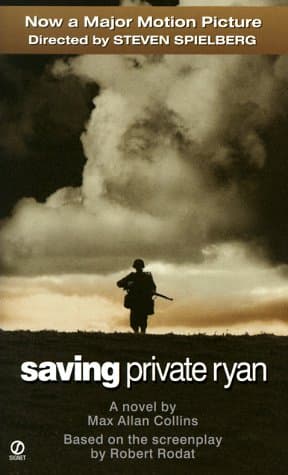
Saving Private Ryan
At a Glance
- Genre: War novel; literary novelization
- Setting: World War II Europe—Normandy coast and the French countryside—with a present-day frame at the Normandy American Cemetery
- Perspective: Close third-person following a small U.S. Army squad; framed by an elderly James Ryan’s point of view
- Author: Max Allan Collins, based on Robert Rodat’s screenplay
Opening Hook
A grave, an old man, and the question that has shadowed a lifetime: Did I earn it? Max Allan Collins’s novelization of Saving Private Ryan plunges straight into the furnace of D-Day and then narrows to a single, excruciating mission—to risk many for the sake of one. The story moves with both battlefield urgency and moral weight, measuring duty against conscience, orders against loyalty. By the end, the rescue becomes a reckoning, and the man saved is asked to carry the meaning of every sacrifice made for him.
Plot Overview
Act I: Omaha Beach and the Order
At the Normandy American Cemetery in the present, an elderly James Ryan falters before a white cross, and the narrative snaps back to June 6, 1944. The Allied landing explodes to life in the Prologue and the carnage of Omaha Beach, where Captain John H. Miller fights through machine-gun fire, surf, and shrapnel to claw a foothold with Sergeant Michael Horvath and a handful of survivors. The opening movement, expanded in the Chapter 1-5 Summary, shows war as raw, deafening, and indiscriminate. Far from the front, the War Department discovers that three of the four Ryan brothers have been killed. General George C. Marshall, invoking the Sullivan brothers, orders that the last surviving son, Private James Francis Ryan of the 101st Airborne, be found and sent home.
Act II: The Road to Ryan
Miller is handed the mission and a small squad from the remnants of his company: the sharp-mouthed Private Robert Reiben, hard-edged Private Anthony Caparzo, devout marksman Jackson, the Jewish Private Stanley Mellish, and the steady medic Corporal Edward Wade. They are joined by Corporal Timothy Upham, a gentle, bookish translator thrust into combat. Moving through hedgerows and ruined villages, they shoulder the suspicion that saving one man is a grotesque bargain. In Neuville, the squad’s first loss lands hard: Caparzo is killed by a sniper while trying to protect a child—an early signpost of the mission’s costs, explored in the Chapter 6-10 Summary.
Act III: Fault Lines and Resolve
Tracking rumors of paratroopers and scattered units, the squad stumbles upon a German machine-gun nest. Against angry pleas to bypass it, Miller orders the assault. The fight is won, but Wade dies in their arms, his last breaths spent asking for his mother—an unraveling described in the Chapter 11-15 Summary. Grief boils over. Reiben threatens to walk, and the squad fractures until Miller lays down his armor: he is a high school English teacher from Pennsylvania. The confession pulls them back together. If this mission has to make sense, Miller says, maybe saving one man can be the decent thing they salvage from hell.
Act IV: Ramelle—A Stand for One Bridge
They finally find Private James Francis Ryan defending a bridge in the town of Ramelle with a scratch team of paratroopers. Told of his brothers’ deaths and the order to go home, Ryan refuses to abandon “the only brothers I have left.” Miller decides to stay and help hold the bridge against a superior German force. In the brutal clash that follows, detailed in the Chapter 16-19 Summary, Jackson and Mellish are killed and the Americans are driven back. Miller is mortally wounded as Allied air support finally arrives to turn the tide. Grasping Ryan’s collar, he leaves a final command that is not an order but a burden: “Earn this.”
Coda
The Epilogue returns to the cemetery. James Ryan, old now and surrounded by his family, asks his wife if he has been a good man. He salutes Miller’s grave—five decades of gratitude and guilt distilled into a gesture.
Central Characters
Saving Private Ryan is powered by an ensemble whose conflicts and loyalties make the mission’s stakes personal. For full profiles, see the Character Overview.
- Captain John H. Miller: A calm, private commander whose shaking hand betrays the strain of leadership. He carries the war’s moral ledger inside him, searching for one decent thing to justify the cost of the others.
- Private James Francis Ryan: The man to be saved—and the man who refuses to be saved at the expense of his unit. Ryan’s refusal reframes the mission, insisting that duty can mean staying, not leaving.
- Sergeant Michael Horvath: Miller’s anchor. Tough, practical, and loyal, he reads the squad’s temperature and backs Miller even when the orders drag them toward ruin.
- Private Robert Reiben: The skeptic of the unit, quick to call out the mission’s logic. His bark masks a loyalty that hardens in the final stand.
- Private Anthony Caparzo: Brash and impulsive, he dies trying to protect a child—a fatal collision of compassion and battlefield reality.
- Private Stanley Mellish: Caught between identity and survival, he gives the squad its sharpest confrontation with the enemy’s inhumanity and his own vulnerability.
- Corporal Edward Wade: The beating heart. His death shatters the squad, exposing the fragility of the purpose holding them together.
- Corporal Timothy Upham: A civilian mind in a soldier’s world. His arc—from timid observer to a man forced to act—shows what war extracts from the unprepared.
Major Themes
-
The Brutality and Chaos of War The book doesn’t flinch. From the storm of Omaha Beach to the street fighting in Ramelle, violence is random, overwhelming, and indifferent. Collins uses close detail—sound, blood, confusion—to strip war of any illusion of glory.
-
The Value of a Single Life vs. The Greater Good Is one man’s rescue worth the lives risked to achieve it? The squad debates this in foxholes and ruins, and the novel refuses easy math. Miller’s hope—that saving Ryan can redeem the senselessness—becomes the moral center of the mission.
-
Duty and Orders Orders send the squad into danger, but duty evolves in the field. Miller obeys his superiors even when the purpose blurs, while Ryan defies a direct order because his duty binds him to the men at the bridge. The tension shows how obedience and conscience collide under fire.
-
Sacrifice and Redemption Sacrifice is everywhere—in medics who linger too long, in soldiers who hold a street a minute more. “Earn this” turns death into a charge for the living: meaning must be made, not assumed. The novel weighs whether redemption can be passed from the dead to the saved.
-
Brotherhood and Camaraderie Bonds form under pressure and fracture under grief, then reform stronger. The squad’s arguments and jokes are survival tools, and Ryan’s choice to stay with his unit honors a brotherhood forged not by blood, but by battle.
-
The Dehumanization of War and Shared Humanity War reduces people to targets and statistics, yet the novel keeps forcing humanity back into view—through small mercies, gallows humor, and memories of home. Upham’s journey, in particular, asks what it takes to kill—and what it costs to keep feeling.
Literary Significance
As a novelization, Saving Private Ryan demonstrates how prose can deepen a well-known story by opening the characters’ interior lives. Max Allan Collins preserves the film’s ferocity while leveraging the page to slow time, track thought, and widen context—especially within Miller’s quiet calculus of command. The result is not a mere transcription but a layered companion work: a war narrative that marries cinematic immediacy to literary introspection, expanding the emotional and ethical contours of an iconic tale.
Historical Context
The novel anchors its fiction in the realities of World War II, especially the shock of Omaha Beach rendered with granular fidelity. Its premise echoes the Niland brothers of New York, whose surviving son was sent home under the U.S. “sole-survivor policy.” That lineage grounds the mission in a real policy and a believable moral universe, lending the story both authenticity and weight.
Critical Reception
Though overshadowed by Steven Spielberg’s film, Collins’s adaptation is praised for retaining the movie’s intensity while enriching character psychology. Readers value how the book’s vantage point clarifies motive and fear, turning set pieces into lived experience. It stands as a high-water mark for tie-in fiction—artful, affecting, and fully capable of standing on its own.