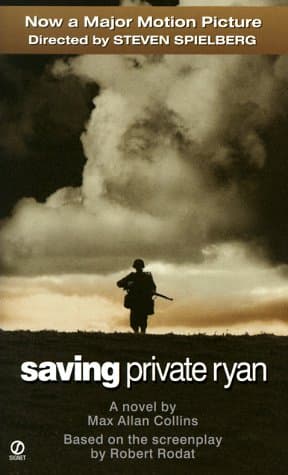
Max Allan Collins’s novelization of Saving Private Ryan turns a single, improbable assignment into a crucible for testing moral arithmetic and human endurance. As Captain John H. Miller leads a battered squad to rescue Private James Francis Ryan, the book confronts the sensory shock of modern combat while asking what a life is worth—and how meaning can be salvaged from chaos.
Major Themes
The Brutality and Chaos of War
The Brutality and Chaos of War strips combat of any romance, revealing it as a storm of randomness, terror, and dehumanization. From Omaha Beach’s carnage to Ramelle’s street fighting, plans dissolve into instinct, luck, and loss, leaving even the most capable soldiers trembling with the cumulative shock. The novel insists that survival often feels arbitrary, and that the mind’s coping—gallows humor, numbness, fixation—emerges as a response to ceaseless horror.
The Value of a Single Life vs. The Greater Good
The Value of a Single Life vs. The Greater Good frames the story’s central moral equation: risking many to save one. The squad’s grumbling “arithmetic” collides with Miller’s choice at the radar nest—endanger the few now to save the many later—and with Ryan’s refusal to abandon the bridge, which challenges any simple calculus. The novel suggests that policy, pragmatism, and conscience rarely align cleanly under fire.
Sacrifice and Redemption
Sacrifice and Redemption give shape to suffering, asking whether loss can yield meaning that outlasts battle. The squad’s deaths culminate in Miller’s charge to Ryan—“Earn this”—and the Epilogue recasts the mission as a lifetime of moral accounting. Redemption here is not triumph but responsibility: the living must prove worthy of the dead.
Supporting Themes
Duty and Orders
Duty and Orders interrogates obedience when commands seem morally or strategically suspect. The squad trudges forward because the order exists, even as their experience tells them the mission makes little sense; the friction between hierarchy and conscience undergirds every argument on the march and every choice in combat, feeding directly into the “one vs. many” dilemma.
Brotherhood and Camaraderie
Brotherhood and Camaraderie emerge less from sentiment than from mutual dependence, shared fear, and dark humor that keeps despair at bay. Arguments, mutiny scares, and grief feel familial because the squad becomes a found family—one Ryan chooses to honor by staying at the bridge—linking this theme to both sacrifice and leadership.
Leadership and Responsibility
Leadership and Responsibility isolate Miller in the paradox of command: he must carry out questionable orders, sustain morale, and decide who risks death—and why. His quiet tremor signals the cost of absorbing his men’s fear, anger, and hopes, while his plainspoken past as a schoolteacher underscores how ordinary people shoulder extraordinary burdens.
The Dehumanization of War and Shared Humanity
The Dehumanization of War and Shared Humanity shows soldiers reduced to roles, numbers, and gear—yet pierced by moments that insist on personhood. Confessions of life back home, doomed acts of compassion, and the moral collapse and resurgence of Corporal Timothy Upham reveal a struggle to remain human inside a machine built to erase identity.
Theme Interactions
- The Value of a Single Life vs. The Greater Good <-> Duty and Orders: A direct collision between moral arithmetic and military obedience; the squad’s skepticism tests the legitimacy of the command.
- Brotherhood and Camaraderie <-> Leadership and Responsibility: Affection and dissent pull against the leader’s duty to risk lives; trust fractures and heals as choices are explained or earned.
- The Brutality and Chaos of War -> Dehumanization of War and Shared Humanity: Relentless violence pressures soldiers toward numbness, yet flashes of empathy resist total erasure.
- Sacrifice and Redemption -> The Value of a Single Life vs. The Greater Good: The “math” is resolved not by logic but by meaning—sacrifice confers value on the saved life and binds the survivor to responsibility.
- Leadership and Responsibility -> Sacrifice and Redemption: Command demands costly decisions; the leader’s losses and last words become the moral compass the survivor must live by.
Character Embodiment
Captain John H. Miller embodies leadership under strain, weighing obedience against conscience while absorbing his men’s fear and fury. His steadiness, private doubts, and final injunction transform tactical decisions into a lifelong moral imperative for the survivor.
Private James Francis Ryan personifies the single life whose rescue tests military logic and human compassion. His refusal to abandon the bridge turns him from passive objective into moral agent, aligning brotherhood with duty and giving the squad’s sacrifice a purpose he must honor.
Private Robert Reiben voices the squad’s hard-nosed skepticism, challenging the mission’s “arithmetic” and forcing leadership to justify risk. His dissent keeps the Value-vs.-Greater-Good debate honest and human.
Private Stanley Mellish channels gallows humor and raw terror, illustrating how camaraderie and fear coexist on the edge of chaos. His close-quarters fighting exposes the war’s dehumanization at its most intimate.
Corporal Timothy Upham begins as an idealistic observer whose moral hesitation collapses under pressure, charting a painful journey from shared humanity toward complicity. His arc makes visible how brutality erodes conscience—and how responsibility arrives too late to save those already lost.
Private Anthony Caparzo represents compassion imperiled: his attempt to save a child meets the sniper’s cold calculus. His death fuses the chaos-of-war theme with the cost of humane impulse.
Corporal Edward Wade personifies sacrificial care; the medic’s loss at the radar nest marks leadership’s hardest choices and the squad’s deepest grief. His death crystallizes the link between responsibility, brotherhood, and redemption.
Sergeant Michael Horvath stands for loyalty forged in battle, the steady backbone that sustains the unit when faith in the mission wavers. His final stand at the bridge seals the squad’s purpose and anchors the story’s vision of earned meaning through sacrifice.