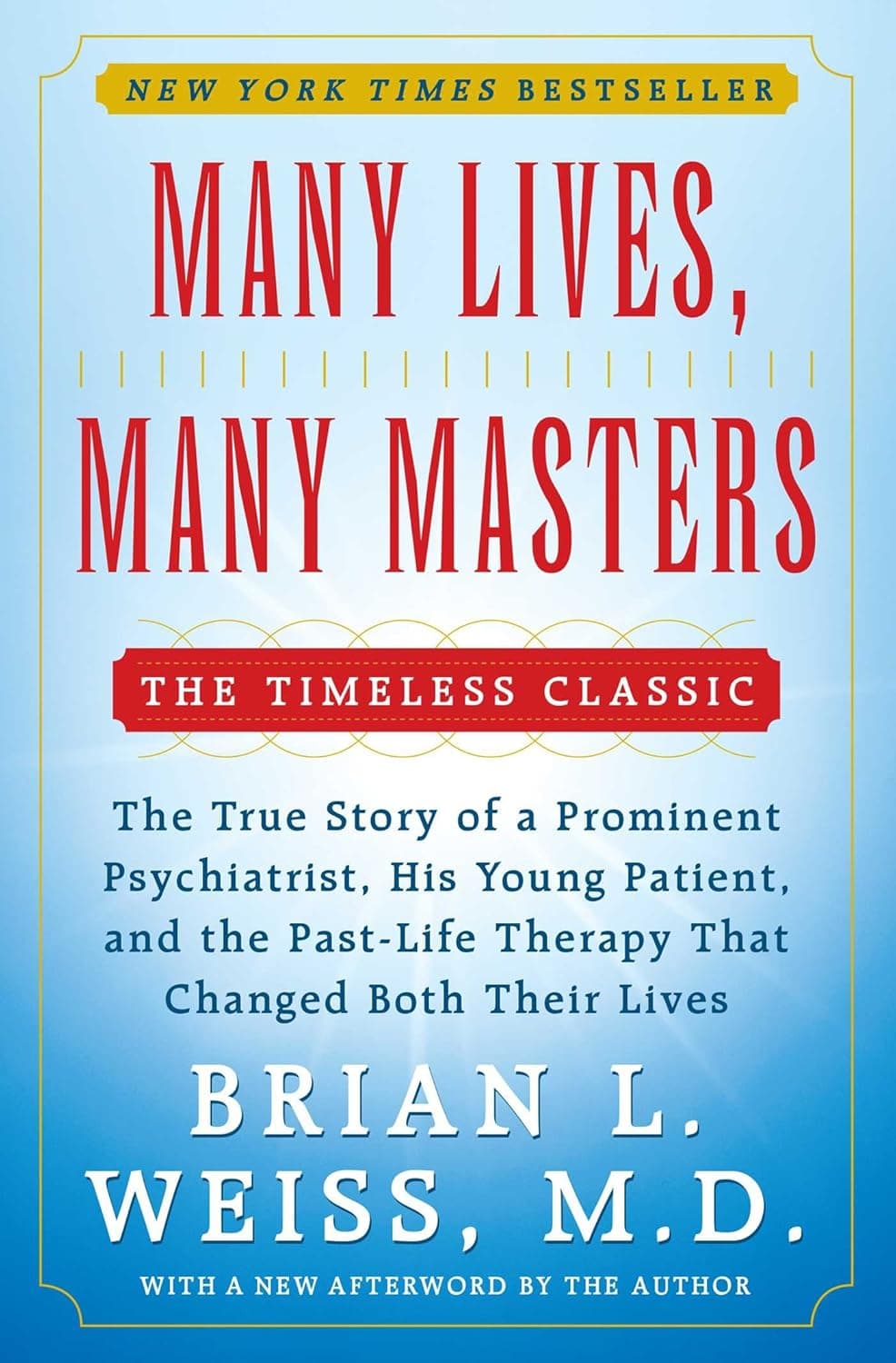
This page provides a curated collection of significant quotes from Brian Weiss's Many Lives, Many Masters, complete with detailed analysis of their meaning and impact on the narrative.
Most Important Quotes
The Irrefutable Proof
"Your father is here, and your son, who is a small child. Your father says you will know him because his name is Avrom, and your daughter is named after him. Also, his death was due to his heart. Your son's heart was also important, for it was backward, like a chicken's. He made a great sacrifice for you out of his love. His soul is very advanced. . . . His death satisfied his parents' debts."
Speaker: The Masters (channeled through Catherine) | Context: Chapter 4, immediately after Catherine enters the between-lives state, delivering verifiable, private details about Dr. Weiss’s family—his father’s Hebrew name, Avrom, and the rare heart defect of his deceased son, Adam.
Analysis: This scene is the book’s hinge, the moment skepticism cracks under the weight of the inexplicable. The precise, intimate facts—unknown to the patient—act as narrative “evidence,” propelling Dr. Weiss from detached clinician to participant in a spiritual investigation. Thematically, it inaugurates his Transformation from Skepticism to Belief, reframing the case study as a mentor-mentee exchange between the Masters and Weiss himself. Stylistically, the calm, declarative diction heightens the shock of recognition, making this a memorable and transformative revelation for both doctor and reader.
The Purpose of Life
"Our task is to learn, to become Godlike through knowledge. We know so little. You are here to be my teacher, I have so much to learn. By knowledge we approach God, and then we can rest. Then we come back to teach and help others."
Speaker: The Masters (channeled through Catherine) | Context: Chapter 3, Catherine’s first channeled message after reliving a peaceful death as Elizabeth.
Analysis: The Masters deliver the book’s governing thesis: life is a classroom, death a recess, and the soul an eternal student-teacher. By recasting existence as iterative learning, the passage dissolves finality and embeds meaning in suffering, growth, and service. The cyclical structure of the sentences mirrors the cycle of incarnations—learning, resting, returning—making the prose itself embody the doctrine. This declaration provides a philosophical compass for the narrative, orienting every regression and revelation toward instruction and compassion.
The Nature of Time and Acceptance
"Patience and timing . . . everything comes when it must come. A life cannot be rushed, cannot be worked on a schedule as so many people want it to be. We must accept what comes to us at a given time, and not ask for more. But life is endless, so we never die; we were never really born. We just pass through different phases. There is no end. Humans have many dimensions. But time is not as we see time, but rather in lessons that are learned."
Speaker: The Masters (channeled through Catherine) | Context: Chapter 8, following a lifetime steeped in fear-driven religion; the “poet Master” answers Weiss’s urgency with a lesson in spiritual timing.
Analysis: Here the Masters overturn linear chronology by substituting a pedagogy of lessons for the clock’s march, transforming anxiety into trust. The contrast between human haste and cosmic pacing dramatizes a core comfort of the book: the soul’s continuity makes patience rational. Phrases like “we were never really born” deploy paradox to loosen fixed identities and soften the fear of endings. The passage’s lyrical cadence and recursive imagery model the serenity it prescribes, making it a touchstone for the work’s meditation on immortality.
Thematic Quotes
Reincarnation and Past Lives
The First Regression
"I see white steps leading up to a building, a big white building with pillars, open in front. There are no doorways. I'm wearing a long dress ... a sack made of rough material. My hair is braided, long blond hair... The year is 1863 B.C."
Speaker: Catherine | Context: Chapter 2, Weiss instructs Catherine under hypnosis to return to the origin of her symptoms; instead she describes a remote ancient life.
Analysis: The sensory precision—stone steps, pillar architecture, coarse fabric—creates documentary vividness that challenges the boundaries of conventional psychotherapy. By leaping past childhood into antiquity, the narrative asserts a new diagnostic field where ancient wounds map onto modern symptoms. The catalog of tactile details functions as evidence within the story’s logic, inviting readers to weigh phenomenology over prior belief. This inaugural regression establishes the book’s investigative method: heal the present by retrieving the distant past.
The Drowning of Aronda
"There are big waves knocking down trees. There's no place to run. It's cold; the water is cold. I have to save my baby, but I cannot . . . just have to hold her tight. I drown; the water chokes me. I can't breathe, can't swallow . . . salty water. My baby is torn out of my arms."
Speaker: Catherine | Context: Chapter 2, recalling her life as Aronda (1863 B.C.), whose death by flood is relived in real time.
Analysis: The staccato syntax and visceral imagery—cold, choking, salt—submerge the reader in somatic panic, mirroring the pathology Catherine carries into her current life. This scene provides the first clear therapeutic payoff: after reliving the trauma, her phobias abate, a change noted in Chapter 3. The juxtaposition of maternal instinct and helplessness casts drowning as both literal death and symbolic rehearsal of loss. As clinical case and spiritual parable, it demonstrates how catharsis through memory can rewire fear at its root.
Spiritual Growth and the Purpose of Life
The Seven Planes
"There are seven planes in all, seven planes, each one consisting of many levels, one of them being the plane of recollection... We have debts that must be paid. If we have not paid out these debts, then we must take them into another life ... in order that they may be worked through. You progress by paying your debts."
Speaker: A spirit from the “lower levels” (channeled through Catherine) | Context: Chapter 12, a non-Master voice outlines the afterlife’s architecture and the moral economy governing rebirth.
Analysis: This cosmology converts abstractions into structure: planes, levels, and ledgers of debt give ethical weight to choices across lifetimes. By introducing Karma and Interconnected Souls, the passage reframes suffering as syllabus rather than sentence, progress as accountability rather than fate. The repetition of “seven planes” functions like a mantra, lending ritual gravity to the schema. It grounds the book’s mysticism in a system, making spiritual growth feel navigable rather than nebulous.
The Diamond Within
"It is as if a large diamond were to be found inside each person... The only differences among people are the number of facets-cleaned. But each diamond is the same, and each is perfect."
Speaker: Dr. Brian L. Weiss (recalling a dream from “Philo”) | Context: Chapter 16, post-treatment, Weiss dreams of a teacher who answers his question about human inequality.
Analysis: The diamond metaphor harmonizes equality and difference: essence is perfect, development is incomplete. By translating moral and spiritual evolution into the tactile act of “cleaning facets,” the image invites active participation in one’s refinement. Its secular elegance bridges science and spirit, matching Weiss’s dual identity as physician and seeker. As a compact credo, it summarizes the book’s hope—that every soul can polish toward clarity, lifetime by lifetime.
Character-Defining Quotes
Dr. Brian L. Weiss
"Years of disciplined study had trained my mind to think as a scientist and physician, molding me along the narrow paths of conservatism in my profession. I distrusted anything that could not be proved by traditional scientific methods."
Speaker: Dr. Brian L. Weiss (Narrator) | Context: In the Preface, Weiss frames his credentials and intellectual bias before presenting Catherine’s case.
Analysis: Weiss’s self-portrait establishes the control in the experiment—the skeptical, method-trained observer against which extraordinary claims will be tested. This candor deepens credibility and heightens narrative tension: will evidence alter identity. The clinical diction (“disciplined,” “methods,” “conservatism”) contrasts later visionary language, marking his arc toward openness. His journey supplies the book’s spine, turning a case report into a conversion narrative.
Catherine
"Her life had always been burdened with fears. She feared water, feared choking to the extent that she could not swallow pills, feared airplanes, feared the dark, and she was terrified of dying."
Speaker: Dr. Brian L. Weiss (Narrator) | Context: Chapter 1, Weiss inventories Catherine’s debilitating phobias at intake.
Analysis: The anaphora of “feared” builds a claustrophobic rhythm that conveys how omnipresent anxiety has become for Catherine. This baseline portrait invites a diagnostic mystery—what origin could unify such diverse terrors—and sets clear stakes for healing. The specificity of symptoms later maps neatly onto past-life scenes, providing narrative symmetry between problem and source. As opening data, it humanizes the patient and primes the reader for the regressions’ therapeutic logic.
The Masters
"Balance and harmony are neglected today, yet they are the foundations of wisdom. Everything is done to excess... This is not the way of nature... Humankind has not learned about balance, let alone practiced it. It is guided by greed and ambition, steered by fear. In this way it will eventually destroy itself."
Speaker: The Masters (channeled through Catherine) | Context: Chapter 16, Weiss recalls a dream-lecture consonant with the Masters’ teachings.
Analysis: The aphoristic tone and ecological metaphor (“the way of nature”) cast the Masters as moral diagnosticians of civilization. By pairing balance with wisdom, the passage elevates moderation from temperament to teleology, a path back to alignment with natural law. The critique of fear and excess resonates with Catherine’s initial condition, linking personal pathology to cultural malaise. Memorable for its prophetic urgency, it frames the book’s insights as not merely therapeutic but civilizational.
Memorable Lines
The Body as a Vehicle
"Our body is just a vehicle for us while we're here. It is our soul and our spirit that last forever."
Speaker: A Master Spirit (channeled through Catherine) | Context: Chapter 10, following a dream in which Catherine’s father sends her back into a burning house.
Analysis: This metaphor elegantly separates instrument from identity, relocating worth from perishable form to enduring essence. Its simplicity functions like a mantra, an antidote to mortality panic that threads through the book. By recasting death as a change of conveyance, the line aligns with the regressions’ continuity of consciousness. It endures as a consoling thesis statement for the work’s doctrine of immortality.
Opening and Closing Lines
Opening Line
"I know that there is a reason for everything. Perhaps at the moment that an event occurs we have neither the insight nor the foresight to comprehend the reason, but with time and patience it will come to light."
Speaker: Dr. Brian L. Weiss (Narrator) | Context: Opening sentence of the book, voiced retrospectively after the events have unfolded.
Analysis: The sentence establishes a hermeneutic of trust—events precede understanding, but meaning awaits discovery. Its temporal imagery (“with time and patience,” “come to light”) anticipates the structure of regression, where hidden causes surface. Positioned as prologue and promise, it preconditions the reader to interpret anomalies as lessons. The line quietly authorizes the narrative’s method: investigate, endure, and insight will follow.
Closing Line
"I hope that you will be helped by what you have read here, that your own fear of death has been diminished, and that the messages offered to you about the true meaning of life will free you to go about living yours to the fullest, seeking harmony and inner peace and reaching out in love to your fellow humans."
Speaker: Dr. Brian L. Weiss (Narrator) | Context: Final sentence of the book’s Epilogue, where Weiss addresses the reader directly.
Analysis: The shift from case history to benediction completes Weiss’s evolution from clinician to guide, extending the Masters’ compassion to the audience. The triad—harmony, inner peace, love—summarizes the curriculum distilled from Catherine’s sessions. By naming the fear of death and prescribing meaning as remedy, the line turns story into praxis. As closure, it reframes the book as an invitation to live differently now, not merely to believe differently.