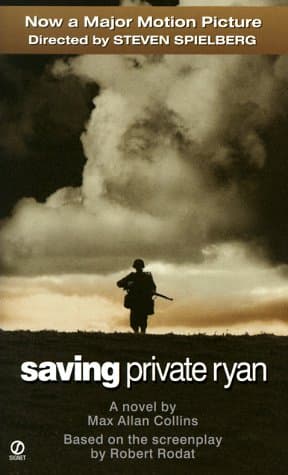
Captain John H. Miller
Quick Facts
- Role: Protagonist and moral center; commander of Charlie Company, 2nd Ranger Battalion
- First appearance: The D-Day assault on Omaha Beach
- Civilian identity: English teacher at Thomas Alva Edison High School in Addley, Pennsylvania
- Key relationships: Sergeant Michael Horvath, Private James Francis Ryan, Private Robert Reiben, Corporal Timothy Upham, Corporal Edward Wade
Who He Is
Boldly competent yet fundamentally reluctant, Captain John H. Miller is an ordinary schoolteacher asked to do an extraordinary thing: lead men through mechanized slaughter and find one soldier in a ruined country. He embodies the crushing weight of Leadership and Responsibility, constantly balancing his men’s survival against the demands of the mission. The novel makes him the hinge between the impersonal logic of war and its human cost, as he struggles with The Value of a Single Life vs. The Greater Good. His trembling hand, baby face, and “ancient eyes” mark him as both citizen and soldier, a man trying to keep enough of himself intact to have something left to bring home.
Personality & Traits
Miller leads with clear-eyed pragmatism and a fierce sense of duty, but his choices are always colored by compassion. The novel lets us see the man beneath the officer: a teacher who hates what killing is doing to him, a commander who still steps into the line of fire when his men need him.
- Decisive, tactical, and unflinching: On Omaha Beach, he snaps shattered men out of paralysis—“Get to where they can’t shoot you!” (p. 38)—and even uses a corpse as cover to survive (p. 34). His improvisations are ruthless because hesitation gets people killed.
- Compassionate command: He calls the Rangers “his boys” (p. 21), dives into the surf to save Delancey from drowning (p. 32), and absorbs each loss as a personal failure, telling Horvath the more he kills, the farther from home he feels (p. 245).
- Haunted and self-aware: Miller knows he’s a “fugitive from the law of averages” (p. 18). His uncontrollable shaking hand (p. 18, 180) is a private barometer of trauma, a physical leak from the pressure cooker of command.
- Reluctant heroism: He hides his civilian life behind rank, letting a betting pool about his past run its course. He fights not for glory but to finish the job and get home—an ethic that keeps him effective and human.
- Leads from the front: He deliberately draws fire so Jackson can cross open ground (p. 67). His courage is active and costly, a choice to risk himself before he risks others.
Character Journey
Miller begins by treating the Ryan mission like another assignment, applying the “simple math” of war where a few die so many can live. Then the math breaks. The deaths of men like Caparzo and Wade, the mutiny that Reiben stokes, and the burden of a captured German he releases force him to confront what the mission is really asking: to value one life above the lives already lost. At his breaking point, he discards the mystique of command and reveals he is a schoolteacher (p. 244). That confession doesn’t weaken him—it rehumanizes him, restores trust, and reframes the mission as something that must be morally intelligible to a civilian heart. When Ryan refuses evacuation, Miller reframes the objective again: hold the bridge. In choosing to defend it, he converts a dubious PR errand into a concrete act his men can believe in. His final order—“Earn this”—transfers the cost of his sacrifice into Ryan’s future and completes an arc from executing orders to authoring their meaning, an act of personal faith that threads duty through redemption.
Key Relationships
- Sergeant Michael Horvath: Horvath is Miller’s ballast—friend, fixer, truth-teller. He’s the only one Miller trusts with his secret tremor and the private arithmetic of command, and he helps Miller locate “one decent thing” inside an ugly mission (p. 262), reinforcing that leadership is sustained by loyal witness.
- Private James Francis Ryan: At first merely an objective, Ryan becomes the living argument for the mission’s worth. His refusal to abandon his “brothers” at the bridge forces Miller to respect conviction over orders; Miller shifts from courier to guardian, ultimately laying down his life so Ryan can carry their story forward.
- Private Robert Reiben: Reiben voices the squad’s resentment and moral skepticism, compelling Miller to justify choices that can’t be justified by rank alone. Their standoff after Wade’s death ends with Miller’s confession, transforming antagonism into earned respect.
- Corporal Timothy Upham: The scholar-translator’s terror and idealism mirror Miller’s buried civilian self. Miller mentors him reluctantly, modeling the grim transition from innocence to action; Upham’s evolution throws Miller’s own transformation into stark relief.
Defining Moments
Miller’s key decisions fuse tactical necessity with moral intent, showing how leadership becomes character under pressure.
- Rallying Omaha Beach: Reeling from shock and deafness, he still organizes men into motion, turning chaos into an assault that gets them off the sand. Why it matters: It establishes him as a leader who can will order from terror, the book’s baseline for heroism.
- The Mutiny and the Confession: After Wade dies and the released German divides the squad, Reiben quits; Miller defuses the standoff by revealing he’s a schoolteacher (p. 244). Why it matters: He reclaims authority through vulnerability, teaching by example that shared humanity—not fear—holds a unit together.
- Choosing the Bridge: Ryan won’t leave; Miller decides to stay and fight. Why it matters: He reframes an abstract rescue into a defensible objective, aligning mission, morale, and meaning.
- Death and Final Words: Mortally wounded, he fires his pistol at a Tiger tank and tells Ryan, “Earn this” (p. 311). Why it matters: He converts his death into a charge that binds survivor’s guilt to purpose, crystallizing the book’s meditation on Sacrifice and Redemption.
Essential Quotes
As baby-faced as any of his men, with clean-shaven, soft features betrayed by ancient eyes, Miller—like all survivors of multiple combat campaigns—knew all too well that he was a fugitive from the law of averages. (p. 18)
This image braids innocence and experience, introducing the central tension of Miller’s character: a civilian face carrying a soldier’s memories. The “law of averages” names his fatalism and the creeping certainty that survival itself is a kind of debt.
Every time you get one of your boys killed, you tell yourself you just saved the lives of two, three, ten, maybe a hundred other men and boys. ... Except this time, the mission is a man. (p. 181-182)
Miller exposes the ethical math of command—cold, utilitarian, necessary—only to admit its collapse when one life becomes the whole objective. The line reframes the plot as a moral experiment and sets up his eventual redefinition of the mission.
I'm a schoolteacher. I teach English at Thomas Alva Edison High School. Addley, Pennsylvania. (p. 244)
The confession punctures the armor of rank and replaces it with credibility. By anchoring his authority in an ordinary life, Miller reclaims the right to lead men who need more than orders—they need a reason.
I don't know anything anymore, except that the more killing I do, the farther away from home I feel. (p. 245)
This is Miller’s moral exhaustion laid bare. “Home” becomes a measure of selfhood and belonging; each act of violence pushes him further from the man he hopes to return to being.
"Earn this," Miller said softly. "Sir?" Ryan asked. Now the captain repeated it firmly, an order: "Earn this." (p. 311)
The final imperative transfers meaning from the dead to the living. It transforms survivor’s guilt into mission, insisting that lives saved must be justified by how they are lived, not merely by the fact of survival.