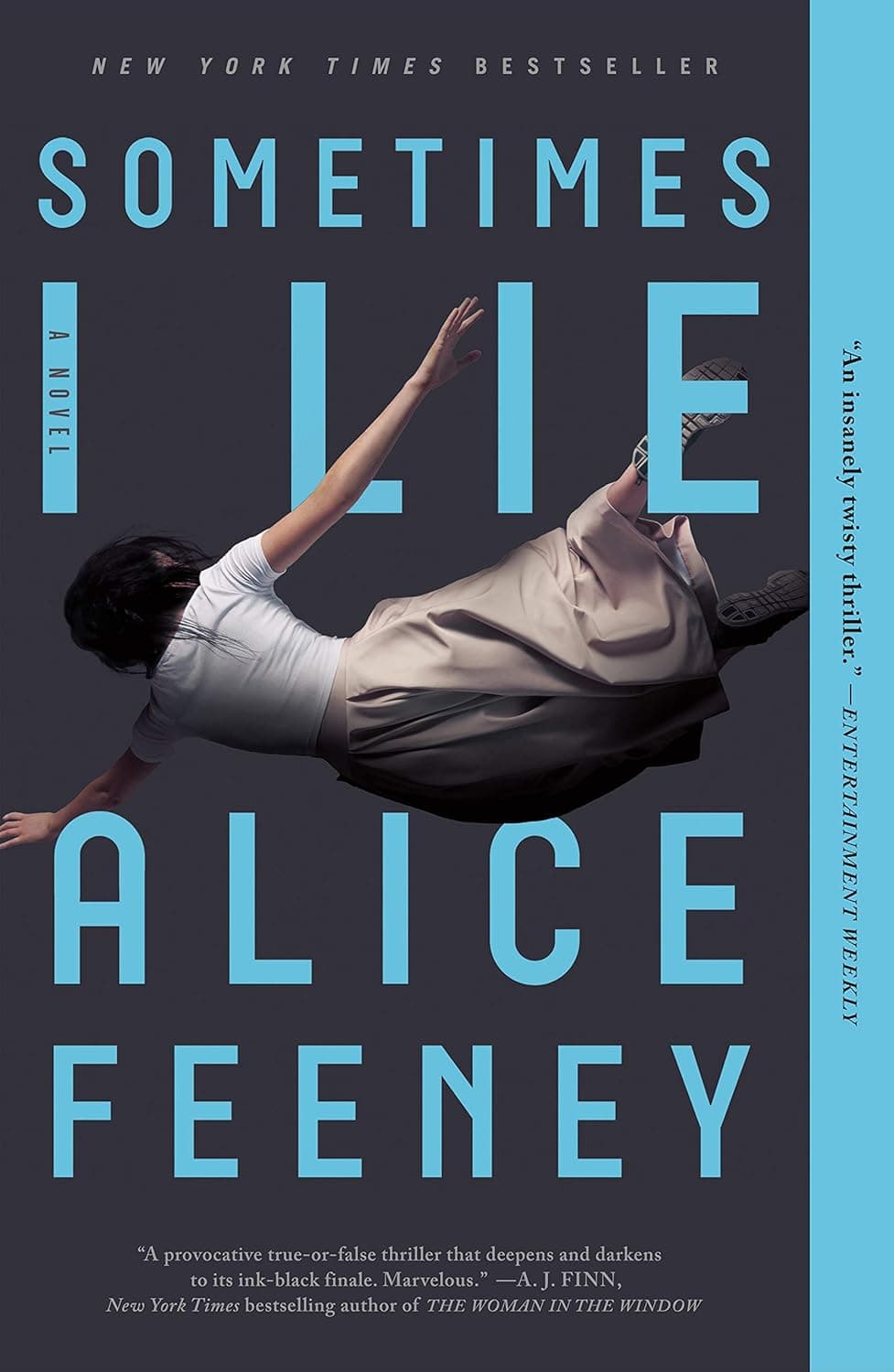
The cast of Alice Feeney’s Sometimes I Lie inhabits a world of fractured memories, buried grudges, and identities worn like masks. What begins as a coma diary spirals into a psychological chess match where every relationship is laced with envy, guilt, and misdirection. As truths surface, the connections among family, friends, and co-workers form an inescapable loop of manipulation and payback.
Main Characters
Amber Reynolds (The Narrator)
Amber Reynolds presents herself as a coma patient, a wronged wife, and the guiding voice across three timelines—now, a week before the “accident,” and the childhood diaries that seed doubt. Brilliantly manipulative and obsessive, she orchestrates professional takedowns and personal vendettas while projecting vulnerability; her need to control others is rooted in the childhood fire that shaped her. Through her marriage to Paul and her volatile bond with Claire, she weaponizes suspicion, jealousy, and the stories she tells about herself. The novel’s defining revelation reconfigures her entirely: “Amber” is actually Taylor, who stole her friend’s identity after the fire, bending memory and evidence to frame the real Amber (living as Claire) and reclaim the life she believes is hers. Her arc is not about recovery but about the cold, methodical fulfillment of revenge—an elegant, devastating con that leaves nearly everyone else in ruins.
Claire (The Real Amber Taylor)
Claire appears as the narrator’s beautiful, meddling younger sister—the woman who might be sleeping with Paul and sabotaging a marriage—but she is, in truth, Amber Taylor, the girl who took in her traumatized friend after the fire. Controlling yet strangely protective, she tries to steer the narrator away from danger, a compulsion born from guilt and a long-ago night she cannot forgive herself for. Her tense interactions with Paul are misread as seduction when they’re really surveillance and intervention; with the narrator, her “sisterly” vigilance becomes the very thing used against her. Claire’s story is the novel’s tragedy: she is gaslit, framed for a deadly fire, stripped of her children, and finally left to die by the person she spent her life trying to save. Seen first as a rival, she emerges as the moral center crushed beneath someone else’s narrative.
Paul Reynolds
Paul Reynolds is a once-successful novelist buckling under the pressure of a second book, a husband trapped between two women whose shared history he cannot decipher. Withdrawn and frustrated, he becomes the ideal mark: credulous enough to believe the narrator’s performance, yet suspicious enough to pry where it hurts—like reading diaries that deepen the narrator’s trap. His fraught marriage to the woman he knows as Amber and his tense, misread exchanges with Claire make him both suspect and scapegoat at various points. As the schemes collide, Paul’s attempts to “fix” things only tighten the noose, and he ends the novel aligned with the impostor who has stolen not just a name but an entire family. He is less an architect of harm than a casualty of it, a pawn moved expertly across someone else’s board.
Supporting Characters
Edward Clarke
Edward Clarke is the obsessive ex-boyfriend who resurfaces like a bad omen, his fixation weaponized by past manipulation and present delusion. He stalks the narrator from university days into adulthood, even infiltrating the hospital as a porter to assault her. Ultimately, Claire turns his obsession against him, luring him to his death in a bleak echo of the novel’s cyclical vengeance.
Madeline Frost
Madeline Frost is the narrator’s imperious co-host at “Coffee Morning,” the face of a workplace war that doubles as a lifelong feud. A public tyrant and private loner, she’s systematically destroyed by the narrator’s media-savvy sabotage—only for a twist to reveal she is the narrator’s aunt, who inherited the family home after the fire. Framed for the blaze that kills David, she becomes both collateral damage and a chosen target in a generational score-settling.
Jo
Jo seems like the narrator’s witty, loyal ally at work—until the mask slips and she’s revealed as an imaginary friend borrowed from childhood. As a voice only the narrator can hear, Jo exposes the depth of the narrator’s fractured psyche and functions as a conduit for strategy, secrecy, and self-justification. Her “presence” is the novel’s quietest, sharpest clue about whose memories we’re actually reading.
Minor Characters
- Matthew: The producer of “Coffee Morning,” caught between Madeline’s tyranny and Amber’s charm; easily steered into facilitating the narrator’s takedown plot.
- David: Claire’s steady, weary husband whose domestic normalcy collides with the sisters’ escalating war; he dies in the fire for which Madeline is framed.
- The Parents: The narrator’s parents are depicted in diaries as neglectful and abusive, dying in the fire their daughter set; the real Amber’s parents died earlier in a coach crash, leaving her vulnerable to the impostor’s arrival.
- DCI Jim Handley: The lead investigator on Amber’s accident, competent but misled by planted evidence and curated narratives that point him in precisely the wrong direction.
Character Relationships & Dynamics
At the vortex are the three principals: the woman calling herself Amber, Claire, and Paul. The marriage between Paul and “Amber” is a study in suspicion and miscommunication, each silence exploited by the narrator to redirect blame and deepen dependency. Claire stands between them, not as a temptress but as a guardian whose interventions read like betrayal—fuel for the narrator’s story that they are having an affair.
The narrator and Claire are bound by the fire: one consumed by guilt, the other by entitlement. Claire’s controlling protection is a penance that the narrator twists into proof of malice, reframing acts of care as acts of sabotage. This codependency calcifies into a fatal loop where forgiveness is impossible and truth is whatever the narrator can make others believe.
Beyond the family triangle, two satellites intensify the chaos. Edward embodies external threat and misplaced devotion, his stalking conveniently clouding timelines and motives. Madeline personifies institutional power and familial resentment, transforming a workplace rivalry into a blood feud once her identity as the aunt is revealed. Together, they widen the arena for the narrator’s manipulations, giving her the smokescreen she needs to execute her final betrayals.
Character Themes
- Identity and Self-Perception: Names, diaries, and memories are camouflage; the narrator isn’t Amber, and “Claire” is. The novel dissects how trauma and desire reshape the self into something performative—and dangerous.
- Manipulation and Control: Every bond is a power struggle, from the newsroom to the bedroom. The narrator engineers outcomes with surgical precision, while Claire’s protective control becomes its tragic mirror.
- Trauma and its Lasting Effects: The childhood fire radiates outward—fueling OCD rituals, imaginary companions, and the compulsion to rewrite the past through present harm.
- Guilt and Blame: Claire is driven to atone; the narrator is driven to accuse. Their opposing responses to the same catastrophe lock them into an escalating cycle of revenge.