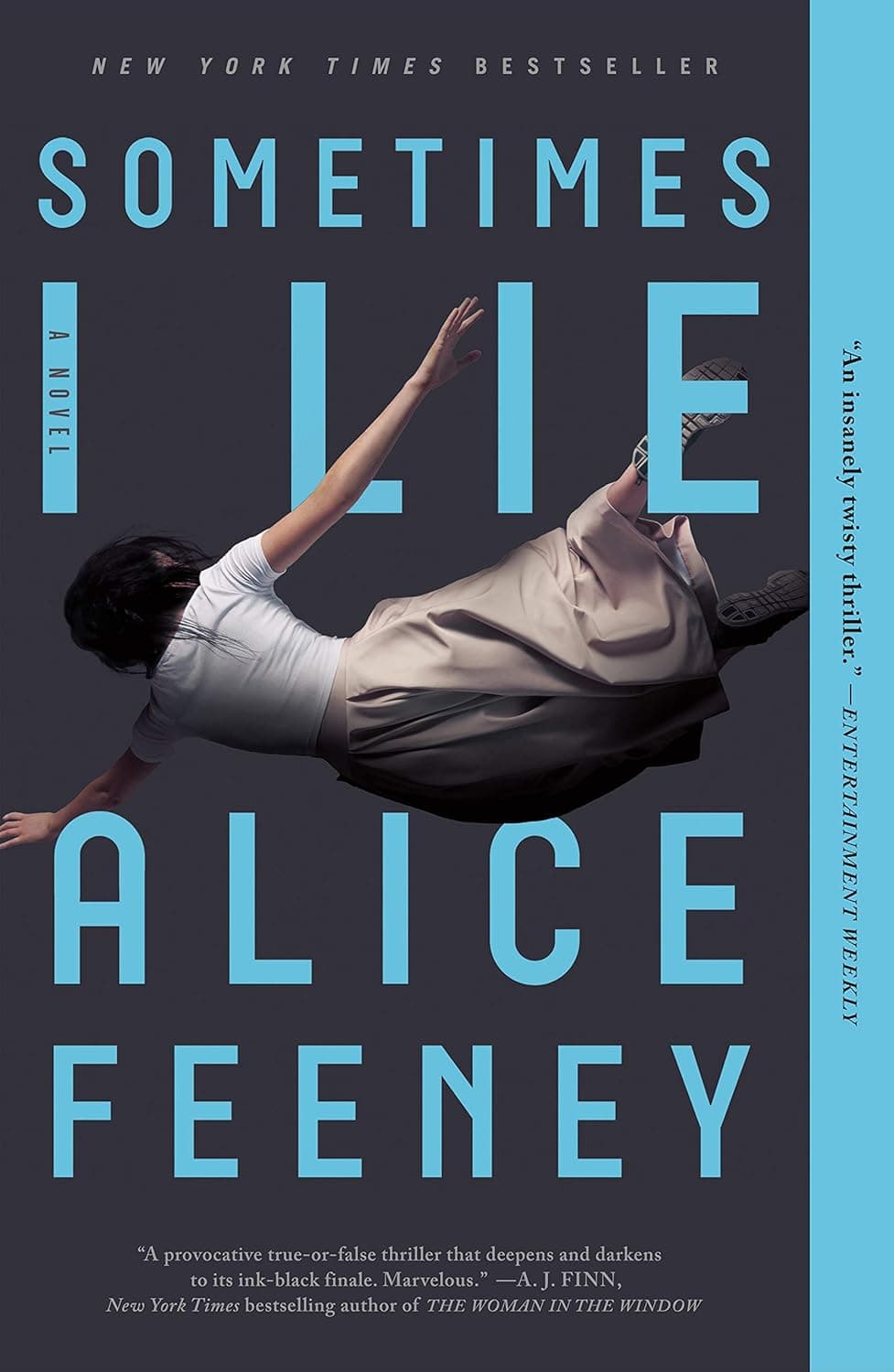
At a Glance
- Genre: Psychological thriller; domestic noir
- Setting: Contemporary England (primarily London), 2016, with childhood diary entries from 1991–1992
- Perspective: First-person narration and interspersed childhood diaries; braided “Now,” “Then,” and “Before” timelines
Opening Hook
“My name is Amber Reynolds. There are three things you should know about me.” With that confession, and the chilling final promise—“Sometimes I lie”—Alice Feeney locks the reader inside the mind of a woman who can hear everything but cannot move. As hospital monitors beep and family members murmur, doubt seeps into every line: who is telling the truth, and about what? The book dares you to trust its narrator, then punishes you every time you do, until even identity itself starts to feel like a trick of the light.
Plot Overview
Now
On December 26, 2016, Amber Reynolds is in a coma after a Christmas Day car crash. She can hear but cannot speak or open her eyes. Her husband, Paul Reynolds, keeps vigil, as does her “sister,” Claire. Police circle the accident, neighbors report arguments, and Paul’s bruised hand becomes a question mark. Trapped in her body, Amber’s certainty curdles into suspicion—especially as a familiar figure from her past, Edward Clarke, now a hospital porter, begins visiting her room. He whispers threats and makes covert, invasive contact, turning her recovery ward into a battleground.
Then
The week before the crash, Amber’s life buckles. At the radio station, she feuds with her ambitious co-host, Madeline Frost, and—together with her colleague Jo—launches “Project Madeline,” a scheme to get her fired. At home, Amber’s marriage sours; on the street, a chance run-in with her college ex, Edward, reignites a dangerous obsession. She wakes in his filthy flat with no memory and the sickening feeling she has been drugged and assaulted. Tension compounds chapter by chapter (see the Chapter 1-5 Summary), as Amber’s personal, professional, and psychological crises pull tighter, like threads cinching a noose.
Before
Diary entries from 1991–1992 chart a lonely girl’s childhood and her intense, possessive friendship with Taylor. Neglect at home makes their bond absolute. In the most chilling entry, the diarist sets her house ablaze, killing her parents so she can be adopted by Taylor’s family. The voice is intimate, wounded—and not as simple as it seems.
Convergence and Reveals
As the timelines braid together, contradictions multiply. In the hospital, Amber senses she isn’t safe. In the days before the crash, betrayals surface at work and at home. And in the diaries, the insistence on belonging takes a ruthless turn. The book’s engine is mistrust: of memory, of love, of what names mean.
The Final Twists
- The identity swap: The narrator is not the “real” Amber. She is Claire, the childhood friend. After the fire, Claire was adopted by Amber’s parents, and in adulthood she took the name “Amber Reynolds.” The childhood diaries belong to Claire, not Amber.
- The revenge: Claire took the radio job to destroy Madeline—her godmother who controlled (and effectively stole) Claire’s inheritance. “Project Madeline” doubles as an act of Justice and Revenge, meticulously staged.
- The crash: On Christmas, after a fight with Paul, Claire learns she’s pregnant but begins to miscarry. She goes to the real Amber’s house. During the frantic drive, the real Amber—intent on psychological damage—deliberately crashes the car.
- The last burns: Six weeks later, Claire recovers. She murders the real Amber and her husband, David, in a house fire and frames Madeline with planted evidence. She adopts Amber’s twins; she and Paul plan a new life in America.
- The final lie: Paul finds the real Amber’s childhood bracelet, engraved with her name and birthdate—proof of his wife’s true identity. The marriage, and the truth, hang in a newly perilous balance. For the complete sequence of reveals, see the Full Book Summary.
Central Characters
For the full cast and deeper profiles, see the Character Overview.
-
Amber Reynolds (Claire): Our narrator and shape-shifter. Raised after the fire as Amber’s “sister,” she grows into a woman who believes love and safety can be seized if she controls the narrative. Brilliant at manipulation and masks, she lies to others—and to herself—until identity becomes a weapon.
-
Claire (Amber Taylor): The real Amber. Forced to live beside the girl who burned her life down, she cultivates quiet fury and fear. Her final, deliberate crash exposes a capacity for harm that mirrors Claire’s, blurring the victim-villain line the novel keeps crossing.
-
Paul Reynolds: Amber/Claire’s husband, a stalled novelist with a crumbling marriage. His distance and bruised knuckles make him suspicious, but his true role is more tragic: he’s a man who never knew who he married, and who realizes too late that knowledge is dangerous.
-
Edward Clarke: Amber/Claire’s obsessive ex. He personifies the past that refuses to stay buried—stalking, assault, and coercion become his tools. In a story crowded with liars, Edward’s violence is the bluntest force of all.
-
Madeline Frost: The charismatic co-host and estranged godmother. To Claire, Madeline is the architect of a ruined inheritance and a life of lack—a grievance she converts into a career-level sting. Madeline’s ambition and charm make her the perfect mark and mirror.
Major Themes
For an expanded discussion, see the Theme Overview.
-
Deception and Unreliable Narration: The novel weaponizes the first person. Claire controls information, invents personas, and withholds the core truth—her identity—until the final act. Every timeline sharpened by her voice becomes a test of readerly faith.
-
Identity and Self-Perception: Names are costumes; families are stories you tell. Claire doesn’t just steal a life—she lives it so completely that the boundary between “Claire” and “Amber” dissolves. The book asks whether identity is essence, performance, or the most convincing lie.
-
Memory and Reality: Coma, blackout, and diary entries scramble what counts as real. The text moves like a hall of mirrors: a remembered event is recast, a diary is reattributed, a confession is revoked. Truth exists—but it’s always one reveal away.
-
Trauma and its Lasting Effects: The childhood fire is the blast radius that shapes everything. Grief becomes obsession; fear becomes control; love becomes possession. The novel traces how early wounds metastasize into adult pathology.
-
Manipulation and Control: Every relationship is a power play. Claire schemes against Madeline and manages Paul; Edward exerts physical control; the real Amber opts for psychological cruelty. The question isn’t who manipulates—but who wins.
Literary Significance
Arriving amid a boom in female-narrated psychological thrillers, Sometimes I Lie distinguishes itself through structure and audacity. Its triptych of timelines, its claustrophobic coma voice, and its ruthless late-game identity reveal transform a page-turner into a commentary on narrative trust. Where many thrillers ground unreliability in addiction or amnesia, Feeney crafts a narrator who lies because it works—on enemies, loved ones, and readers. The final reversal—that the story’s most basic premise, the “who,” is false—elevates the novel from twisty entertainment to a sleek anatomy of deception.
Critical Reception
Critics praised the novel’s intricate plotting, propulsive pacing, and gasp-worthy turns. Outlets likened it to the “domestic noir” juggernauts of the decade, while authors lauded its “true-or-false” tension and ink-black finale. Reviewers noted a rare reread impulse: once the mask drops, the groundwork glints everywhere. As a debut, it announced Alice Feeney as a major voice in contemporary suspense.