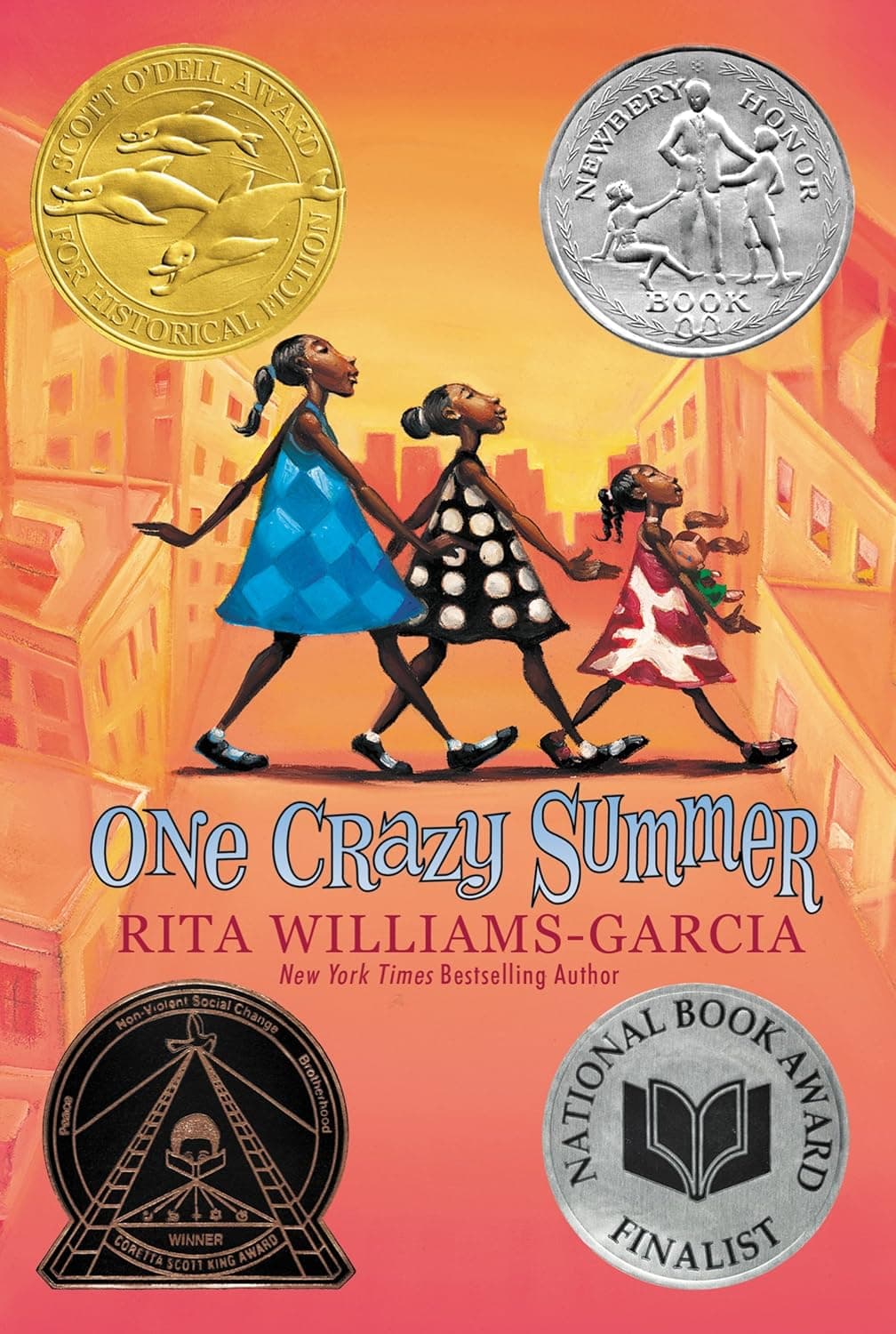
Opening Context
Set in the charged summer of 1968, One Crazy Summer follows three sisters who leave their orderly Brooklyn life for Oakland’s tumult, where community breakfasts, protest flyers, and poetry presses shape their days. Through this journey, the Gaither girls confront a mother who refuses easy definitions, a movement often misunderstood from the outside, and a city that widens their sense of who they can be. The cast below maps the family bonds, frictions, and unexpected alliances that transform their summer—and them.
Main Characters
Delphine Gaither
Delphine is the eleven-year-old narrator whose steady voice and careful plans anchor both her sisters and the story. Forced into responsibility after her mother’s departure, she polices order—meals, money, schedules—while absorbing the slights and uncertainties Oakland throws at them. Her summer becomes a test of control versus care: she mothers Vonetta and Fern, negotiates Cecile’s coldness, and slowly lets herself play, most memorably as Hirohito coaxes her into the pure joy of a go-kart’s “glorious hill.” Through the People’s Center and her growing empathy for Cecile, she learns to balance protection with presence, recognizing that her identity is more than caretaker and that understanding can coexist with hurt.
Cecile Johnson (Nzila)
Cecile, who calls herself Nzila, is a fiercely self-defined poet whose abandonment of her daughters casts the book’s longest shadow. Guarding her kitchen press and her autonomy, she resists mothering on anyone’s terms but her own, even as the Black Panthers rely on “Sister Nzila” to print the literature that fuels their work. Arrest and disclosure peel back her armor—an orphaned past, homelessness, and a conviction that she was incapable of nurturing—complicating the girls’ picture of her as merely cruel. She never becomes traditionally tender, yet she edges toward connection, allowing a fragile truce that culminates in an awkward, genuine embrace at the airport, shifting her from symbol to flawed, knowable person.
Supporting Characters
Vonetta Gaither
Vonetta is the nine-year-old middle sister—dramatic, stylish, and hungry to be seen—whose flair both enlivens and destabilizes the trio. Her craving for approval drives her to deface Fern’s doll to impress peers, a betrayal that stings until she channels her performance into reciting Cecile’s poem at the rally. She clashes with Delphine’s authority and courts the Ankton sisters’ attention, but ultimately learns that being noticed matters less than being known.
Fern Gaither
Fern, seven, begins as the quiet “baby” clutching Miss Patty Cake, yet proves the keenest watcher and the boldest truth-teller. Losing her doll becomes a turning point, clearing space for her own voice to rise—most powerfully when she reads an original poem that exposes Kelvin as a police informant. Her insistence on her name, not “Little Girl,” compels Cecile’s respect and signals her emergence as her own person.
Sister Mukumbu
Sister Mukumbu is the People’s Center teacher whose warmth, rigor, and pride in Black history offer the girls a steadiness they don’t find at home. She embodies the Panthers’ community mission—feeding, educating, organizing—while modeling a nurturing authority Delphine can trust. Her classroom becomes the girls’ safe harbor and a lens through which they see themselves as part of something larger.
Hirohito Woods
Hirohito is a cool, quietly resilient boy whose father is imprisoned, giving Delphine a personal window into the costs of activism. He lightens her burden, nudging her from vigilance toward play, and their tentative crush unfolds in small, generous moments. Through him, Delphine connects to Oakland not just politically but as a place where she is allowed to be eleven.
Crazy Kelvin
Crazy Kelvin blusters through the Center with slogans and scorn, policing children’s choices (especially Fern’s doll) in the name of revolutionary purity. His exposure as a police informant reveals the difference between performance and commitment, sharpening the girls’ understanding of danger and duplicity. In contrast to Sister Mukumbu, he shows how ideology without compassion curdles.
Big Ma
Big Ma, the sisters’ grandmother, represents the rootedness of Southern values, churchgoing discipline, and an uncompromising moral code. Though she stays in Brooklyn, her voice echoes through Delphine’s choices, shaping how the girls interpret Oakland and Cecile. She stands as the foil to Cecile’s radical self-making, giving Delphine two models of Black womanhood to measure herself against.
Minor Characters
- Pa (Louis Gaither): A steady, pragmatic father who sends his daughters west, believing a reckoning with their mother is overdue.
- The Ankton Sisters (Eunice, Janice, and Beatrice): Local girls whose cool reserve both intimidates and attracts the Gaithers, especially Vonetta, offering a test of belonging.
- Sister Pat: An energetic college student at the Center who amplifies the Panthers’ educational mission with youthful zeal.
- Mean Lady Ming: The weary Chinese restaurant owner whom Delphine learns to see with empathy, reminding the girls not to mistake exhaustion for unkindness.
Character Relationships & Dynamics
The Gaither sisters operate as a tightly braided unit, with Delphine as organizer, Vonetta as spark, and Fern as quiet center; conflicts flare—over attention, rules, and a defaced doll—but their loyalty never buckles. Their collective strength is most visible when they navigate the People’s Center together, absorbing history lessons, free breakfasts, and the sense that they belong to a community bigger than their household.
The most charged relationship is between the girls and Cecile: they arrive expecting a mother and meet an artist guarding her freedom. Day by day, the girls renegotiate what family can look like—accepting takeout dinners and closed doors while glimpsing the poetry and pain that shaped Cecile’s refusal of convention. The airport embrace doesn’t erase hurt; it acknowledges complexity and the possibility of a different, truer connection.
Within the movement’s orbit, Sister Mukumbu and Crazy Kelvin form a study in contrasts—one nurtures, the other polices; one builds trust, the other erodes it—clarifying for the girls that activism is defined as much by care as by rhetoric. Hirohito, meanwhile, personalizes the stakes and softens Delphine’s vigilance, opening a lane for friendship and first crushes alongside political awakening.
Finally, Big Ma’s traditionalism and Cecile’s radical self-definition bracket Delphine’s coming-of-age: two models of womanhood and motherhood that seem irreconcilable yet both shape her ethics. Encounters with peers like the Ankton sisters test the girls’ social courage, while the reveal of Kelvin’s informant status underscores the real dangers surrounding the Center—and the resilience required to choose community anyway.