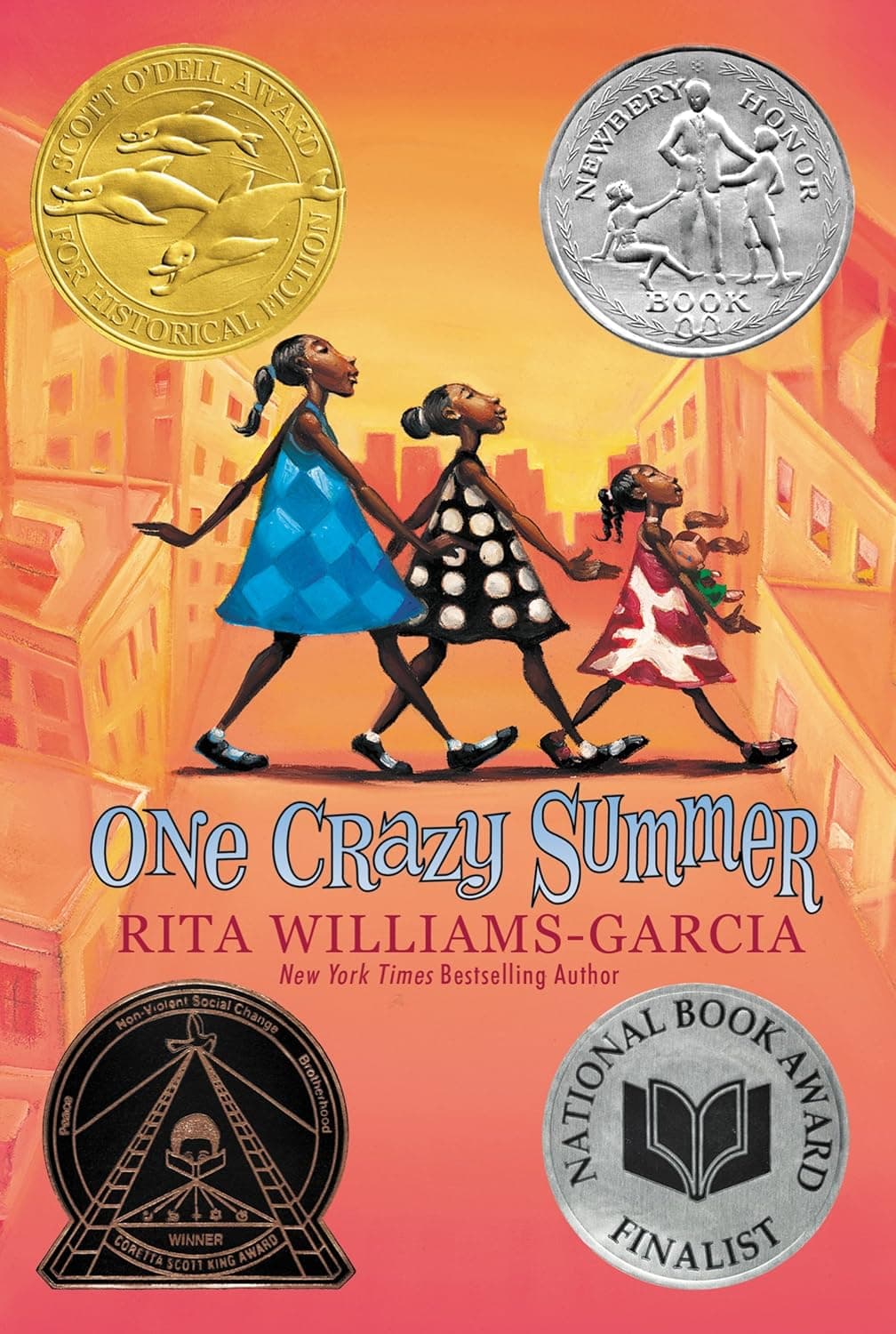
One Crazy Summer: Summary & Analysis
At a Glance
- Genre: Historical fiction (middle grade)
- Setting: Oakland, California, summer 1968; with a Brooklyn home base
- Perspective: First-person narration by Delphine Gaither
- Core conflict: Three sisters seek a mother’s love from Cecile Johnson (Nzila) while awakening to Black Power politics
- Tone: Wry, observant, warm; political but intimate
Opening Hook
Eleven-year-old Delphine has kept her sisters fed, clothed, and safe—everything except loved by the mother who left them. When Delphine, Vonetta, and Fern fly from Brooklyn to Oakland to spend a month with that missing mother, they dream of Disneyland and TV stars. Instead, they find Cecile—an impenetrable poet who bars them from her kitchen and sends them to a Black Panther-run day camp for breakfast and revolution. What begins as a disastrous reunion becomes a summer of hard truths, poetry, and chosen courage—where growing up means learning what love looks like when it refuses to be easy.
Plot Overview
Act I: Arrival and Disappointment
Shipped west by Pa and their strict grandmother Big Ma, Delphine, her nine-year-old sister Vonetta, and seven-year-old Fern land in sunny California and step into the chill of Cecile. She refuses hugs, insists on being called Nzila, and forbids them from entering her kitchen—her sacred printing press and poetry lab. To keep them out of her way, she sends them to the People’s Center each day for free breakfast and a summer camp run by the Black Panther Party. These opening chapters establish the tug-of-war between the girls’ longing for mothering and Cecile’s fierce independence (see Chapter 1-5 Summary).
Act II: Immersion and Fracture
At the Center, the sisters enter a new language of pride, power, and community. They meet the nurturing teacher Sister Mukumbu, the needling provocateur Crazy Kelvin, and quiet racer Hirohito Woods. Lessons on revolution and identity complicate the “colored” world they knew in Brooklyn. At home, Delphine pushes back—sneaking into the forbidden kitchen to cook for her sisters and sparring with Cecile about money and care. Tensions flare when Vonetta, stung by taunts about Fern’s beloved white doll, colors Miss Patty Cake black, sparking a furious sister fight and forcing Delphine to face the family’s fault lines (see Chapter 6-10 Summary and Chapter 21-25 Summary).
Act III: Arrest and Resolve
Craving one day of adventure, Delphine plans a San Francisco excursion—cable cars, Chinatown, the Golden Gate. The triumph vanishes when they return to Oakland to find police swarming Cecile’s house. Cecile and two Panthers are arrested; Delphine, protecting her sisters, tells officers they’re the “Clark sisters” and denies Cecile is their mother. Back inside, the kitchen—Cecile’s heart—is ransacked, its press overturned, its words scattered.
Act IV: Voices on the Mic, Truth in the Night
At the “Rally for Bobby,” the sisters decide to perform one of Cecile’s poems and take the stage. Their recitation of “I Birthed a Nation” electrifies the crowd; then Fern steps forward and delivers her own poem, exposing Crazy Kelvin as an informant. As the audience erupts, the girls spot Cecile—newly released—watching them, expression unreadable (see Chapter 26-30 Summary). That night, Cecile finally speaks the past: the violence and silencing she endured, why she left, and the name she once gave Fern—Afua. On departure day she calls Fern by her true name. At the airport, the sisters run to her and find, at last, a brief but real embrace—too late to rewrite the past, just in time to carry home a new understanding (see Chapter 31-33 Summary).
Central Characters
For fuller profiles, see the Character Overview.
- Delphine Gaither: The family’s steady center—watchful, responsible, and old beyond her years. Her arc loosens the grip of control as she lets others help, risks joy (that go-kart ride), and sees Cecile not as a villain to forgive or a saint to worship, but a complex woman with her own wounds.
- Vonetta Gaither: Dramatic, social, and hungry to be seen. Her bid for attention—recoloring Fern’s doll—reveals the pain of belonging and the lure of performance. She learns that visibility without loyalty rings hollow.
- Fern Gaither: Quiet and observant, fiercely attached to Miss Patty Cake. Onstage, she finds her voice—poetic, brave, and piercing—and cuts through adult duplicity with a child’s clear sight.
- Cecile (Nzila): A mother who refuses the script. Detached and exacting, she protects her art and name as survival. In shards of honesty, she lets the girls glimpse the trauma she escaped and the love she can offer—imperfect, limited, but real.
- Others: Big Ma, the strict matriarch whose rules have raised the girls; Sister Mukumbu, a gentle teacher of pride and purpose; Hirohito Woods, whose quiet friendship delivers Delphine a breath of childhood; and Crazy Kelvin, a smiling disruptor revealed as an informant.
Major Themes
For a broader map of ideas, visit the Theme Overview.
-
Family, Motherhood, and Abandonment (full theme): The novel refuses easy redemption arcs. Cecile’s love doesn’t look like bedtime stories or packed lunches, yet it exists—guarded, stuttering, and finally spoken. Williams-Garcia argues that family isn’t compliance with a role; it’s the complicated act of recognition.
-
Identity and Self-Discovery (full theme): The sisters move from “colored” to “Black,” learning that identity is both inheritance and choice. Cecile’s name Nzila and Fern’s reclaimed Afua show how naming can be an act of self-making—and how the right to name oneself is political.
-
Social Justice and Activism (full theme): Panthers in this story cook breakfasts, teach children, and organize rallies as much as they carry slogans. The girls learn revolution begins with care, community, and truth-telling—on a stage, in a kitchen, and in a life.
-
Coming of Age (full theme): Delphine’s journey is not just toward political awareness but toward being allowed to be eleven. Letting the wind take her on Hirohito’s go-kart, she practices a different kind of courage: trusting joy after years of vigilance.
Historical Context
- The Black Panther Party: Born in Oakland in 1966, the Panthers paired community programs—like the Free Breakfast for Children the girls attend—with radical critiques of policing and poverty. The novel demystifies the movement by foregrounding service, education, and neighborhood solidarity.
- 1968’s upheavals: The assassinations of Dr. Martin Luther King Jr. and Robert F. Kennedy sharpen the novel’s urgency, reflecting a nation grieving and reorganizing its demands.
- COINTELPRO: Cecile’s wary talk of “the Man” signals the very real surveillance and infiltration of Black activist groups. Fern’s public unmasking of Kelvin as an informant fictionalizes a tactic that fractured movements from within.
Literary Significance
One Crazy Summer is a landmark of children’s historical fiction because it marries political clarity with intimate voice. Through Delphine’s sharp, often funny narration, the book opens a space where readers can hold contradiction: a mother who leaves and loves, a movement that cooks and resists, a child who leads and still longs to play. Williams-Garcia shuns neat fixes; instead she crafts characters whose complexity makes the closing embrace feel earned. The result is a humane, accessible portrait of the Black Panther Party and a timeless story about how children carry, question, and reshape the worlds adults hand them.
Critical Reception
Awards and honors include the Newbery Honor (2011), Coretta Scott King Award (2011), National Book Award Finalist (2010), and the Scott O’Dell Award for Historical Fiction (2011). Critics praised the novel’s authentic voice, emotional precision, and depiction of the Panthers beyond stereotype—balancing humor and heart with the era’s volatility. Its success led to two sequels, P.S. Be Eleven and Gone Crazy in Alabama, extending the Gaither sisters’ unforgettable story.