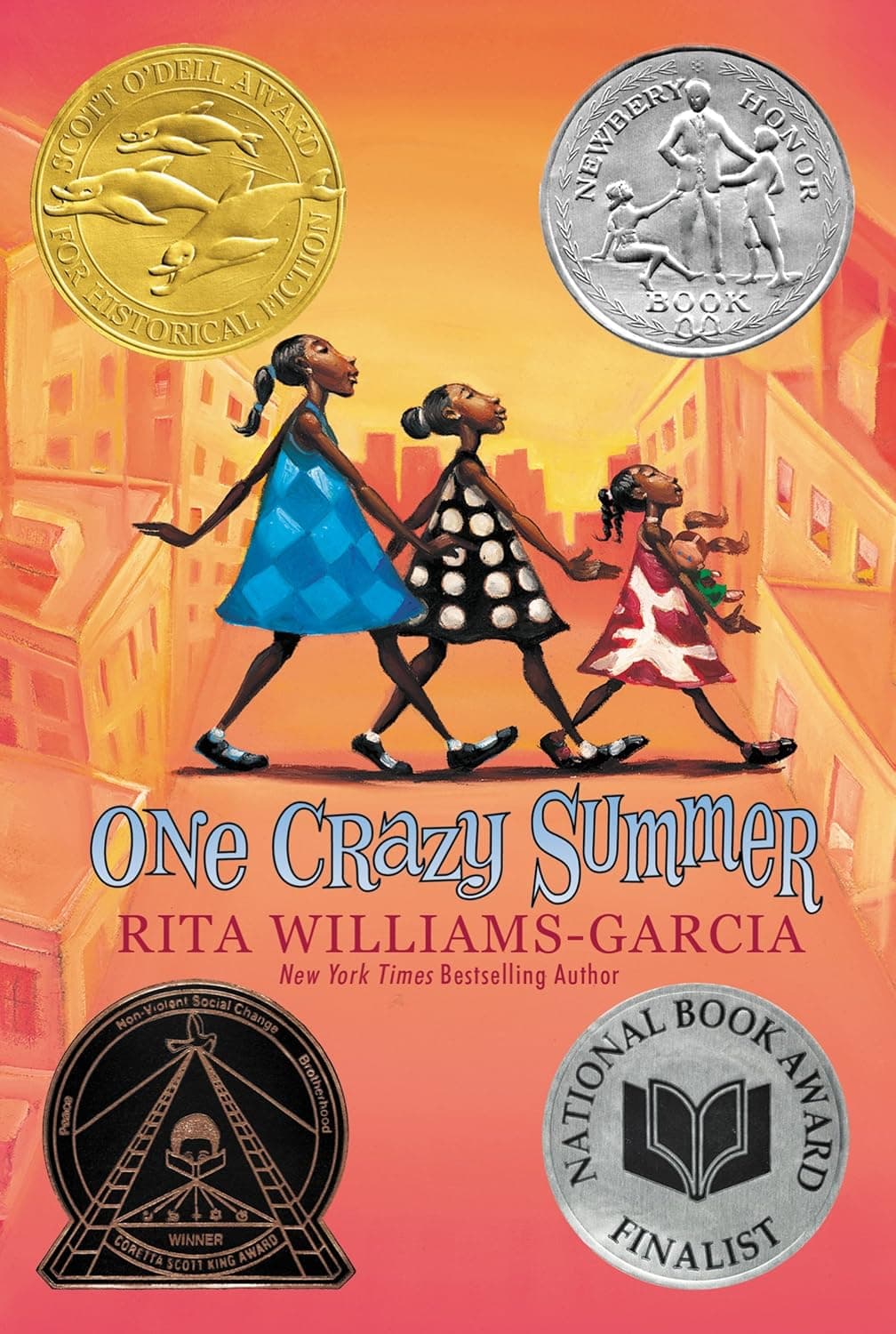
Rita Williams-Garcia sets One Crazy Summer at the intersection of private hurt and public upheaval: three sisters cross the country in 1968 to face the mother who left them and the movement reshaping Black America. Across four major strands—family, identity, activism, and growing up—the novel asks how love, language, and community can repair what abandonment and oppression break.
Major Themes
Family, Motherhood, and Abandonment
The novel’s beating heart is the sisters’ attempt to define family around an absence. Family, Motherhood, and Abandonment explores how Cecile’s refusal of traditional maternal roles—her closed kitchen, her insistence on art over caretaking—forces Delphine into premature motherhood, even as the girls still yearn for tenderness. The airport embrace the sisters initiate at summer’s end reframes family as something they actively claim, not something Cecile passively provides.
Identity and Self-Discovery
The girls’ time in Oakland becomes a laboratory for self-definition—personal, racial, and artistic. Identity and Self-Discovery unfolds through names and voices: Cecile becomes Nzila (“the path”), Fern becomes Afua, and Delphine learns to be more than the “little mother.” Moments like the challenge to Miss Patty Cake and Fern’s poem at the rally push each sister to decide who she is beyond roles assigned by family or society.
Social Justice and Activism
Set against the Black Panther Party’s community work, the book demystifies revolution as both everyday care and real risk. Social Justice and Activism shows the People’s Center feeding children, teaching history, and preparing kids to face police, while arrests and infiltration reveal the dangers of dissent. Art and action converge when the sisters perform their mother’s poem at the rally, turning private words into public power.
Coming of Age
Delphine’s arc moves from vigilance to vulnerability, from duty to joy. Coming of Age crystallizes in the go-kart ride down the “glorious hill” and in Delphine’s insistence—“I’m only eleven years old”—that she deserves a childhood. Learning to release control without abandoning care, she begins to see her mother as complicated rather than simply cruel, and herself as a child with a future, not just a caretaker with a list.
Supporting Themes
The Power of Words, Poetry, and Naming
Language is authority, intimacy, and rebellion at once. Cecile/Nzila weaponizes and sanctifies names, withholding Fern’s to enforce distance, while Fern’s public poem exposes betrayal and claims a voice. This theme threads through the major ones: words become a bridge in a fractured family, a tool for political education, and a mirror for identity.
Community and Belonging
Where the Gaither home life is fractured, the Panthers’ breakfast line, Sister Mukumbu’s classroom, and the Woods family’s kindness model chosen kinship. Community answers abandonment, complements activism’s ideals with daily care, and eases Delphine’s coming of age by giving her a place to be only a child for a while.
Responsibility vs. Selfishness
Delphine’s relentless caretaking contrasts with Cecile’s fierce self-preservation, complicating easy judgments. As Delphine learns it “wouldn’t kill [her] to be selfish,” responsibility becomes a shared, flexible ethic rather than a burden one child must carry—clarifying both family expectations and the self she’s allowed to discover.
Memory and Truth
Delphine’s “flashes” of recollection collide with fuller, more painful histories Cecile eventually reveals. The correction of memory reshapes blame into understanding, reframing abandonment, refining identity, and softening the terms of Delphine’s passage into maturity.
Theme Interactions
- Family ↔ Identity: Cecile’s quest to be Nzila fuels abandonment; her refusal of motherhood pushes Delphine into the identity of “little mother,” stalling her own self-discovery. As the girls learn and rename, they reimagine what their family can be.
- Activism ↔ Coming of Age: Political education accelerates Delphine’s growth—from suspicion of “trouble” to recognition of injustice and solidarity—so that civic awareness becomes part of personal maturity.
- Words/Poetry ↔ Family: Naming and refusal to name police distance; later, sharing Cecile’s poem at the rally transforms private fracture into public connection.
- Community ↔ Abandonment: The People’s Center and neighbors supply what Cecile withholds, proving that care can be collective when kinship fails.
- Responsibility ↔ Joy: Letting go (the go-kart, the rally performance) teaches Delphine that healthy responsibility includes room for pleasure and play—key to her identity and her bond with her sisters.
Character Embodiment
Cecile/Nzila Cecile personifies the collision of artistry, activism, and motherhood. Her renaming asserts identity and political allegiance, while her closed kitchen and withheld affection enact abandonment; through her, the novel probes whether selfhood and caretaking must conflict, and how words both distance and unite.
Delphine Gaither Delphine embodies responsibility, coming of age, and the redefinition of family. Managing money-in-the-shoe and meals, she bears adult burdens until Oakland’s community and her own small rebellions (the hill, the confession of being eleven) let her reclaim childhood and speak honestly about her pain.
Vonetta Gaither Vonetta’s craving for attention marks her negotiation of identity and belonging; her impulse to recolor Miss Patty Cake signals the pressure—and missteps—of adopting visible markers of Black pride. She tests the boundaries of sisterhood, performing and seeking validation as she figures herself out.
Fern Gaither (Afua) Fern’s arc centers on naming and voice. Dismissed as “Little Girl,” she claims power through her poem at the rally and in finally being called by her true name, tying language to dignity, identity, and a renewed family bond.
Sister Mukumbu She represents the nurturing face of activism—education, meals, history—demonstrating that social justice is built as much in classrooms and breakfast lines as at rallies. Her care offers the sisters a model of community motherhood.
Crazy Kelvin Kelvin embodies the movement’s contradictions: rhetoric without integrity, militancy shading into manipulation. His exposure as an informant warns that activism must be principled to be transformative, sharpening the girls’ political education.
Big Ma Guardian of tradition and respectability, Big Ma underscores generational divides in language (colored vs. Black), motherhood, and discipline. Her stern care highlights what Cecile withholds, complicating the family’s moral landscape.
Hirohito Woods and Mrs. Woods The Woods family illustrates community as practical love: safety, rides, food, and that “we have to stick together” ethos. Hirohito, especially, gives Delphine space to be a kid, linking belonging to the freedom necessary for growth.