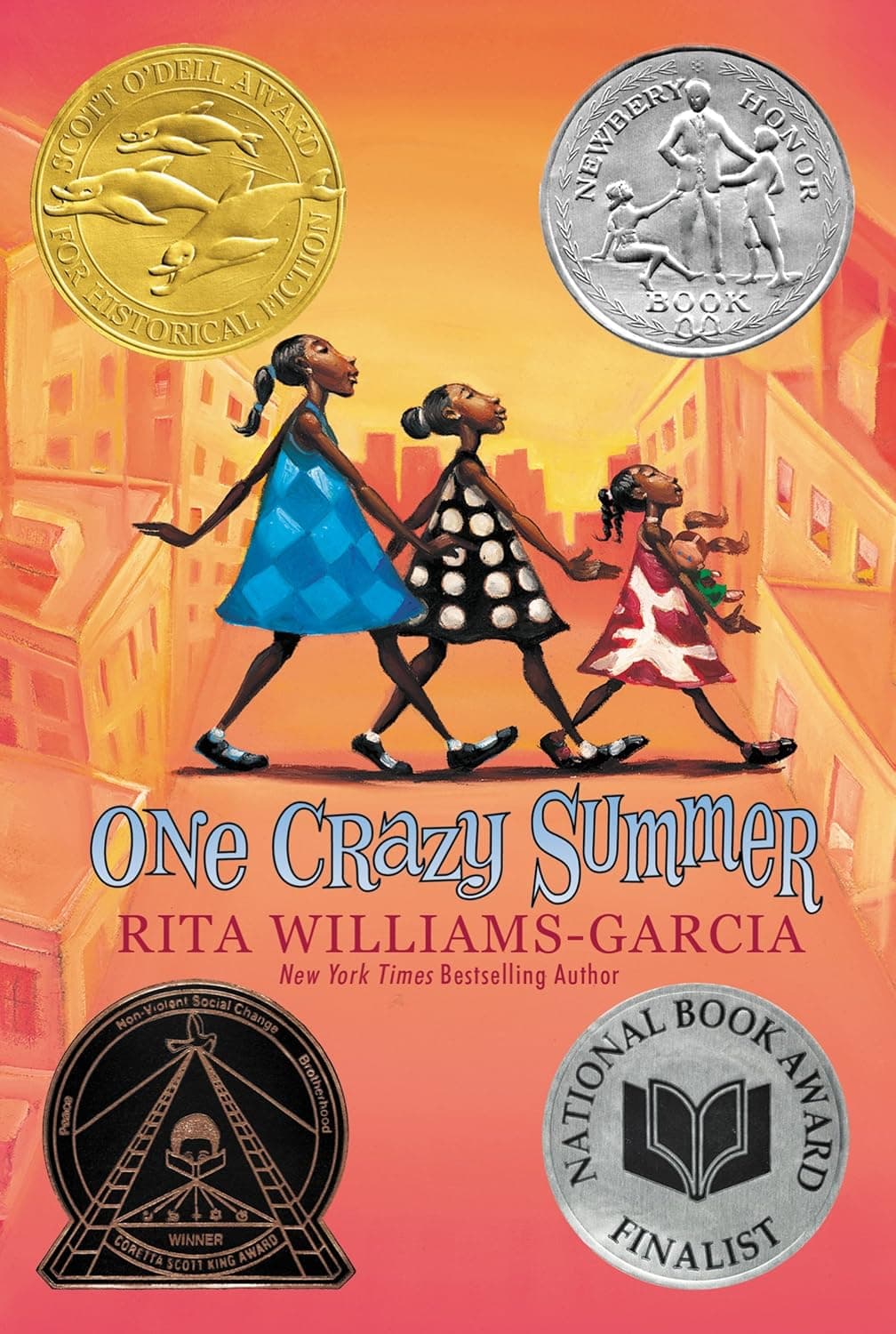
Fern Gaither
Quick Facts
- Role: Youngest Gaither sister (age seven); the “baby” who becomes the truthteller-poet of the summer
- First appearance: Opening of the novel, traveling to Oakland
- Key relationships: Protective eldest sister Delphine Gaither; competitive middle sister Vonetta Gaither; distant mother Cecile Johnson (Nzila); antagonist Crazy Kelvin
- Symbols: Miss Patty Cake (Fern’s doll)
- Themes she illuminates: Identity and Self-Discovery, Family, Motherhood, and Abandonment, Coming of Age
Who She Is
Boldly tender and unsparingly honest, Fern Gaither is the smallest voice that carries farthest. Her insistence on her name and her refusal to be minimized define her from the start: Fern may be seven, but she knows who she is. Clutching Miss Patty Cake, she moves through Oakland with a child’s plain sight that cuts through adult performances. That innocent clarity—what others misread as naiveté—lets her see hypocrisy, name it, and ultimately speak it aloud. Fern’s arc fuses vulnerability and courage into a single gift: a voice that can both comfort and confront.
Personality & Traits
Fern’s personality blends softness with steel. She follows her sisters’ lead, yet resists any label that erases her. What looks like babyish attachment (the doll, the echoing refrains) becomes the groundwork for an artist’s discipline—watching, storing details, and telling the exact truth when it matters.
- Innocent yet perceptive: She “halfway believed in things not true,” but that openness lets her notice what others miss—most notably Kelvin’s cozy rapport with a police officer.
- Bold about identity: When Cecile calls her “Little Girl,” Fern answers, “I’m not Little Girl. I’m Fern.” The line is simple, but it’s a manifesto: a child demanding personhood.
- Deep attachments, real stakes: Her bond with Miss Patty Cake is a lifeline in the chaos of a mother who left and a new city. When that bond is violated, the loss is seismic, forcing rapid emotional growth within the pressures of family and abandonment.
- A follower with a streak of independence: She often echoes Delphine and Vonetta—“Surely don’t,” “Me too”—yet at the rally she breaks rank, abandoning group performance to recite her own poem and speak an uncomfortable truth.
Character Journey
At first, Fern is the doll-clutching youngest who relies on Delphine’s care and the comforting scripts of childhood. Oakland immediately complicates that safety: Cecile’s refusals chill her, Kelvin’s needling targets her identity through the doll, and Vonetta’s defacement of Miss Patty Cake wounds her deepest source of comfort. That rupture does not harden Fern into cynicism; instead, it clarifies her. She shifts from echoing to composing, from being spoken for to speaking. Onstage, she claims a poet’s authority, reciting a spare, cutting poem that exposes Kelvin and commands a crowd. Cecile, who has kept herself closed, recognizes the artist in her youngest and names her “Afua”—a private affirmation that Fern’s voice belongs to creation. By summer’s end, the child called “Little Girl” is Fern Gaither, a poet whose truth-telling reorders her family’s silence.
Key Relationships
-
Delphine Gaither: Delphine is Fern’s everyday anchor—provider of water, bedtime, and protection—so their bond has a mother–child texture. Fern’s growth doesn’t sever that dependence; it reframes it, as Delphine shifts from speaking for Fern to making space for Fern to speak for herself.
-
Vonetta Gaither: Sibling rivalry and play flare into real harm when Vonetta marks up Miss Patty Cake. The betrayal cuts deeply, yet it also pushes Fern toward independence; the rupture becomes the crucible for Fern’s self-definition and eventual artistic confidence.
-
Cecile Johnson (Nzila): Fern refuses to be erased by Cecile’s distance, correcting “Little Girl” to “Fern” until her mother must acknowledge her. The final airport hug—initiated by Fern—breaks Cecile’s wall, showing that Fern’s love and insistence on recognition can be both boundary and bridge.
-
Crazy Kelvin: Kelvin tries to shame Fern for loving a white doll and postures as a radical. Fern’s quiet observation and unblinking poem expose him as an informant, transforming the smallest target of his bullying into the person who topples his authority.
Defining Moments
Small scenes reveal Fern’s core; public ones reveal her power. Together, they map a move from dependence to authorship.
- The glass of water: Cecile’s refusal to give Fern a drink spotlights the emotional drought Fern faces at home. It sets the stakes: Fern must learn to ask for care—and endure when it’s withheld.
- Destruction of Miss Patty Cake: Vonetta’s marker turns comfort into grief. The loss forces Fern to locate security within herself, catalyzing the move from follower to creator.
- The rally poem: Choosing to recite her own piece instead of performing with her sisters, Fern centers truth over applause. By naming Kelvin’s collusion, she shifts from child to witness, earning the community’s and Cecile’s respect.
- The airport hug: Fern’s spontaneous embrace cracks Cecile’s reserve. It proves her love is agentive, not needy—she initiates reconciliation on her terms.
Symbols & Significance
Miss Patty Cake is more than a toy; she’s Fern’s portable refuge in a world of adult absences. When the doll is defaced, the violation externalizes Fern’s struggle over identity and belonging, and her response—poetry—becomes a new refuge she makes herself. Cecile’s secret name for her, Afua (Friday, creation), seals that transformation: Fern’s “made” thing is her voice.
Essential Quotes
Fern folded her arms, holding Miss Patty Cake by a tuft of her patchy, yellow hair. “We need night-beds. We sleep at night.”
- Even half-asleep, Fern names a need plainly and refuses adult euphemism. The grip on Miss Patty Cake underscores how her truth-telling is rooted in vulnerability, not bravado.
“I’m not Little Girl. I’m Fern.”
- This correction is a line in the sand against erasure. By insisting on her name, Fern claims respect, identity, and the right to be addressed as a person, not a category.
My mother calls me Little Girl, but this is a poem by Fern Gaither, not Little Girl. This is a poem for Crazy Kelvin. It’s called ‘A Pat on the Back for a Good Puppy.’
“Crazy Kelvin says ‘Off the pig.’ Crazy Kelvin slaps everyone five. The policeman pats Crazy Kelvin on the back. The policeman says, ‘Good puppy.’ Crazy Kelvin says, ‘Arf. Arf. Arf, arf, arf, arf.’ Because I saw the policeman pat your back, Crazy Kelvin. Surely did.”
- The poem’s childlike diction (“puppy,” “Arf”) is strategic—it strips Kelvin of revolutionary swagger and exposes him through a simple observation. Fern wields innocence like a scalpel, turning an image everyone saw into a truth no one else dared to say.
“Hey. That’s my name. Our mother said my name!”
- The joy here is not just being noticed but being recognized as herself. After a summer of insisting on identity, the acknowledgement confirms that Fern’s voice has altered the family’s emotional order.