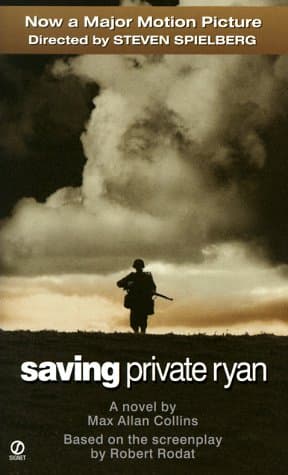
What This Theme Explores
Sacrifice and Redemption asks what a single life is worth amid mass death, and whether meaning can be wrested from the carnage of war. The novel measures sacrifice at multiple scales—from faceless battlefield losses to intimate choices that cost one life to save another. Redemption, in turn, is not exoneration but obligation: the burden on the living to justify what others forfeited. The final order of Captain John H. Miller—“Earn this”—turns a rescue into a lifelong moral charge for Private James Francis Ryan.
How It Develops
The story opens in chaos at Omaha Beach, where sacrifice is vast, impersonal, and mechanized. Survival demands choices that erode identity and morality; in that maelstrom, redemption is inconceivable because staying alive consumes every scrap of attention and courage.
When the rescue mission begins, sacrifice narrows from a strategic abstraction to a personal arithmetic: the squad is asked to risk eight lives for one. Their march becomes a debate about value—whether a single man can justify new deaths layered atop so many. The deaths of Private Anthony Caparzo and Corporal Edward Wade sharpen the question; grief turns the mission into a search for meaning equal to their loss, while Private Robert Reiben voices the raw logic that the exchange rate is obscene.
At the radar nest, the captain’s tactical calculus—make a hard sacrifice now to save unknown men later—nearly breaks the unit. Necessity becomes indistinguishable from guilt; the cost is paid immediately, but the promised redemption is deferred and uncertain. Miller’s steadiness frays, his private tremor signaling how cumulative sacrifice corrodes the self.
At Ramelle, the theme reaches clarity. Ryan refuses evacuation, claiming the right—and duty—to stand with “the only brothers I had left,” recasting himself not as a prize but as a participant in the same moral economy of sacrifice. Miller reciprocates by abandoning the letter of his orders for their spirit, helping defend the bridge to give everyone’s loss a discernible purpose. In dying, he compresses the novel’s argument into a single directive: let the saved life justify the price. In the Epilogue, an elderly Ryan seeks confirmation that he has indeed paid that debt with a good life, showing redemption as a burden one carries, not a moment one reaches.
Key Examples
-
The Brutal Calculus of D-Day: The Omaha Beach landing renders soldiers interchangeable—sacrifice as sheer attrition. The captain’s impulse to survive collides with the dehumanizing logic of total war.
Struggling, paddling toward shore, Miller felt Delancey taking more hits, seven or eight of them, jerking violently in his grasp, puffs of blood misting the air. Miller wondered if this might not finally be the moment he should choose to go insane.
— Chapter 2: Chapter 1-5 Summary, p. 34
This moment shows how survival can require actions that feel morally unmoored, foreshadowing the need for later redemption. -
The Mission’s Inception: General Marshall justifies saving one man by invoking a sacred language of national grief.
"'I pray that our Heavenly Father may assuage the anguish of your bereavement,' " he said from memory, " 'and leave you only the cherished memory of the loved and lost, and the solemn pride that must be yours to have laid so costly a sacrifice upon the altar of freedom.' "
— Chapter 3: Chapter 6-10 Summary, p. 87
By framing the mission with Lincoln’s words, the novel threads state duty into personal obligation, sanctifying a decision that will demand private sacrifices from the squad. -
Caparzo’s “Decent Thing”: Caparzo dies trying to save a French child—a personal, compassionate sacrifice that resists the war’s cold logic (Chapter 4: Chapter 11-15 Summary, p. 147). His act insists that redemption can begin with small decencies, even when they seem tactically unwise.
-
Wade’s Death and Miller’s Choice: As Wade bleeds out, the captain grants him morphine, trading his own moral certainty for mercy (Chapter 4: Chapter 11-15 Summary, p. 227). The scene collapses the distance between tactical necessity and intimate care, binding sacrifice to compassion rather than strategy.
-
Ryan’s Refusal: When found, Ryan asserts a duty to his unit over his own safety, redefining what it means to be “saved.”
"Well, then, you just tell her when you found me, I was with the only brothers I had left. Tell her that there was no way I was going to desert those brothers. You tell her that . . . and she'll understand."
— Chapter 5: Chapter 16-19 Summary, p. 260
His refusal transforms the mission from extraction to solidarity, aligning his survival with shared purpose. -
The Final Command: The captain’s last words connect every death to Ryan’s future conduct.
"Earn this," Miller said softly.
"Sir?" Ryan asked.
Now the captain repeated it firmly, an order:
"Earn this."
— Chapter 5: Chapter 16-19 Summary, p. 311
The imperative reframes redemption as an ongoing life ethic, not a single heroic moment. -
A Life Earned: At the end, Ryan asks his wife to judge the worth of his life—proof that redemption is a continuing labor, never self-awarded.
"Alice . . . have I lived a good life? Am I a good man?"
"Jim . . . what . . ."
"Tell me I've earned it."
— Epilogue, p. 316
The echo of the captain’s order shows how sacrifice reshapes identity across decades.
Character Connections
Miller embodies the theme’s tension between duty and humanity. He tallies the dead he has sent forward, tries to balance accounts by choosing battles that might save unknown men, and finally wagers his life on making the bridge mean something. His death seals the idea that redemption must be carried by the living, not claimed by the fallen.
Ryan, the focal point of others’ sacrifice, resists the premise that his life is exceptional. By choosing to fight at Ramelle and then accepting the moral debt of survival, he turns from object to agent—from being “saved” to living so that others’ losses matter.
Sergeant Michael Horvath articulates the squad’s pivot from cynicism to purpose, arguing that saving Ryan might be “the one decent thing” they can salvage from the war. He translates grief into a workable ethic, a bridge from tactical absurdity to moral clarity.
The squad as a whole stages the theme’s arguments. Reiben’s skepticism forces the story to face its hardest math; Wade and Caparzo’s choices insist that compassion is a valid currency in war; and their deaths raise the stakes so that “earning it” becomes not a slogan but a debt with names.
Symbolic Elements
The Bridge at Ramelle concentrates the novel’s moral economy: it is a literal chokepoint whose defense lends visible purpose to sacrifice. Fighting for it makes the cost legible, so redemption can be imagined rather than merely hoped for.
The Graves at St. Laurent, a vast grid of crosses, frame the narrative with the scale of loss. The image turns the personal story of one squad into a meditation on all the unnamed debts the living owe the dead.
Miller’s Shaking Hand externalizes invisible wounds. It marks how each decision compounds, how leadership requires absorbing moral shock so others can go on—and why redemption must address not only death but the damage carried by survivors.
Contemporary Relevance
In any era of conflict, statistics flatten suffering while individuals carry its weight. This theme demands that we ask what is owed to those who serve and what the living must do to justify that cost—through policy, remembrance, and private conduct. It cautions that meaning is not inherent in sacrifice; it is conferred by how we live afterward, in decency that is daily rather than dramatic.
Essential Quote
"Earn this."
— Chapter 5: Chapter 16-19 Summary, p. 311
Spare and absolute, the order collapses the distance between battlefield and lifetime, turning survival into a vocation. It universalizes the story’s math: whoever benefits from others’ losses inherits a duty to make that benefit meaningful. The novel’s closing scene proves the line is not closure but commencement—a standard Ryan spends his life trying to meet.