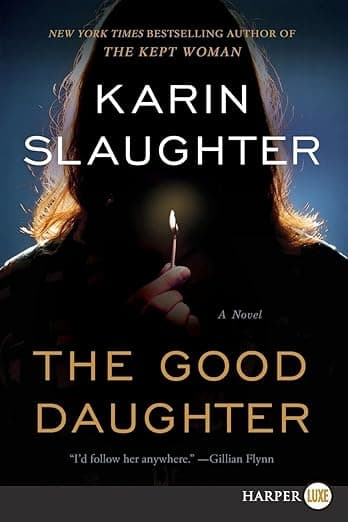
Opening
Two timelines collide: a brutal home invasion in 1989 shatters a family, and nearly three decades later a school shooting drags the survivors back into the same spiral of violence, law, and guilt. The prologue burns in visceral detail; the present-day chapters tighten the screw, forcing Charlotte Quinn to relive—and act on—the past she can’t escape.
What Happens
Prologue: What Happened to Samantha (March 16, 1989)
Eight days after a firebombing destroys their home, fifteen-year-old Samantha Quinn and thirteen-year-old Charlotte Quinn practice relay handoffs at a dilapidated farmhouse. Their mother, Gamma Quinn, a brilliant, exacting academic, pushes them hard while their father, Rusty Quinn—a defense attorney infamous for freeing a Black man from death row—calls to say a sheriff’s car is on its way. Before it arrives, two masked men break in. One is Zachariah Culpepper, a former client of Rusty’s, who claims Rusty owes them money. When Gamma grabs the shotgun barrel to defuse the situation, Zachariah shoots her in the face, killing her in front of her daughters—a wound that crystallizes lifelong Family Trauma and Its Aftermath and the cost of Justice, Morality, and the Law.
The men march the girls into the woods to a shallow grave meant for Rusty. Zachariah and his younger accomplice, whom he calls “Hightop,” argue; the younger man hesitates. Seizing the moment, Sam shoves Charlie and screams for her to run. A shot drops Sam. She wakes as dirt pours over her face. Remembering Charlie’s tip about making an air pocket, she cups her hands, fights the suffocating soil, and kicks free. Gamma’s final command to protect her sister drives Sam’s desperate escape—pure Survival and Resilience bound to Sisterhood and Familial Duty. Bleeding and dazed, she staggers toward the sound of passing cars.
Chapter 1: 28 Years Later
Nearly three decades on, Charlotte, now a defense attorney, stops at Pikeville Middle School to swap iPhones with Mason Huckabee, a handsome teacher and ex-Marine she slept with the night before. Separated from her husband, Ben Bernard, she feels reckless and raw—evidence of The Past's Influence on the Present. When Huck learns her last name, his warmth cools; the Quinn reputation still scorches in Pikeville.
Gunshots rip through the hallway. Huck snaps into tactical mode, but Charlie charges toward the danger, propelled by old reflexes and terror. At the end of the corridor, Principal Pinkman lies dead. Beside a dying eight-year-old, Lucy Alexander, kneels Judith Pinkman—formerly Miss Heller, the same woman who sheltered a traumatized thirteen-year-old Charlie after the 1989 attack. Charlie holds Lucy’s hand as the child dies, reliving the helpless, incandescent horror of her past.
Chapter 2
The shooter stands yards away: Kelly Wilson, a pale, Goth-style teen, presses a revolver to her chest, ready to kill herself. Huck steps between Kelly and the police rushing in, speaking calmly, using names, controlling his breath. Officers shout, weapons drawn. Huck coaxes Kelly to surrender; she lifts the revolver toward his outstretched hand.
As Huck takes the gun, a jumpy officer fires. The bullet rips through Huck’s arm. Chaos surges. Kelly is disarmed and shoved to the floor.
Chapter 3
Police pile onto Kelly, stomping her face into the linoleum. Huck yells for Charlie to call Rusty; instead, she starts filming on Huck’s phone. Officer Greg Brenner smashes Charlie in the face, breaking her nose. She wakes hours later, handcuffed in an interview room, accused of obstruction.
Ben arrives to negotiate damage control; the police have already fabricated a cover story. Charlie refuses hush terms, insisting on a written apology from the officer who hit her. Special Agent Delia Wofford of the GBI takes Charlie’s statement. Then the bombshell: Kelly turned eighteen two days ago. She’s no longer a juvenile—she can face the death penalty.
Chapter 4
Lenore, Rusty’s unflappable secretary, drives Charlie from the station. The façade cracks; Charlie sobs about Huck, her marriage, and Lucy. They head to Sadie’s Holler to reach Kelly’s family before a warrant lands. At Kelly’s crumbling trailer, her mother, Ava, sits in stunned denial. With SWAT minutes away, Charlie slips into Kelly’s bedroom to find anything that might help the defense. The room is childlike—Hello Kitty, kittens, middle-school trinkets—frozen innocence at odds with murder.
Sirens near. Charlie spots a middle-school yearbook, hides it in her purse, and walks out as SWAT breaches. Later, on the phone, Huck says he was interrogated for hours. When Charlie asks about the murder weapon, he lies and pretends ignorance—proof he’s hiding evidence.
Character Development
Charlotte’s present-tense crisis fuses with the past: the girl who ran through woods now runs toward gunfire. The chapter set sharpens everyone’s edges—who protects, who lies, who chooses the law over love.
- Samantha Quinn: Defined by ferocity and sacrifice. She recognizes Zachariah, anticipates death, and still chooses Charlie’s survival over her own. Buried alive, she engineers her escape through grit and memory.
- Charlotte Quinn: Tough, impulsive, and deeply wounded. She charges into danger, refuses to be bullied by police, and breaks the law to secure potential evidence. Her marriage cracks under the strain of old and new betrayals.
- Gamma Quinn: Brilliant and exacting, she dies defying a gunman and imparting a last command that becomes the sisters’ moral lodestar.
- Rusty Quinn: A true believer in the adversarial system. His cases endanger his family in 1989; in the present, he pivots immediately to defend Kelly, prioritizing principle over comfort.
- Mason Huckabee: A capable protector under fire and a practiced liar afterward. His heroism sits beside secrecy, marking him as a volatile ally.
- Ben Bernard: A principled prosecutor and estranged husband. He balances professional obligation with residual loyalty to Charlie, absorbing the blow of her infidelity without abandoning her.
- Kelly Wilson: A paradox—a “sweet,” “not smart” teen described by Huck, encased in a child’s room yet implicated in murder. Her recent eighteenth birthday raises the stakes from tragedy to capital case.
- Judith Pinkman: The emotional hinge between timelines, linking past rescue to present atrocity and collapsing the distance between then and now.
Themes & Symbols
The novel binds personal catastrophe to systemic pressures. Family Trauma and Its Aftermath spills from the 1989 grave into the school hallway; grief rewires Charlotte’s instincts, her marriage, and her ethics. The Past's Influence on the Present pulses in every echo: a police siren becomes a memory trigger; Judith appears in both scenes of carnage; the sisters’ childhood relay becomes a lifelong mandate.
The justice system sits at the center, askew. Justice, Morality, and the Law frames Rusty’s career, the police brutality Charlie films, Ben’s political calculus, and Kelly’s sudden exposure to capital punishment. The law promises order; the narrative keeps asking whose pain it ignores. Meanwhile, Survival and Resilience and Sisterhood and Familial Duty drive action: Sam’s escape is literal survival; Charlie’s choices—rushing toward gunfire, stealing evidence—are survival strategies shaped by loyalty.
Symbols:
- The Blind Pass: The botched baton handoff in the prologue becomes a metaphor for responsibility—put the baton in your sister’s hand, every time—and the cost when protection fails.
- The Farmhouse: A “higgledy-piggledy” exile, embodying displacement and the Quinns’ burned safety—an architecture of loss.
- The Grave: Prepared for Rusty but used on Sam, it collapses roles of victim and intended target, underscoring the indiscriminate fallout of vengeance.
Key Quotes
“You have to put that baton firmly in her hand every time.” Gamma’s coaching line becomes the moral blueprint of the book. Protection isn’t abstract; it’s a practiced, repeatable act. When Sam shoves Charlie to run—and when Charlie later risks arrest to help Kelly—both are baton passes under fire.
“Always protect your sister.” Reduced to an imperative, Gamma’s final plea welds duty to identity. It explains Sam’s ferocity in the grave and Charlotte’s compulsion to confront danger, even when it costs her safety, marriage, and career.
Huck calls Kelly “sweet” but “not smart.” The description complicates the shooter stereotype and hints at manipulation or vulnerability. It pushes the story from open-and-shut atrocity toward a legal and moral tangle.
Zachariah’s nickname for his partner—“Hightop.” A throwaway label humanizes the accomplice and signals internal conflict, setting up the split-second window that saves Charlie and nearly kills Sam. It foreshadows later fractures inside institutions meant to protect.
Why This Matters and Section Significance
These chapters establish the novel’s double-helix structure: past atrocity entwined with present crisis. The prologue supplies the psychological engine driving every choice Charlotte makes; the school shooting forces that engine into overdrive, placing her between principle and protection, law and loyalty. With Rusty aligning to defend Kelly, Ben straddling justice and politics, and Huck blurring heroism with deceit, the stage is set for a legal thriller that is also a trauma narrative—one where every action is a baton pass, and every failure to grasp it echoes through lives and decades.