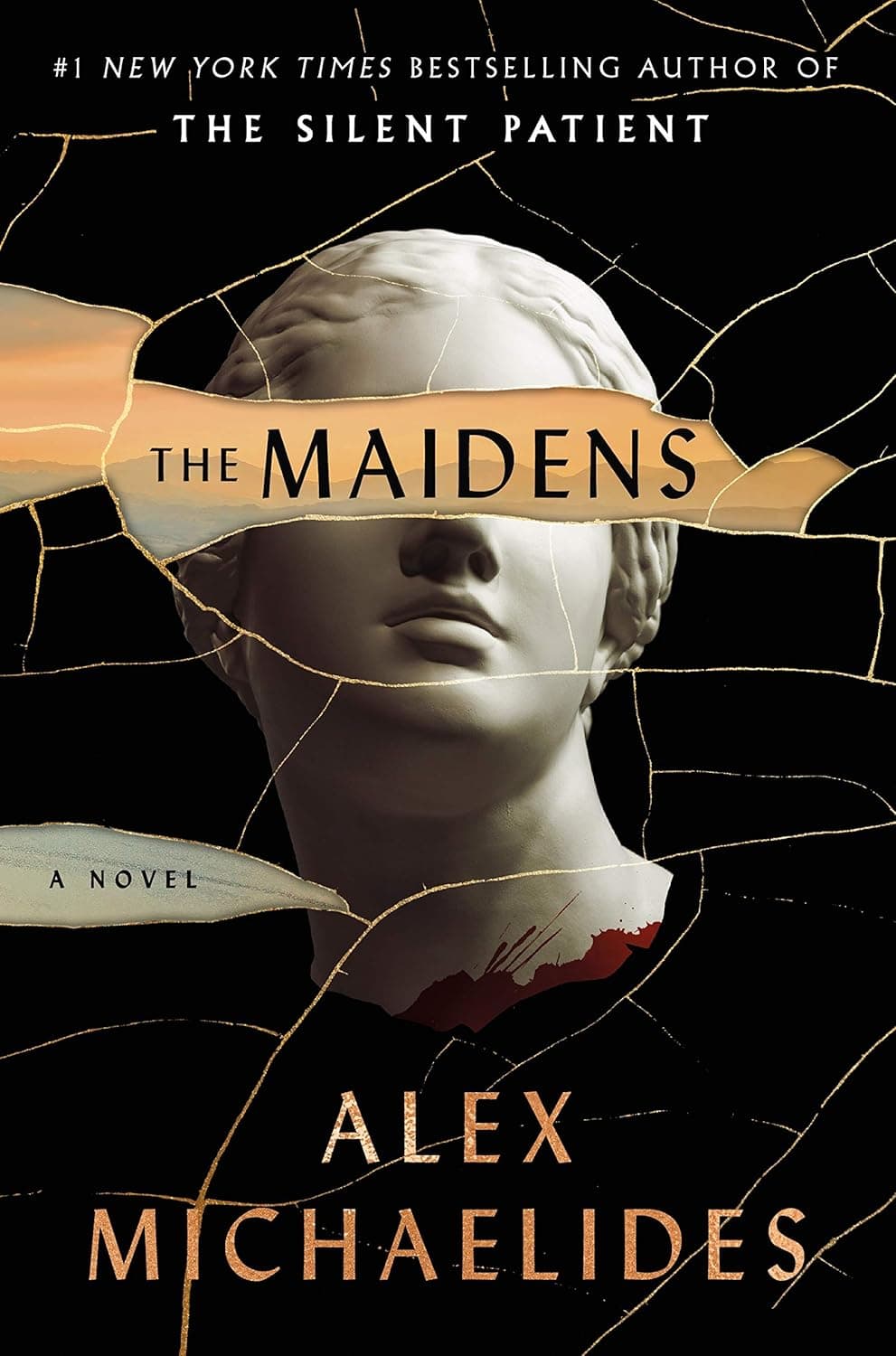
What This Theme Explores
Obsession and fixation in The Maidens ask how love, grief, and intellectual certainty can harden into compulsions that overwrite judgment. The novel tests the boundary between devotion and pathology, showing how “knowing” can feel bodily and yet be utterly wrong. It interrogates whether fixation is a response to loss, a tool for control, or an identity in disguise—and how such intensity can justify harm. Ultimately, it suggests that what looks like passion can curdle into a need to possess, punish, or reenact the past.
How It Develops
From the outset, the narrative locates obsession inside grief: Mariana Andros clings to the memory of her husband, Sebastian, treating objects as reliquaries and routine as ritual. This private fixation is immediately set against a predatory one: Henry Booth’s intrusive attachment to Mariana. When a student is murdered, Mariana’s grief reconstitutes itself as certainty—she fixates on Edward Fosca as the killer and refuses alternatives, transforming pain into purpose.
As the investigation deepens, the theme widens from the individual to the collective. The secret society of The Maidens orbits Fosca with liturgical intensity, their devotion mirroring Mariana’s prosecutorial zeal. Even seemingly benign intensity appears in Fred, whose instant conviction that he and Mariana are fated to be together offers a softer, yet still unsettling, portrait of fixation’s persistence.
With further deaths, obsession becomes both plot engine and misdirection. The story uses Mariana’s certainty to narrow the field of vision—hers and ours—while flashing the psychological roots of compulsion: the hunger to make chaos legible, the seduction of ritual and pattern, the promise that control can be regained if the right narrative is enforced.
The ending reframes everything: Zoe is unmasked as the murderer, her crimes animated by a lifelong, possessive obsession with Sebastian. In exposing Sebastian as a manipulator who cultivated that fixation, the novel suggests that one obsessive force breeds another. Mariana’s wrongheaded pursuit still matters—its relentless pressure smokes out the truth—but the final turn insists that obsession’s confidence is not evidence; it is a story we tell ourselves until reality breaks it.
Key Examples
The book’s most vivid moments expose how fixation distorts feeling into compulsion and idea into action.
-
Mariana’s obsessive mourning: Her grief ritualizes Sebastian’s absence, turning objects into talismans that seem to postpone loss and keep love “alive.” This is fixation as a sanctuary that slowly becomes a prison, anchoring her to the past even as danger gathers in the present.
Instead, Mariana brought the shoes close to her chest. She cradled them tight, as she might a child. And she wept. ... That’s why she couldn’t throw away his possessions—by holding on to them, she could keep Sebastian alive, somehow, just a little bit—if she let go, she’d lose him entirely. — Prologue
-
Henry’s pathological attachment: Henry’s stalking, boundary violations, and self-harm dramatize obsession as a demand for care that brooks no refusal. His escalating gestures—culminating in carved crosses—translate need into coercion, showing how fixation can weaponize vulnerability. (See Chapter 1-5 Summary.)
-
Mariana’s certainty about Fosca: From the instant she hears his name, Mariana’s “knowledge” of Fosca’s guilt is visceral, not evidentiary—a felt truth that narrows inquiry. The line between intuition and obsession blurs, and conviction becomes a cage for both sleuth and reader.
Edward Fosca was a murderer. This was a fact. This wasn’t something Mariana knew just on an intellectual level, as an idea. Her body knew it. She felt it in her bones, along her blood, and deep within every cell.
-
Zoe’s all-consuming “love”: Zoe’s confession recasts her crimes as a devotional program to honor and complete the fantasy she shared with Sebastian. Her fixation masquerades as romance, but its logic is annihilating: to preserve an idea of love, she destroys everything that contradicts it.
"I loved him, Mariana. I loved him— ... It’s true. I’ve been in love with Sebastian ever since I can remember—ever since I was a little girl. And he loved me." — Chapter 81-83 Summary
Character Connections
Mariana Andros’s arc is a study in transferred obsession. Her memorial fixation on Sebastian becomes prosecutorial fixation on Fosca; each grants structure to grief, but also blinds her to Zoe. Crucially, her obsession is double-edged: it distorts her reasoning, yet sustains the tenacity that ultimately exposes the truth.
Zoe embodies fixation as identity. She scripts herself as Sebastian’s chosen counterpart and then edits reality—through ritual, murder, and manipulation—until it matches the story. Her collapse shows how obsession reorders morality: once the story must survive, people become expendable.
Sebastian, revealed posthumously, is the seedbed of other fixations. His charisma and control foster Zoe’s dependency; his “love” functions as dominance, illustrating how narcissistic obsession recruits a partner’s psyche as its stage.
Edward Fosca is a magnet for other people’s fixations. By curating The Maidens’ devotion and aestheticizing his authority, he thrives on being the center of others’ intense regard. He is not the murderer, but he normalizes obsessive attention as a social currency.
Henry Booth translates unmet needs into compulsion. His behaviors echo the novel’s link between fixation and unresolved hurt, aligning with the dynamics of childhood trauma and its consequences: desperation seeks certainty, and certainty seizes on a person.
Fred offers a gentler, yet telling, portrait: infatuation framed as destiny. His “premonitions” are intrusive but protective; the novel uses him to show that fixation can trend toward care—without ceasing to be uneasy.
Symbolic Elements
Sebastian’s possessions: Shoes, clothes, and books function as reliquaries for Mariana’s grief. They grant the illusion of continuity while binding her to a frozen past, a material map of how obsession turns memory into ritual.
The Maidens: The white dresses, secrecy, and ceremonial cohesion present collective obsession as a cult of aesthetics. Group devotion beautifies control, revealing how fixation is easier to obey when it looks like tradition.
Greek frameworks: Recurring motifs from Greek mythology and tragedy—especially Persephone—become the killer’s template. Myth supplies a script that justifies violence as “fate,” letting obsession masquerade as destiny.
The postcards: Each carefully chosen tragic quotation is a calling card of ritualized control. They codify the murders as a literary game, flaunting fixation as intellect and turning investigation into a choreography the killer believes they direct.
Contemporary Relevance
In an era of stan culture, parasocial bonds, and algorithmically amplified devotion, The Maidens traces how admiration mutates into entitlement and control. Its depiction of a charismatic academic surrounded by a fervent coterie resonates with ongoing scrutiny of power, consent, and institutional glamour. The novel also underscores how unaddressed trauma seeks certainty in scripts—romantic, intellectual, or mythic—highlighting the urgency of mental-health literacy before need ossifies into compulsion.
Essential Quote
Edward Fosca was a murderer. This was a fact. This wasn’t something Mariana knew just on an intellectual level, as an idea. Her body knew it.
This sentence crystallizes obsession’s epistemology: it feels like truth because it is felt. By elevating conviction over evidence, the novel shows how fixation narrows reality to fit the body’s insistence—seductive, propulsive, and catastrophically wrong. The line thus becomes the story’s compass and its misdirection, guiding Mariana forward while steering her astray.