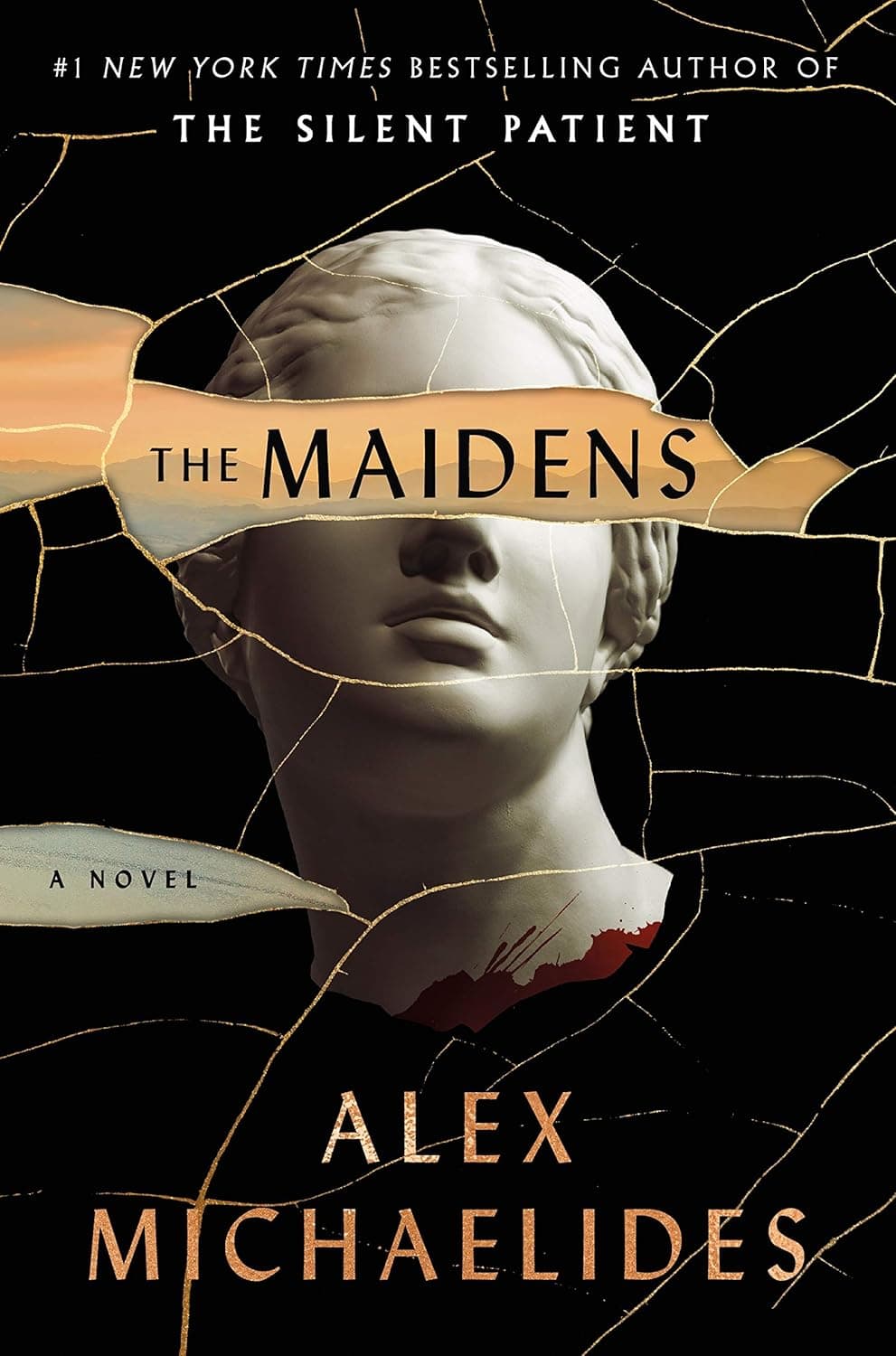
At a Glance
- Genre: Psychological thriller; dark academia; gothic suspense
- Setting: Cambridge University (St. Christopher’s College), with echoes of London and the Greek island of Naxos
- Perspective: Primarily third-person focused on Mariana Andros, intercut with disturbing, anonymous diary entries
Opening Hook
A call in the night yanks grief-stricken therapist Mariana Andros back into the world she’s been avoiding. Her niece Zoe is terrified—her best friend at Cambridge has vanished—and the shadows around the ancient college feel suddenly alive. When the body is found, Mariana’s pain hardens into purpose: she knows who did it. The charismatic classics professor Edward Fosca holds court over a secret coterie of young women called the Maidens, and from the first page Mariana believes he’s a killer. But on these cloistered grounds, certainty can be fatal.
Plot Overview
Act I: The Call and the Circle
Still gutted by the death of her husband Sebastian, Mariana lives inside a fog of Grief and Loss. Then comes the frantic plea from her niece, Zoe: Zoe’s best friend, Tara Hampton, is missing from St. Christopher’s College. Mariana rushes to Cambridge, where Tara is soon discovered murdered. Before she vanished, Tara had confided that her life was being threatened by the magnetic Greek Tragedy professor Edward Fosca. The suspicion ignites Mariana’s own Obsession and Fixation: as she asserts in the Prologue, she is certain of Fosca’s guilt. She learns he presides over a handpicked group of female students—the Maidens—of which Tara was a member. To Mariana, he looks like a cult leader; to everyone else, she looks unhinged.
Act II: The Hunt
The campus grows tighter and darker as two more Maidens are slain, each killing signaled by a postcard quoting Greek drama. The ritual pattern threads the story’s Theme Overview and underscores its reliance on Greek Mythology and Tragedy: sacrifice, fate, and the violent echo of ancient grief. Mariana’s only steady ally is Fred, a clever, earnest PhD student who harbors a crush on her. Meanwhile, a volatile former patient, Henry Booth, stalks her through Cambridge, complicating the investigation and feeding the police perception that Mariana is unstable. Red herrings multiply, and Mariana’s certainty about Fosca becomes both her armor and her blindfold.
Act III: The Revelation
When Mariana becomes convinced that Zoe is the next target, she rushes to a lonely riverside folly where Zoe claims the weapon is hidden. There, the mask drops: Zoe is the murderer. She confesses she had been seduced and manipulated by Sebastian; behind his golden façade was an amoral predator who engineered a plot to murder Mariana for her inheritance, using Zoe to kill the Maidens and frame Fosca. Sebastian’s accidental death in Naxos didn’t erase the plan—Zoe finished it, a last, twisted act of devotion.
Aftermath
In the frantic confrontation recounted in the Chapter 81-83 Summary, Zoe attacks; Fred intervenes and is gravely stabbed, buying Mariana the moment she needs to overpower her. The Epilogue reveals Zoe committed to the Grove psychiatric unit, now treated by Theo Faber, the protagonist of The Silent Patient. Mariana is left to sift the rubble of Deception and Betrayal—her marriage, her memories, her sense of self—wondering what was ever real. For deeper detail, see the Full Book Summary.
Central Characters
A full cast list appears on the Character Overview page.
“We all secretly hope that tragedy will only ever happen to other people. But Mariana knew, sooner or later, it happens to you.” — see more on Quotes
- Mariana Andros
- A gifted group therapist gutted by loss and susceptible to certainty. Her tunnel-vision pursuit of Fosca becomes a way to transmute pain into action. The final reveal forces a brutal reckoning: her marriage was a masterpiece of deceit, and survival now means rebuilding a self beyond grief.
- Zoe
- Initially the fragile niece and seeming damsel; ultimately the novel’s cold center. Her obsession with Sebastian, stoked by grooming and betrayal, curdles into violence. Zoe embodies how love warped by power becomes devotion without conscience.
- Edward Fosca
- A brilliant, preening academic who abuses soft power—attention, exclusivity, aura. He is the perfect red herring: morally compromised, theatrically suspicious, and utterly convinced of his own myth, yet not a murderer.
- Sebastian
- Present as memory until the truth reframes him as the story’s hidden monster. Charming, calculating, and predatory, he manipulates from beyond the grave, proving that the dead can still orchestrate ruin.
- Fred
- Earnest, awkward, and kind—the novel’s moral anchor. He steadies Mariana’s descent and ultimately risks everything to save her, a quiet heroism that counters the predatory men around her.
- Henry Booth
- A disturbed former patient whose fixation on Mariana casts long, threatening shadows. He’s a reminder that danger isn’t always the culprit you suspect—but the chaos they invite can be just as deadly.
Major Themes
-
Grief and Loss
- Grief and Loss is the novel’s engine and Mariana’s compass, even when it points the wrong way. Her mourning becomes a filter that distorts evidence and elevates intuition over clarity, illustrating grief’s power to both motivate and mislead.
-
Appearance vs. Reality
- The Cambridge idyll hides predation, jealousy, and ritual violence; façades outnumber truths. Explored further on Appearance vs. Reality, the novel delights in misdirection: Sebastian’s saintly mask, Zoe’s innocence, Fosca’s theatrical villainy, and a campus that looks like sanctuary but functions as a maze.
-
Greek Mythology and Tragedy
- Through lectures, inscriptions, and staged aesthetics, Greek Mythology and Tragedy frame the plot as a modern ritual of sacrifice and fate. The Maidens echo Persephone; the postcards summon Euripides; and the narrative asks whether ancient scripts still govern modern desires.
-
Childhood Trauma and Its Consequences
- The killer’s diary entries and Mariana’s own upbringing trace how early wounds metastasize into adult harm. Childhood Trauma and Its Consequences becomes both explanation and warning: pain that isn’t healed seeks repetition.
-
Obsession and Fixation
- The story hinges on obsessions—Mariana’s pursuit of Fosca, Zoe’s devotion to Sebastian, Fosca’s curation of the Maidens. Obsession and Fixation shows how desire masquerades as purpose until it crosses into compulsion, narrowing vision and enabling violence.
-
Deception and Betrayal
- Love and trust are weaponized: Sebastian grooms and deceives; Zoe betrays the only person trying to save her. Deception and Betrayal leaves Mariana questioning every memory, underscoring how the cruelest lies are the ones we want to believe.
Literary Significance
The Maidens cements Alex Michaelides’s signature blend of Agatha Christie–style misdirection and psychological acuity. As a defining entry in dark academia, it leverages Cambridge’s cloisters and secret societies to create a beautiful, breathless trap—where status, scholarship, and seduction blur. The cameo of Theo Faber in the Epilogue stitches The Maidens to The Silent Patient, hinting at a shared universe of damaged healers and predatory charmers. Its twist invites debate, but its atmosphere, structural cunning, and meditation on grief keep it lodged in readers’ minds.
Historical Context
Published in 2021, the novel rode a wave of dark academia’s popularity on social platforms, channeling the aesthetic’s fascination with candlelit libraries, exclusivity, and the romance of classical learning. It also engages contemporaneous conversations about power dynamics in universities: Fosca’s behavior illustrates how charisma and mentorship can shade into grooming, even when they stop short of criminality.
Critical Reception
Points of Praise
- Atmosphere: Critics lauded the immersive Cambridge setting and its gothic tension.
- Pacing: A propulsive, clue-studded narrative that rewards quick reading.
- Classic Structure: A closed circle of suspects, artful red herrings, and a bold final reveal.
Points of Criticism
- The Twist: The Zoe–Sebastian conspiracy divided readers—ingenious to some, contrived to others, and often compared unfavorably to The Silent Patient’s coup.
- Characterization: Several found the Maidens and side figures sketched as types rather than fully inhabited lives.
- Protagonist’s Choices: Mariana’s risk-taking and ethical lapses strained credibility for a trained therapist, frustrating some reviewers.