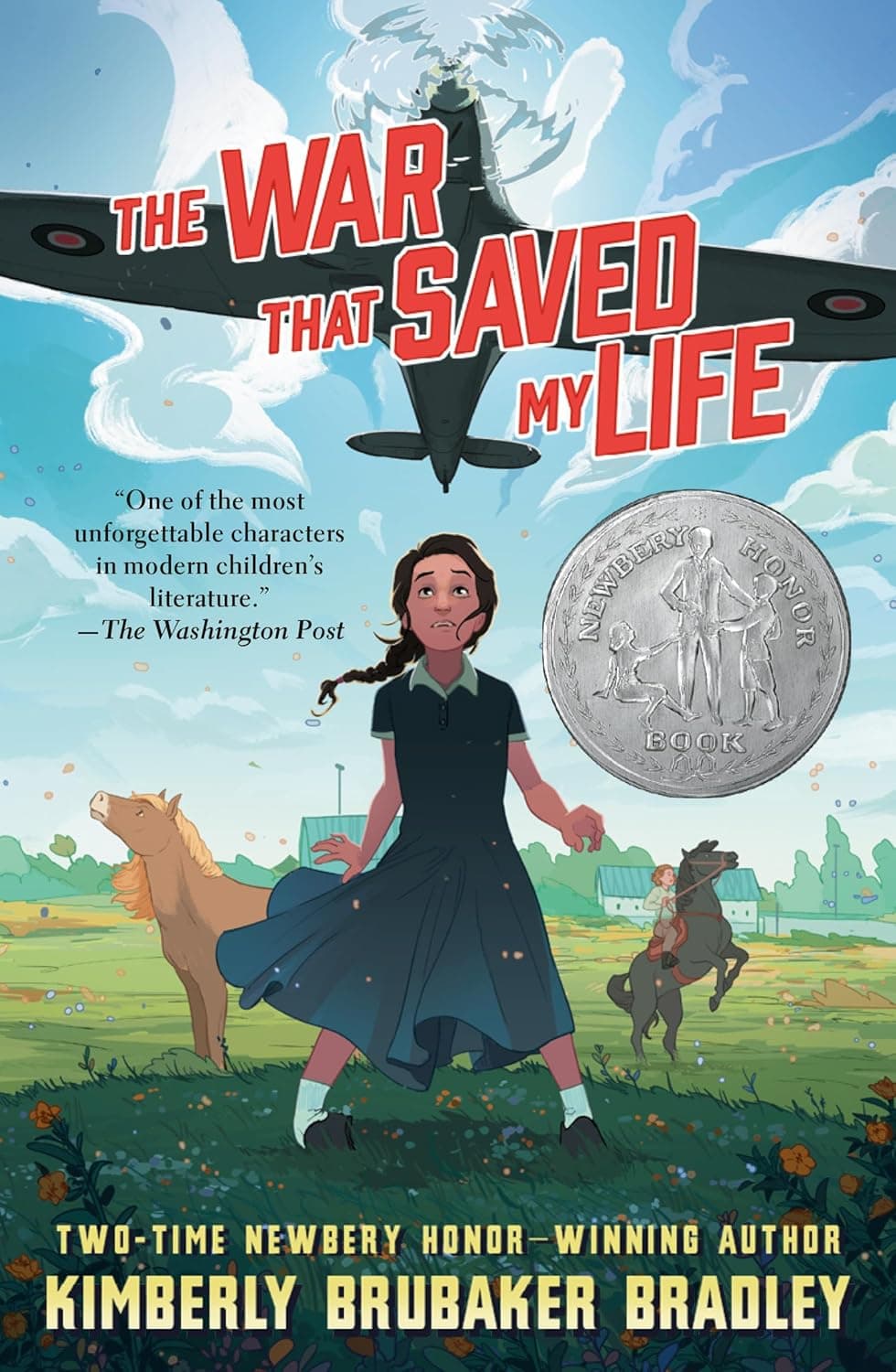
Opening Context
Set in wartime Britain, the cast of The War That Saved My Life navigates evacuation, scarcity, and fear while forging bonds that challenge what “family” means. Across class lines and country lanes, wounded children and wounded adults meet—and slowly teach each other trust, dignity, and love. The war threatens them, but it also creates the space for reinvention.
Main Characters
The story centers on the abused child learning to claim a life of her own, the grieving woman who becomes an unexpected mother, and the biological parent whose cruelty must be overcome.
Ada Smith
Ada is the novel’s narrator and beating heart, escaping a life of confinement to discover competence, courage, and self-worth. Terrified of kindness after years of cruelty, she nonetheless pushes herself—teaching herself to walk, learning to read and ride, and noticing everything—to protect her younger brother, Jamie, and make sense of a wider world. Under Susan’s steady care, she begins to believe she is worthy of safety and love, even as shame and anger from Mam’s abuse resurface. Her bond with the pony Butter becomes a bridge to freedom she can feel in her body long before she can trust people. Through evacuation and air raids, she realizes she is not her mother’s verdict; war becomes the unlikely doorway to her new identity and chosen family.
Susan Smith
Susan begins as a reluctant guardian—depressed, solitary, and convinced she isn’t “nice”—but proves herself practical, principled, and fiercely protective. An Oxford-educated woman who hides gentleness behind brisk competence, she feeds, clothes, and advocates for the children before she can name her affection. Caring for Ada and Jamie interrupts her grief for Becky and quietly restores her sense of purpose; as she learns the contours of the children’s trauma, she adjusts, persists, and chooses them again and again. By the end, she claims the role of mother not by sentiment but by action, standing between the children and harm and making their home together undeniable.
Mam
Mam is the story’s antagonist: a cruel, shaming force whose neglect and violence imprison her children. She favors Jamie for being “normal,” yet offers neither child real care, defining Ada only by her clubfoot and enforcing isolation as punishment. Static to the last, she returns unchanged—her rejection severing the final thread that tied the children to their old life. In refusing them, she unwittingly frees them to belong with Susan.
Supporting Characters
Jamie Smith
Jamie is Ada’s younger brother and the immediate reason she flees London, his safety anchoring her every risk. He arrives sweet, frightened, and homesick, but steadies under Susan’s routines, gradually turning to her for comfort as he outgrows survival habits learned under Mam. His attachment to the cat Bovril and his fading bedwetting quietly mark his own healing and the security of a real home.
Lady Thorton
Lady Thorton oversees billeting and the WVS with an iron face and genuine sense of duty, embodying the village’s upper-class authority. Initially rigid with Susan, she softens as she witnesses Susan’s devotion and faces her own maternal fear for her pilot son, Jonathan. Her evolution from officious gatekeeper to uneasy ally maps the story’s broader collapse of class barriers under wartime pressure.
Fred Grimes
Fred is the Thorton estate’s groom and an unassuming father figure to Ada. Patient and expert with horses, he treats her as capable, teaching her to care for and ride Butter without pity or fuss. His steady presence grounds Ada’s growth, confirming that competence and respect can replace shame.
Maggie Thorton
Maggie becomes Ada’s first true friend, meeting her as an equal despite class differences. A skilled rider with her own family tensions, she recognizes Ada’s grit and offers uncomplicated camaraderie. Their shared love of horses opens a door to ordinary girlhood Ada has never known.
Minor Characters
- Stephen White: A boy from Ada’s London lane who carries her to the train and first challenges the lie that she is “simple,” planting a seed of self-belief.
- Colonel McPherson: The blind, elderly man Stephen tends; gruff yet emblematic of duty and old-world propriety.
- Dr. Graham: The village doctor who examines Ada’s foot and introduces the possibility of surgical correction, reframing her “difference” as treatable rather than shameful.
- Butter: Susan’s pony, inherited from Becky; for Ada, a living symbol of Freedom and Imprisonment, translating control and joy into muscle and motion.
- Bovril: The stray cat Jamie adopts, signaling comfort that is his own and coinciding with the end of his bedwetting.
- Daisy: The publican’s daughter who labors alongside Ada during Dunkirk, forging a brief bond in shared crisis.
Character Relationships & Dynamics
At the novel’s center is the found family of Ada, Jamie, and Susan, a trio forged by wartime necessity and sustained by daily acts of care. Susan’s practical nurture—boots that fit, food without strings, a firm word against cruelty—meets Ada’s fierce protectiveness of Jamie, slowly transforming vigilance into trust. As Jamie begins to seek comfort from Susan, Ada must renegotiate her role from sole protector to sister-daughter within a real household, a shift that both threatens and ultimately deepens her sense of belonging.
In stark contrast stands the biological family with Mam, where neglect and abuse define every interaction. Mam’s contempt teaches Ada to anticipate pain and to see herself as a burden; Jamie’s fragile loyalty to the familiar underscores how trauma can masquerade as home. The children’s final break with Mam makes explicit the novel’s moral geometry: family is proved by protection, not blood.
Mentors and peers widen Ada’s world. Fred’s quiet respect gives her a language of skill and responsibility; Maggie’s friendship offers the ordinary social freedom of a girl among equals. Stephen’s early kindness and Dr. Graham’s medical clarity puncture the lies Ada has been told about her body and worth. Around them, Lady Thorton’s wary authority bends toward empathy, and the village—brought together by evacuation and Dunkirk—becomes a web of small alliances that sustain the children when bombs and bureaucracy fail.
Together, these dynamics trace a movement from isolation to interdependence: a child learning she is not a monster, an adult remembering she can love, and a community discovering that survival is a collective art.