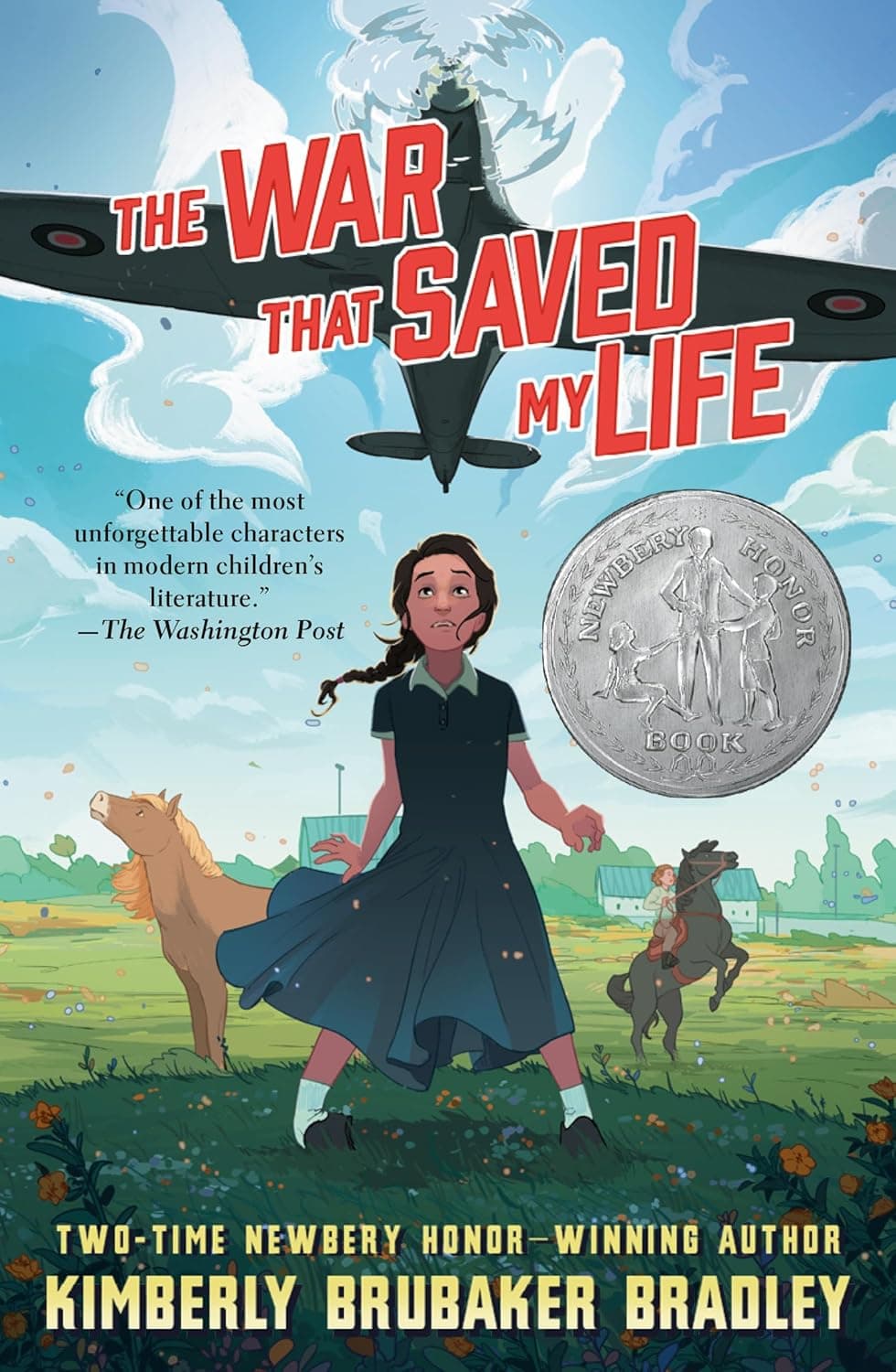
The War That Saved My Life — Summary & Analysis
At a Glance
- Genre: Middle-grade historical fiction
- Setting: England, 1939–1940; London and the Kent countryside
- Perspective: First-person, narrated by Ada Smith
- Core Focus: Trauma, healing, and the making of a found family amid World War II
Opening Hook
Ten-year-old Ada Smith has never stepped outside her London flat. Her mother, Mam, calls her a monster and locks her away because of her untreated clubfoot. When the government orders children evacuated from the city, Ada refuses to be left behind while her brother Jamie is sent to safety. She teaches herself to walk in secret—one agonizing step at a time—and runs toward a life she has never been allowed to imagine.
Plot Overview
The story begins in a single-room London flat where Ada lives as a captive to Mam’s violence and shame. Through a tiny window, she watches other children play and dreams of air and light. When London announces the evacuation of children to the countryside, Mam decides only Jamie will go. In a desperate act of will, Ada slowly learns to walk—an escape plan detailed in the Chapter 1-5 Summary—and slips away with her brother to the trains.
In a Kent village, the last two unclaimed evacuees are taken in by Susan Smith, a reluctant, grieving woman who doesn’t think she’s fit to care for children. Susan’s cottage opens Ada’s world: warm baths, steady meals, clean clothes, and the startling freedom of open fields. Susan gets Ada crutches, and with them comes movement, dignity, and a sense of possibility. Ada discovers Butter the pony and, with help from Maggie Thorton and Fred Grimes, learns to ride—mastery that feels like flight. Trust is slower. Ada, conditioned by years of cruelty, fears kindness has a trap. Susan teaches her to read and write; slowly, the letters line up into a new way of seeing herself.
As the “Phoney War” ends and the Battle of Britain begins, danger reaches their village skies. Air-raid drills, shelters, rationing, and rumors of spies become part of daily life. Ada’s courage crystallizes when she spots a German spy coming ashore and alerts the authorities, becoming a local hero—an act that powers her emerging Identity and Self-Worth. For Ada, bravery is no longer just survival; it’s choosing to belong.
Then Mam arrives. She drags Ada and Jamie back to London, insisting Susan never really wanted them. The old terror resurfaces: Mam seizes Ada’s crutches and locks her in again.
“You ain’t going out of this room. Got that? ’Cause I don’t need the world shaming me for having a crippled girl.” When a devastating air raid rips through their neighborhood, Ada and Jamie flee into the wreckage. Susan—who has traveled to London, desperate and determined—finds them. Back in Kent, they discover Susan’s house has been bombed; neighbors have been digging in the rubble, fearing the worst. Amid the destruction, Ada finally believes the truth: she is loved. Home is not a place—it’s Susan, and the family they choose together.
Central Characters
The novel’s heart is the fragile, fierce triangle of Ada, Jamie, and Susan, surrounded by a village that challenges and changes them. For more detail, see the full Character Overview.
-
- Who she is: A bright, angry, and resourceful girl whose world has been narrowed by abuse and an untreated clubfoot.
- Arc: From locked-away “monster” to rider, reader, and rescuer; she learns to trust, to claim joy, and to name herself worthy.
- Defining moments: Teaching herself to walk; riding Butter; catching a spy; choosing Susan as family.
-
- Who she is: A solitary woman grieving the loss of Becky, doubtful she can mother anyone.
- Arc: Care becomes purpose; protection becomes love. She rebuilds a life by building a family.
- Defining moments: Getting Ada crutches; insisting on school and literacy; crossing bombed London to bring the children home.
-
- Who he is: Ada’s lively younger brother, torn between loyalty and fear.
- Arc: Learns safety beyond Mam’s flat, bonds with Susan, and grows into steadier confidence.
- Defining moments: Evacuation, adjusting to village life, and choosing Susan with Ada.
-
- Who she is: The source of Ada’s trauma—cruel, shaming, and immovable.
- Arc: Static. Her hardness clarifies what love is not and propels Ada’s final break from the past.
-
- Role: Brisk leader of the local WVS whose rigidity masks real care; she helps weave the community net around the children.
-
- Role: Ada’s first friend; their cross-class friendship widens Ada’s world and self-image.
-
- Role: The stableman who teaches Ada horsemanship and quiet steadiness—another model of gentle strength.
Major Themes
For a full map of ideas, see the Theme Overview.
-
Trauma, Abuse, and Healing
- The novel shows how cruelty reshapes belief: Ada internalizes shame until safety lets her question it. Healing is halting and nonlinear—made of small risks, repeated kindness, and the daily work of relearning one’s worth.
-
The Meaning of Found Family
- Biology offers no guarantees. Ada, Jamie, and Susan gradually choose one another, proving that love is built through care, constancy, and shared courage. Found family becomes the antidote to the harm of the past.
-
War as a Catalyst for Change
- World War II devastates—and frees. The evacuation pries open Ada’s prison and thrusts her into the conditions where she can grow. The title’s paradox underscores the personal salvations that can emerge from historical catastrophe.
-
Freedom and Imprisonment
- The book contrasts locked rooms with open fields, but also highlights inner captivity: the lies Ada believes about herself. Mobility, literacy, and trust mark her passage from confinement to genuine freedom.
-
Courage and Resilience
- Heroism lives in daily acts: standing, walking, asking for help, saying yes to love. Ada’s spy-catching is dramatic, but the novel insists that persistence against fear is its own quiet revolution.
Literary Significance
Winner of a Newbery Honor and the Schneider Family Book Award, The War That Saved My Life expands the possibilities of children’s historical fiction. Kimberly Brubaker Bradley fuses meticulous home-front detail—Operation Pied Piper, the Battle of Britain, class and disability stigma—with an intimate first-person voice that never condescends to young readers. Ada’s limited early understanding makes each discovery feel earned, while the wartime setting is not backdrop but catalyst, shaping character and choice. The result is a novel that treats trauma with honesty, models recovery without simplification, and argues convincingly that love, chosen and proven, can remake a life. For memorable lines and pivotal moments, visit the book’s Quotes page.