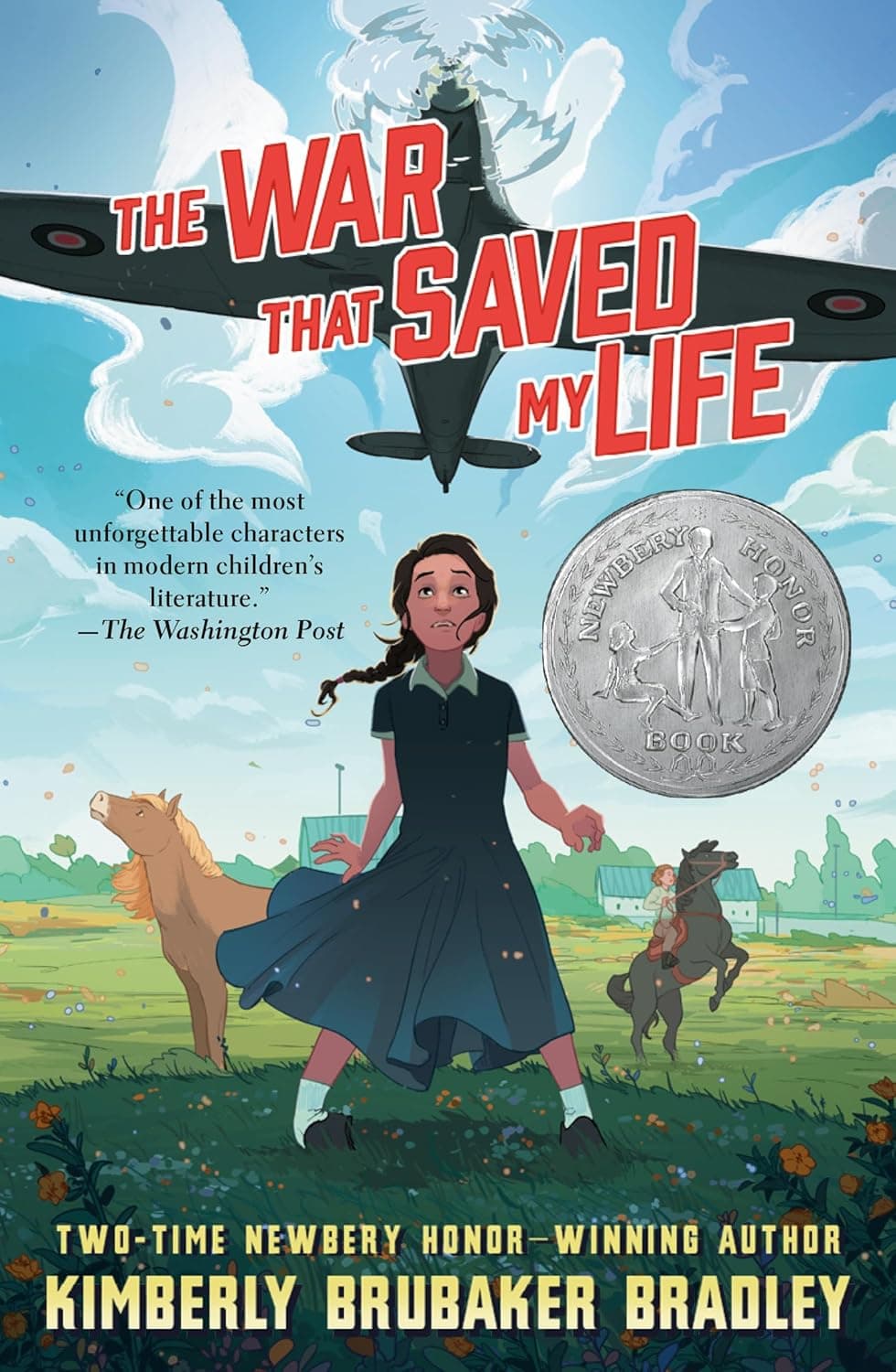
Ada Smith
Quick Facts
- Role: Protagonist and first-person narrator of The War That Saved My Life
- Age: Ten at the novel’s start; born with an untreated clubfoot
- Setting: From a one-room London flat to the Kent countryside during WWII
- First appearance: Locked inside her mother’s flat, caring for her younger brother
- Core ties: Protective sister to Jamie; wary evacuee who grows into a beloved daughter figure; first real friend is Maggie; finds freedom through riding Butter
Who They Are
Ten-year-old Ada Smith is the novel’s beating heart: a girl who claws her way from a childhood of captivity to a hard-won sense of self. Imprisoned by her abusive mother, Mam, and driven by ferocious devotion to her younger brother, Jamie Smith, Ada’s life has been defined by shame over her clubfoot, hunger, and isolation. The WWII evacuation cracks her prison wide open. As she stumbles into safety and care, the story probes how trauma reshapes thought and behavior, and how dignity is relearned through love—central questions in Trauma, Abuse, and Healing and Identity and Self-Worth. Even Ada’s first glimpse of herself in a mirror at the train station—shock at her pallor, clumpy hair, and grubby clothes—captures a child seeing herself, and her possibilities, for the first time.
Personality & Traits
Ada’s temperament blends fierce survival instincts with a stubborn, budding belief that she is worth more than the life she’s been given. Abuse has made her hypervigilant and mistrustful, but it has not extinguished her intelligence, protectiveness, or appetite for freedom.
- Resilient and determined: She secretly teaches herself to walk, shredding her thin skin and enduring excruciating pain. Later, she refuses to quit until she can ride Butter and jump walls.
- Fiercely protective: Ada parents Jamie—scrounging food, keeping him quiet to avoid beatings, and dragging him out of London with the evacuees to save him.
- Guarded and fearful: Conditioned to expect blows, she braces for punishment from adults and “goes away inside [her] head” when overwhelmed, a trauma coping strategy that takes time to unlearn.
- Intelligent and observant: Illiterate but quick-thinking, she studies people from her window and reads social cues; that same acuity later helps her spot a German spy.
- Proud and stubborn: Ada resists charity and balks at reading lessons because accepting help feels like admitting weakness—echoes of Mam’s shaming.
- Brave: Her courage is practical and hard-earned, a hallmark of Courage and Resilience—from limping through escape to standing up to officials while reporting a spy.
Character Journey
Ada’s arc traces a path from confinement to hard-won freedom—an embodiment of Freedom and Imprisonment. In London, Mam’s cruelty defines Ada’s self-image: she is “rubbish,” unlovable, and damned by her foot. Teaching herself to walk is the first act of rebellion, staking a claim on her body and future. Evacuation to Kent feels like stepping into color after grayscale: green fields, open sky, and the astonishing speed of a pony beneath her. Yet early kindness terrifies her; safety itself feels suspect.
Slowly, care and routine—baths, food, clean clothes, and gentle instruction—unspool her defenses. Riding Butter makes speed and control tangible; reading begins to stitch language to self-respect. But healing is jagged: the dark of air-raid shelters echoes Mam’s cabinet, and on Christmas Eve, being called “beautiful” detonates years of internalized contempt. The turning point arrives when Mam returns to reclaim the children. Ada goes back to London out of duty to Jamie, but she is no longer inwardly captive. After the Blitz, her rescuer appears through smoke and rubble; choosing that love—and being chosen in return—cements The Meaning of Found Family. War remains a terror, but paradoxically, it is also the opening that lets Ada step into a life where she is safe, wanted, and free.
Key Relationships
-
Jamie Smith: Ada’s bond with Jamie is her first purpose and identity—protector, parent, anchor. In Kent, Jamie adapts faster and warms to their guardian more easily, which needles Ada’s jealousy and fear of being left behind. Learning to trust that Jamie’s growing independence won’t erase their bond helps Ada shift from mere survival to real sisterhood.
-
Susan Smith: With Susan Smith, love is practical—meals, baths, boots—and patient, the opposite of Mam’s conditional scorn. Susan’s quiet insistence that Ada is capable and worthy (literacy lessons, riding, advocacy) gives Ada language and proof for a new self-concept. Their relationship evolves from wary necessity into chosen kinship, the novel’s emotional center.
-
Mam: As antagonist and early world-maker, Mam teaches Ada to equate love with pain and disability with moral failure. The final confrontation doesn’t reform Mam; it reforms Ada’s understanding of herself. Recognizing that Mam’s hatred is about Mam—not Ada—severs the last psychological chain.
-
Maggie Thorton: As Ada’s first peer friend, Maggie Thorton treats her like a normal girl who can ride, squabble, and apologize. Friendship with Maggie widens Ada’s world beyond family and survival, normalizing joy and play, and confirming she belongs among other children.
-
Butter (the pony): More than transport, Butter is a bridge between body and freedom. Riding translates inner grit into physical grace, helping Ada feel strong, fast, and in control after a childhood of stillness and shame.
Defining Moments
Even as Ada’s growth is gradual, certain scenes crystallize who she was—and who she is becoming.
- Teaching herself to walk: Secret practice shreds her feet but proves her will. Why it matters: Ada refuses the identity imposed on her; she claims her body as her own tool, not her sentence.
- The girl on the pony: From the evacuation train, she sees a rider soar a stone wall and vows, “I’m going to do that.” Why it matters: Desire becomes direction; she can imagine a future self.
- First mirror at the station: Shock at her pallor and grime exposes how little she’s been able to see herself. Why it matters: Recognition—however painful—is the precondition for change.
- Christmas Eve breakdown: Being called “beautiful” collides with Mam’s insults and triggers a panic attack. Why it matters: Affection can feel dangerous when it contradicts an abuser’s script; healing means learning to tolerate goodness.
- Catching the spy: Ada insists on reporting suspicious behavior and is vindicated. Why it matters: She uses her voice publicly, reframing herself from “rubbish” to reliable, capable citizen.
- Returning with Mam: She goes to London to safeguard Jamie, not from submission. Why it matters: Duty without self-erasure—Ada acts from strength, not fear.
- Rescue after the Blitz: Through smoke and wreckage, her chosen guardian claims her. Why it matters: Belonging is no longer conditional or fragile; it survives even when the house doesn’t.
- War as a Catalyst for Change: Evacuation is both danger and doorway. Why it matters: War’s chaos creates the very cracks through which Ada’s new life grows.
Essential Quotes
She was my mother, after all. This line compresses Ada’s confused loyalty and the tyranny of obligation. Abuse has taught her that “mother” is unbreakable law, even when that law destroys her; the novel’s arc asks her to separate title from love and duty from self-erasure.
I was hungry, and I was alone, and I was trapped, and right now, no matter what, you have to do what I say. You have to stay here with me. I’m the person who keeps you safe. Ada’s self-appointed guardianship over Jamie reveals both trauma and authority. She speaks from scarcity—hunger, loneliness, captivity—but also from competence; protecting Jamie is how she survives, and how she learns she can lead.
I would like to speak to your commanding officer. The government asks us to report anything suspicious, and that’s what I am going to do. If you won’t listen, I want to talk to someone who will. Here Ada claims institutional respect, demanding to be heard despite her age and disability. The formality of “commanding officer” signals a new self-possession: she understands systems and insists they take her seriously.
"You’re beautiful." She was lying. She was lying, and I couldn’t bear it. I heard Mam’s voice shrieking in my head. “You ugly piece of rubbish! Filth and trash! No one wants you, with that ugly foot!” The collision of praise and internalized insult dramatizes trauma’s voice inside Ada’s head. Beauty feels impossible—and threatening—because accepting it would mean betraying the narrative that kept her psychologically “safe” under Mam; recovery requires rewriting that script.
I slipped my hand into hers. A strange and unfamiliar feeling ran through me. It felt like the ocean, like sunlight, like horses. Like love. I searched my mind and found the name for it. Joy. “So now we’re even,” I said. This is Ada naming what safety feels like in her body—vast, warm, fast—and recognizing love as reciprocity, not debt. The image chain (ocean, sunlight, horses) ties physical freedom to emotional revelation; “we’re even” reframes care as mutual, not owed.