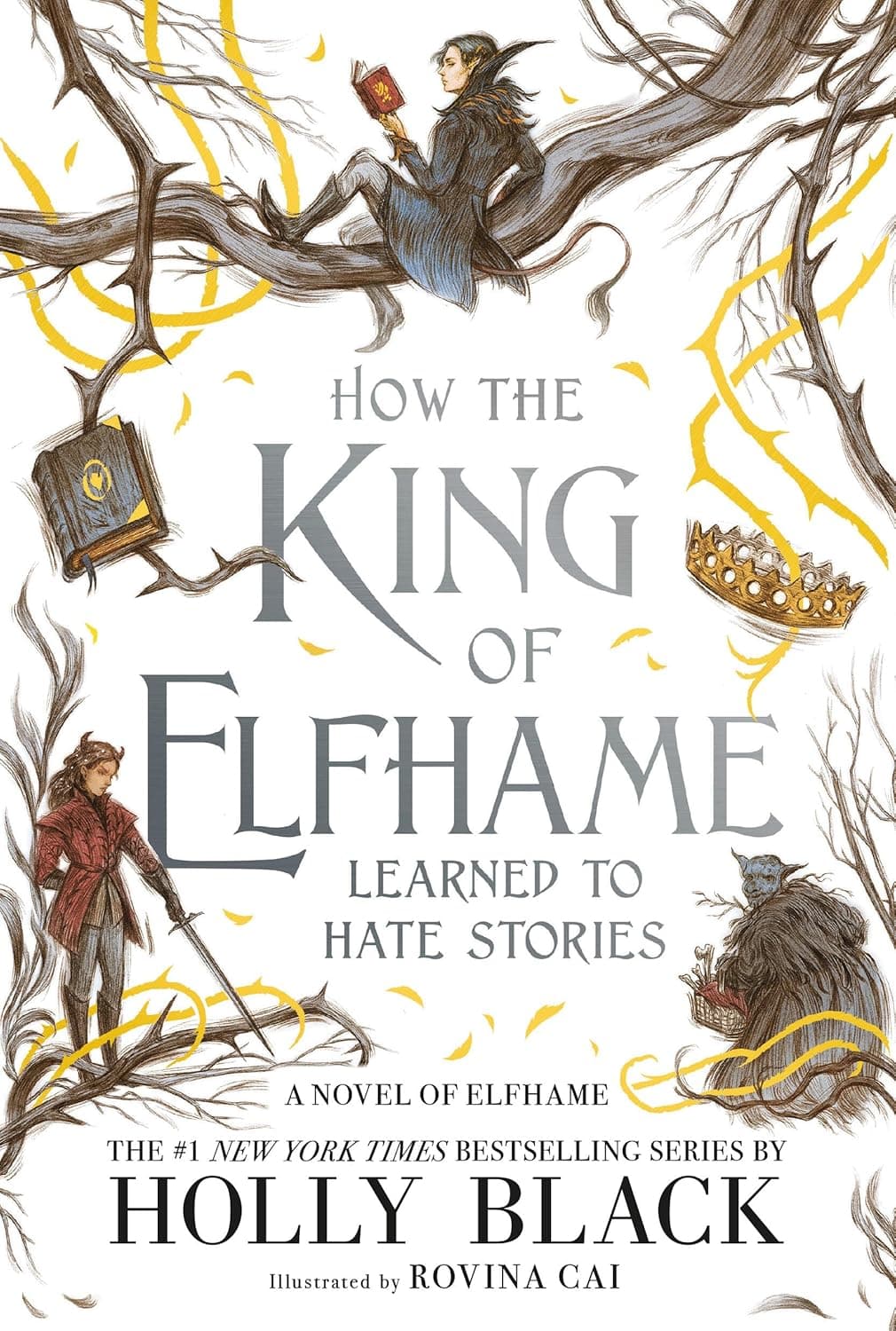
Opening
In these chapters, Prince Cardan ricochets between past and present, from the petty theater of cruelty that forges his obsession to the quiet resolve of a king who chooses mercy. A single old tale—once just a bedtime story—becomes his way to save lives, protect Jude, and change how their world remembers him.
What Happens
Chapter 9: The Prince of Elfhame Stomps Around
After the betrayal by Nicasia and Locke, Cardan sprawls among mortal novels when Nicasia arrives with delicacies from the Undersea, proposing they resume their plan to rule together. He recognizes the truth his brother Balekin once pressed on him—that Nicasia offers power—but realizes he doesn’t want it, or her. When he refuses, she confesses the real reason for her return: Locke has left her for a mortal girl.
Humiliated and furious, Nicasia reframes Locke’s desertion as an insult to Cardan as well and demands retribution. “Punish all three of them,” she urges, pressing him to enlist Valerian to torment the mortals and to force Locke to play along. Cardan sees an opening to become the villain everyone expects, and he agrees, claiming he’d have done it “just for fun.” This choice funnels them toward the river.
On the riverbank, Cardan watches Jude Duarte stand unflinching in freezing water as he and his friends taunt her. He anticipates begging, maybe tears; instead, Jude’s hatred burns steady, and her contempt cuts deeper, as if she sees straight through his act. Shaken, he retreats, feeling as though he’s lost. In the nights that follow, her defiance becomes an obsession—he wants to make her submit, to admire him, or to make her insignificant enough that he can stop thinking about her. A brief flash-forward finds the Roach teaching him a coin trick and telling him, “all you really get to control is yourself,” a lesson Cardan can’t yet manage to apply to his thoughts of Jude.
Chapter 10: The King of Elfhame Tries to Do One Good Thing
In the present, Cardan slips into Jude’s mortal life for an evening of bubble tea, dumplings, and family warmth with Vivi, Heather, and Oak. He likens himself to a “feral cat,” half-understanding this domestic peace yet drawn to it. Later, in bed, he asks why Jude didn’t hate everyone in Elfhame; she answers softly, “I hated you,” before kissing him—proof of how their enmity evolves into intimacy.
The next day, Bryern, a phooka and Jude’s former employer, explains that solitary fey nearby are being harried by Queen Gliten’s knights and stalked by a monster in the woods. Cardan bristles as the plea is aimed almost entirely at Jude, as though his interest or help is irrelevant. Jude accepts a map and the task. That night, Cardan notices how readily she agrees to send for reinforcements and realizes she intends to sneak out alone instead.
He searches her rucksack and finds armor and the map. The monster’s territory is stamped with a single word: ASLOG. Memory snaps into place—Aslog of the West, a troll woman wronged by Queen Gliten. Cardan connects the old story to the turmoil in the woods and understands that he can end this without bloodshed. With one good, clear choice, he can stop Jude from walking into a needless fight and use a story to right a debt.
Key Events
- Nicasia fails to win Cardan back; he rejects her politics and her.
- She reveals Locke’s betrayal and urges Cardan to “Punish all three of them.”
- The river confrontation with Jude reshapes Cardan’s desire into fixation.
- Cardan and Jude share a domestic night with her mortal family.
- Bryern requests aid against Gliten’s knights and a lurking “monster.”
- Cardan discovers Jude’s solo plan and recognizes the “monster” as Aslog.
Character Development
Cardan’s past cruelty reads as armor he straps on to protect a bruised ego and a frightened heart; his present restraint shows the same mind turned toward care and consequence. Jude remains the iron-spined survivor whose instinct is to fight alone—now tempered by love, not diminished by it.
- Cardan:
- Shifts from posturing villain to observant, self-directed king.
- Reframes “fun” cruelty as hollow performance and chooses diplomacy instead.
- Uses knowledge—stories, history, context—as power rather than intimidation.
- Jude:
- Her defiance in the river becomes the axis of Cardan’s fixation.
- In the present, she loves fiercely but still defaults to solitary action.
- Nicasia:
- Pride curdles into spite; rejection prompts manipulation.
- Seeks control through cruelty when affection and status fail her.
Themes & Symbols
Stories cease to be ornament and become tools. Through The Power and Peril of Stories, a tale first told in the Chapter 3-4 Summary transforms into leverage in the present, proving that history—spoken in the shape of myth—demands reckoning.
Cardan’s early performance of brutality embodies Cruelty as a Defense Mechanism. Jude’s contempt punctures his facade, exposing fear masquerading as power. Across the divide from river to bedroom, Love and Redemption takes root: intimacy replaces spectacle, and Cardan seeks to protect Jude not by controlling her but by changing the story they both live in.
Key Quotes
“Punish all three of them.”
- Nicasia reframes humiliation as a power play, inviting Cardan to reclaim control through shared cruelty. The command fans old rivalries into public theater, setting the river scene into motion.
“I would have done it just for fun.”
- Cardan’s line is a mask he wears for an audience that expects monstrosity. The bravado conceals wounded pride and a boy terrified of being seen as small.
“All you really get to control is yourself.”
- The Roach’s counsel undercuts the logic of domination that defines Cardan’s youth. It becomes the seed of his kingship: turning away from managing others’ fear to mastering his own impulses.
“I hated you.”
- Jude’s confession collapses their history of antagonism into intimacy without erasing it. Love grows not in spite of clarity but because of it—naming the past so they can build something different now.
Why This Matters and Section Significance
These chapters anchor the book’s emotional arc. Chapter 9 reframes a notorious act not as senseless malice but as a brittle performance born of heartbreak and fear, revealing why Jude’s contempt matters more to Cardan than her hatred. Chapter 10 pays off the story’s design: the folktales Cardan once absorbs passively become instruments he wields actively. By recognizing Aslog and choosing a peaceful remedy, he protects Jude from her loner’s instinct and makes a king’s choice—to repair the past rather than repeat it.