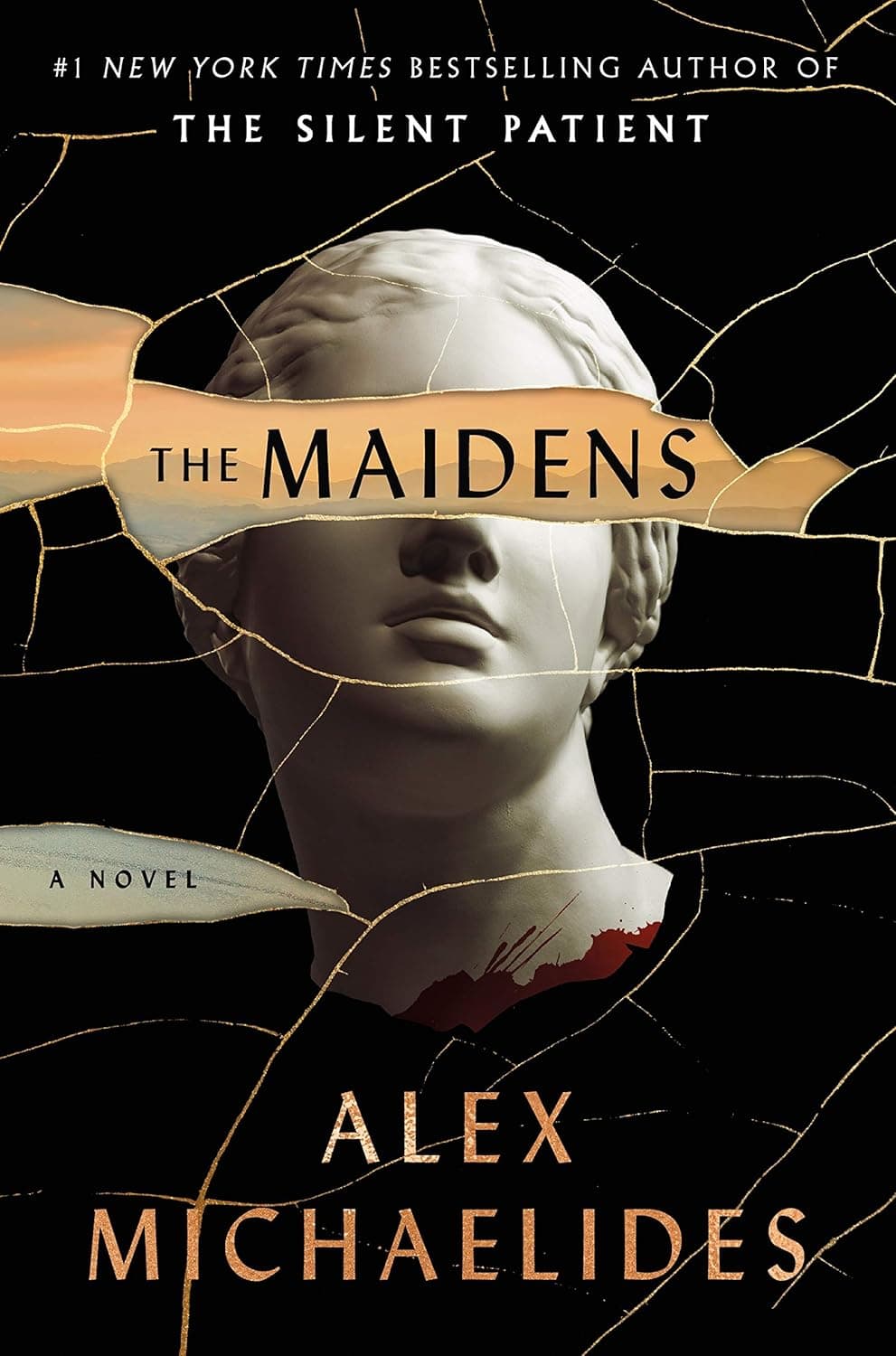
This page compiles and analyzes significant quotes from Alex Michaelides's The Maidens, exploring their deeper meanings and connections to the novel's characters and themes.
Most Important Quotes
The Unshakable Conviction
"Edward Fosca was a murderer. This was a fact. This wasn’t something Mariana knew just on an intellectual level, as an idea. Her body knew it. She felt it in her bones, along her blood, and deep within every cell."
Speaker: Narrator (reflecting Mariana's thoughts) | Location: Prologue | Context: This is the opening of the novel, establishing Mariana's state of mind as she reflects on the events that have just transpired, determined to prove Fosca's guilt.
Analysis: This line functions as a thesis and a trap, anchoring the reader to Mariana’s certainty while priming a grand misdirection toward Edward Fosca. The visceral phrasing—knowledge “in her bones” and “along her blood”—privileges intuition over reason, signaling a narrative steered by affect, grief, and embodied conviction rather than evidence. Through free indirect discourse and stark declaratives, the opening casts Mariana as both expert and unreliable witness, blurring her professional judgment with the force of private loss. It also seeds the theme of Obsession and Fixation, turning her certainty into the engine of the plot—and the vector of its ultimate irony.
The Revelation of the True Author
"‘Who wrote the letter, Zoe?’ Zoe stared at her, her eyes full of tears. She spoke in a whisper. ‘Sebastian, of course.’"
Speaker: Mariana Andros and Zoe | Location: Part Six, Chapter 1 | Context: In the folly by the river, after Mariana has found the incriminating letter hidden inside Zoe's stuffed zebra, she confronts Zoe, assuming Edward Fosca is the author. Zoe delivers the novel's stunning twist.
Analysis: This quiet exchange detonates the novel’s anagnorisis, collapsing the scaffolding of Mariana’s assumptions in a single, devastating reveal. The economy of dialogue and the gently staged pause (“in a whisper”) heighten the peripeteia, flipping the story’s moral geometry and exposing a core of Deception and Betrayal. The name “Sebastian” recasts previous tenderness as predation and recontextualizes the murders as part of a long con designed to mislead both Mariana and the reader. By hinging the turn on a soft-spoken certainty—“of course”—the novel underscores how often horror wears the tone of inevitability.
The Victim Becomes the Detective
"‘You framed him, Mariana. Sebastian said all I had to do was make you think I was afraid of Fosca. You did the rest. That was the funniest part of this whole performance: watching you play detective.’ She smiled. ‘You’re not the detective … You’re the victim.’"
Speaker: Zoe | Location: Part Six, Chapter 2 | Context: During their final confrontation at the marsh, Zoe reveals the full extent of Sebastian's plan and Mariana's unwitting role in it.
Analysis: Zoe’s taunt strips Mariana of agency and lays bare the novel’s governing irony: the investigator is the quarry. The metatheatrical language—“performance,” “play detective”—exposes the story as a staged illusion, crafted by Sebastian and sustained by Mariana’s grief-prone certainty, crystallizing the theme of Appearance vs. Reality. The role reversal is both psychological and structural, transforming the detective narrative into a victim narrative without changing protagonists. In its cruelty, the line forces a retrospective reread, revealing how easily fear and love can script someone’s fate.
Thematic Quotes
Grief and Loss
The Weight of Love
"Mariana was still in love with him—that was the problem. Even though she knew she’d never see Sebastian again—even though he was gone for good—she was still in love and didn’t know what to do with all this love of hers. There was so much of it, and it was so messy: leaking, spilling, tumbling out of her, like stuffing falling out of an old rag doll that was coming apart at the seams."
Speaker: Narrator (describing Mariana's feelings) | Location: Chapter 1-5 Summary (Chapter 1) | Context: A year after Sebastian's death, Mariana is struggling to sort through his belongings, overwhelmed by her unresolved grief.
Analysis: The rag-doll simile externalizes Mariana’s interior collapse, turning love into unruly matter that refuses containment. The image of seams splitting suggests that her identity was stitched together with Sebastian as the binding thread, so bereavement becomes unmaking. By rendering love as something that “leaks” and “spills,” the prose emphasizes grief’s physicality and its power to override reason—an emotional logic that later steers her choices. This passage provides the lens through which the mystery unfolds: not just who did it, but how sorrow primes a mind to see what it needs to see.
Grief as Fear
"No one ever told me that grief felt so like fear. —C. S. Lewis, A Grief Observed"
Speaker: Epigraph | Location: Part One | Context: This quote from C.S. Lewis serves as the epigraph for the first part of the novel, setting the emotional tone for Mariana's journey to Cambridge.
Analysis: As paratext, the epigraph orients the reader toward the psychological substrate of the plot, equating Mariana’s mourning with dread. That equivalence explains her hypervigilance—her need to control, to solve, to protect—as fear refracted through love. It also fuses the internal and external stakes: the murders amplify the terror of loss, while loss distorts her reading of the murders, creating a feedback loop. The line becomes a diagnostic key, unlocking why certainty feels safer than ambiguity—and why that safety proves perilous.
Greek Mythology and Tragedy
The Demand for Sacrifice
"‘The oracles agree: in order to defeat the enemy and save the city … a maiden must be sacrificed—a maiden of noble birth—’"
Speaker: Clarissa Miller (translating the postcard) | Location: Part Two, Chapter 7 | Context: Mariana brings the first postcard, found in Tara's room, to her former tutor Clarissa, who translates the Ancient Greek quotation from Euripides' The Children of Heracles.
Analysis: Intertextuality with Euripides supplies the murders with a tragic grammar: prophecy, purity, and the calculus of communal survival. The mandate to sacrifice a “maiden of noble birth” foreshadows the killer’s aestheticization of violence and the victims’ curated identities. It also hints at a perpetrator steeped in academia, using classical authority to sanctify cruelty and misdirect suspicion. In mystery terms, the oracle functions as both clue and red herring—revealing method while concealing motive.
The Cult of the Maiden
"This is the Eleusinian cult... The secret rite of Eleusis—that gives you exactly that liminal experience of being between life and death—and of transcending death. What was this cult? Well, Eleusis is the story of Persephone—the Maiden, as she was known—the goddess of death, queen of the Underworld…"
Speaker: Edward Fosca | Location: Part Two, Chapter 10 | Context: During his lecture on Greek tragedy, Fosca captivates his students with a description of the ancient mystery rites dedicated to Persephone, the original "Maiden."
Analysis: Fosca seduces with pedagogy, converting scholarship into spellcasting by invoking liminality, secrecy, and transcendence. His rhetoric glamorizes death and confers esoteric status on its initiates, conditions perfect for a cultic bond. By yoking his “Maidens” to Persephone, he supplies a mythic script that makes brutality look like ritual, enabling both devotion and denial. The scene cements him as a plausible architect of the crimes while, craftily, weaponizing his charisma as a narrative decoy.
Character-Defining Quotes
Mariana Andros
"He thinks he’s got away with it, she thought. He thought he had won. But he hadn’t. Not yet. Mariana was determined to outsmart him. She had to."
Speaker: Narrator (reflecting Mariana's thoughts) | Location: Prologue | Context: In the aftermath of the main events, Mariana steels herself for the intellectual and emotional battle to expose the killer.
Analysis: Mariana’s resolve is both her heroism and her hamartia: the drive that propels her investigation and the rigidity that blinds it. The clipped sentences embody willpower, turning determination into rhythm and momentum. Dramatic irony hangs over the passage—the reader later learns her target is wrong, but her commitment is real—highlighting how virtue can be co-opted by design. This mixture of grit and tunnel vision defines her arc, from self-appointed avenger to manipulated mark who must reclaim agency.
Zoe
"‘You’re not a goddess, Zoe. You’re a monster.’ ‘If I am,’ she heard Zoe say, ‘Sebastian made me one. And so did you.’"
Speaker: Mariana Andros and Zoe | Location: Part Six, Chapter 2 | Context: During their final confrontation, Mariana expresses her horror at what Zoe has become, and Zoe deflects the blame onto the two people who were supposed to protect her.
Analysis: Zoe’s rejoinder reframes culpability, casting monstrosity as manufactured rather than innate. The line invokes grooming, complicity, and the cyclical nature of harm, underscoring the theme of Childhood Trauma and Its Consequences. Her claim is at once excuse and indictment, exposing the moral murk where victimhood and perpetration overlap. In its defiant symmetry—“Sebastian made me… And so did you”—the dialogue crystallizes Zoe’s self-conception: forged by love’s betrayals into something lethal.
Edward Fosca
"‘What do we make of this deception—as a group? What do we think it means?’ ‘Well,’ said Carla, ‘I think it says a lot about their relationship.’"
Speaker: Edward Fosca and Carla | Location: Part Four, Chapter 14 | Context: During the group therapy session, Fosca turns the tables on Mariana by revealing that Zoe is a Maiden, using therapeutic language to mock and undermine her.
Analysis: Fosca’s appropriation of therapy-speak—“as a group,” “what do we think”—weaponizes reflection into spectacle, exposing his instinct for domination. By orchestrating Mariana’s humiliation through pseudo-clinical inquiry, he demonstrates his talent for controlling narratives and crowds. The exchange showcases his charisma and cruelty, sharpening his profile as an eminently believable suspect. It also dramatizes the central misdirection: truth framed as process can still be a performance.
Sebastian
"I love you, Zoe. That’s why I’m writing this. I want you to see me as I am. And then? You’ll forgive me, won’t you? Kiss all my wounds and make them better. You are my destiny, you know that, don’t you?"
Speaker: Sebastian | Location: Part Six, Chapter 5 | Context: This is part of the letter Mariana finds hidden in Zoe's stuffed animal, revealing the true nature of Sebastian's relationship with his niece.
Analysis: The letter exposes a predator’s lexicon: self-mythologizing, second-person seduction, and the outsourcing of responsibility to the victim. Phrases like “Kiss all my wounds” and “You are my destiny” recast abuse as romance and burden Zoe with salvation, hallmarks of narcissistic grooming. The confessional pose (“see me as I am”) is less honesty than manipulation, designed to bind through pity and grandeur. This passage shatters Sebastian’s memorial image, revealing the story’s most chilling masquerade.
Memorable Lines
Tennyson's Ghost
"He was staring at Hallam—at Hallam, standing just beyond the light … behind the veil. That was the look in his eyes. The eyes of a man communing with the dead. Tennyson was lost … He was in love with a ghost. He had turned his back on life. Had Mariana?"
Speaker: Narrator (reflecting Mariana's thoughts) | Location: Part Four, Chapter 17 | Context: Mariana has a moment of insight while looking at a portrait of a young Alfred, Lord Tennyson, realizing his expression is one of profound grief for his lost love, Arthur Hallam.
Analysis: Through ekphrasis, the portrait becomes a mirror: Tennyson’s grief-struck gaze reflects Mariana’s fixation “behind the veil,” an allusion to In Memoriam’s boundary between worlds. The image of communing with the dead sharpens the novel’s preoccupation with liminality—how mourning suspends the living between presence and absence. Mariana’s concluding question turns the scene inward, signaling a nascent self-awareness that her love is tethering her to death. This is a hinge moment, nudging her from haunting to hard-won clarity.
Opening and Closing Lines
Opening Lines
"Edward Fosca was a murderer. This was a fact."
Speaker: Narrator | Location: Prologue | Context: The novel begins with this stark, unequivocal declaration from Mariana's perspective.
Analysis: The paratactic punch of two stripped-down sentences manufactures certainty out of cadence. As an opening gambit, it aligns the reader with Mariana’s conviction while quietly establishing a theme the novel will invert: the peril of “facts” felt rather than proven. The line’s authority primes a classic red herring, making later revelation feel like betrayal not only of character but of form. In a story about masks, this is the first and most persuasive one.
Closing Lines
"She stopped outside it. She hesitated. Then she reached out, turned the handle— And went inside."
Speaker: Narrator | Location: Epilogue | Context: Months after the traumatic events, Mariana finally goes to the Grove, the secure psychiatric unit, to visit Zoe.
Analysis: The threshold image turns a simple motion into ritual: hesitation, decision, passage. The door functions as a secular rite of initiation, marking Mariana’s shift from avoidance to confrontation, from fixation to the possibility of repair. The triadic cadence (“hesitated… turned… went”) gives the ending a quiet resolve without promising absolution. In a novel obsessed with veils and underworlds, stepping through this doorway is the bravest, most honest crossing.