Opening
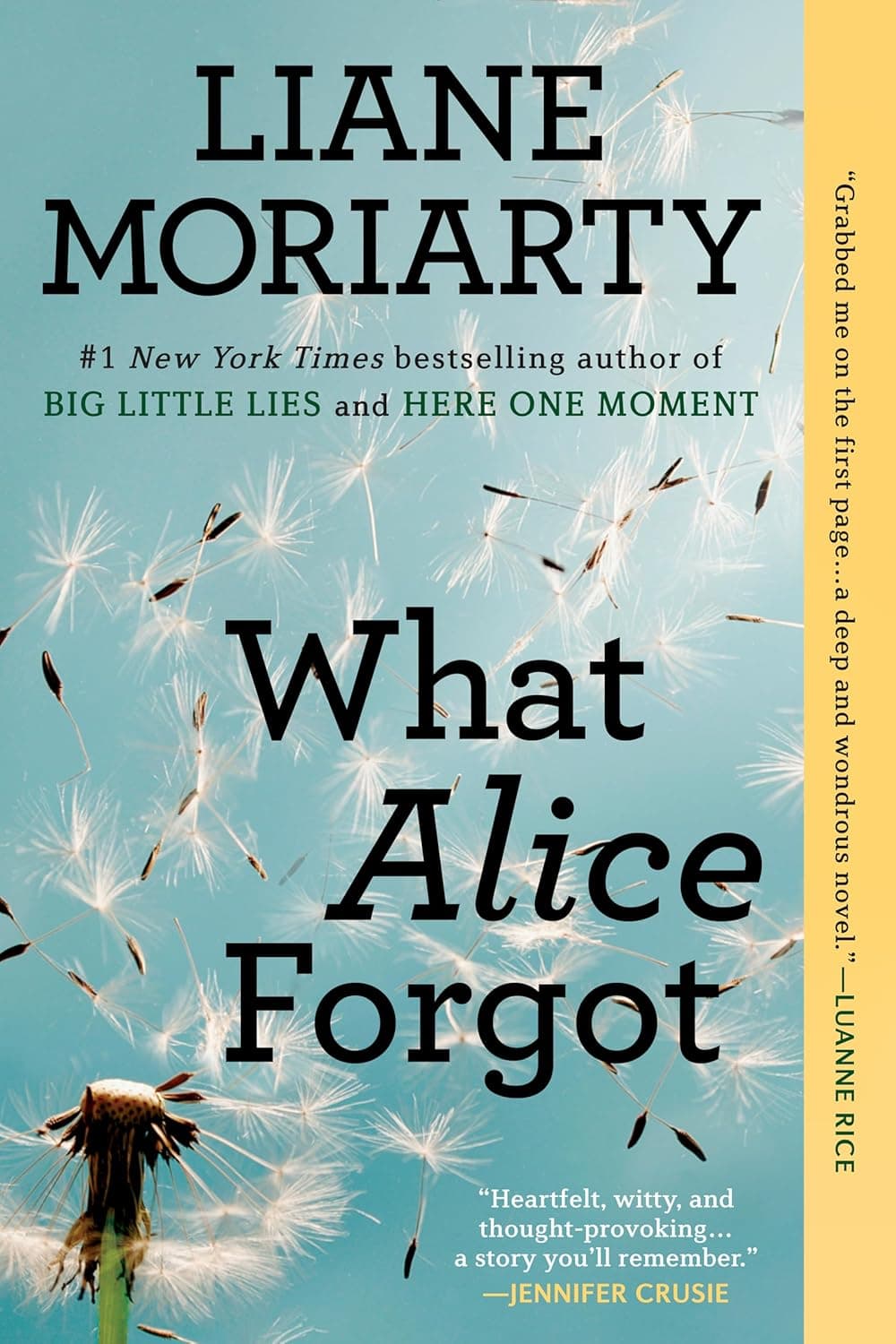
A head injury yanks Alice Love out of one life and drops her into another. She thinks it’s 1998 and she’s newly pregnant and adored by Nick Love; instead, it’s 2008, she’s nearly forty, and a decade of memories has vanished. As shifting voices and stray clues flood in, the novel sets up a mystery about who Alice has become and whether the marriage she remembers still exists, laying early groundwork for The Evolution of Love and Marriage and Memory and Identity.
What Happens
Chapter 1: The Fall
Alice drifts in a blissy, watery haze—until a shock of pain makes her realize she’s on the floor. Her thoughts lurch toward the baby she believes she’s carrying; she’s 29, it’s 1998, and Nick is “bloody besotted” with her. She catalogs the rules of pregnancy (no soft cheese) and basks in the glow of first-love certainty, a private proof that their marriage is tender and true, echoing The Evolution of Love and Marriage.
She opens her eyes to a gym—alien territory for a woman who “doesn’t believe in gyms.” Strangers hover, including colleague Jane Turner and a relentlessly upbeat instructor. When Alice mentions she’s pregnant, Jane calls it a “disaster,” and Alice’s confusion spikes. Paramedics arrive; Alice confidently gives the year as 1998 and the prime minister as John Howard. Then Jane levels the blow: “I just got an invitation to her fortieth birthday.” The line cracks Alice’s reality and launches the core conflict of Memory and Identity.
Chapter 2: The Ambulance and the Sister
The ambulance ride feels like a parade of strangers who somehow know her. People chirp about a “big day coming up,” and Alice reaches for something as simple as what she ate for breakfast—only to retrieve a stream of rosy memories of Nick and early marriage. She feels unmoored in time, “like an escaped balloon,” and an image flashes: pink balloons in a gray sky. It hits with a surge of grief and rage that has no place to land.
The narrative widens to an alternate voice: a therapist homework entry by Alice’s older sister, Elisabeth. A high-powered professional with a brittle edge, Elisabeth coolly notes she and Alice aren’t speaking because of a “banana muffins incident.” When Jane reports that Alice is “pregnant,” Elisabeth’s response is “trembly rage,” hinting at Infertility and the Longing for Family. She supplies the first outside timeline marker: in 1998, Alice was pregnant with Madison Love. Elisabeth’s voice—cynical, wounded, unsentimental—sharply contrasts with Alice’s dreamy certainty.
Chapter 3: The Hospital
In the fluorescent calm of the ER, a doctor tells Alice the date: 2008. The number won’t stick. As he examines her, another shard of memory slices through—“I’m sorry, but there is no heartbeat”—and the pink balloons darken the sky. The grief feels huge, real, and unplaced, foreshadowing a trauma buried somewhere in the missing decade.
Physical facts pile up. The doctor shows her a pale C-section scar and stretch marks; Alice’s stomach is flat. Her obstetrician? Retired three years ago. A nurse confirms the date: May 2, 2008. Alice does the math and staggers at the impossible: her “Sultana” would be ten. The body she inhabits—and the life it proves—forces her to confront Transformation of the Self.
Chapter 4: The Backpack of Clues
Left alone, Alice opens the red backpack Jane swears is hers. Her hands are manicured. A white groove marks where a wedding ring once sat. She can’t bring herself to meet the 39-year-old woman in the mirror. Inside, she finds a scarlet dress labeled Small, a size she never imagined wearing, and then a balm from the past: the Tiffany charm bracelet Nick gave her when she first got pregnant. It feels like a lifeline to the only version of herself she trusts.
The Gucci wallet is a revelation. A driver’s license shows a chic woman with short blond hair—everything Nick loved her not to have. A business card from a physiotherapist carries a cryptic, intimate note about “happier times.” Grabbing the sleek phone, Alice calls Nick’s office. A gatekeeping PA, Annabelle, announces that Nick is now General Manager and in Portugal at a conference. Something in Alice hardens, and a “taut, tart” voice she doesn’t recognize slices back. The call ends—and the phone rings again. A small voice says, “Mum?”
Chapter 5: The Children
The chapter opens with a third form: a letter from Frannie, Alice’s grandmother, to her late husband. Frannie’s warm, observational tone gently frames family history until it’s interrupted by the news of Alice’s accident.
Back at the hospital, Alice speaks to the child who calls her Mum. He mentions “Dad” in Portugal and an “Uncle Ben,” confirming a tie to Elisabeth’s husband. The conversation feels dizzying and delicate, as if she’s impersonating herself. Later, she flips through a planner; a school photo slides out—three children, two girls and a boy. The label reads: Olivia, Tom, and Madison Love. She studies their faces like strangers. Tom’s grimace echoes Elisabeth’s; the others are blank to her. When a nurse asks about the picture, the façade crumbles. Alice sobs and admits she can’t remember the last ten years—her children’s lives erased from her mind.
Character Development
These chapters split the protagonist in two: the soft, enamored 29-year-old Alice and the sleek, formidable 39-year-old whose choices and habits are stamped across her body and belongings. Surrounding voices—Elisabeth’s raw candor and Frannie’s nostalgia—add texture and tension, hinting at rifts and losses the younger Alice can’t fathom.
- Alice Love
- Clings to early-marriage memories and her Tiffany bracelet as anchors.
- Confronts physical proof of motherhood she can’t remember: C-section scar, stretch marks, a flat belly.
- Reveals a sharper, “snooty” cadence on the phone, suggesting her present-day persona is intact beneath the amnesia.
- Avoids the mirror, afraid of the woman she’s become.
- Elisabeth
- Presents as competent and caustic, using journal homework to vent.
- Flashes “trembly rage” at the news of Alice’s “pregnancy,” signaling deep pain around fertility.
- Marks estrangement with the petty-but-loaded “banana muffins incident.”
- Nick Love
- Exists in Alice’s mind as passionate and “besotted.”
- In the present, is absent, powerful, and insulated by a hostile PA, implying distance and status.
- His preferences (long hair) contrast starkly with Alice’s current look (short blonde), hinting at shifting dynamics.
- Frannie
- Functions as the family’s affectionate archivist.
- Offers generational perspective and calm during crisis.
- Her letter form adds warmth and memory-keeping to a story about lost memory.
Themes & Symbols
The novel frames identity as both story and sediment. Through amnesia, Memory and Identity becomes an investigation: is Alice the woman she remembers or the one her body, wallet, and acquaintances confirm? The clash between inner narrative and external evidence drives tension and empathy, forcing Alice—and the reader—to weigh intention against outcome.
Alongside this, The Evolution of Love and Marriage surfaces in the gap between “bloody besotted” newlyweds and a marriage run through corporate titles, conferences, and gatekeepers. Transformation of the Self is etched onto Alice’s skin and habits: motherhood, discipline, wealth, and a voice capable of steel. Elisabeth’s “trembly rage” injects Infertility and the Longing for Family, complicating sisterhood and refracting Alice’s forgotten fertility through another woman’s grief.
Symbols
- The Gym: Embodies the regimented, image-conscious life of 39-year-old Alice—alien to her younger self yet undeniably hers.
- The C-section Scar: Irrefutable evidence of a life-altering event Alice can’t retrieve, collapsing denial.
- The Tiffany Bracelet: A talisman of the love-story origin, offering continuity amid rupture.
- Pink Balloons: Celebration turned elegy; paired with “no heartbeat,” they signal unprocessed loss floating at the edge of consciousness.
Key Quotes
“Bloody besotted.”
- Alice’s cherished memory of Nick compresses the heady certainty of early love. It sets a benchmark against which the cooler, corporate present is measured and found wanting.
“I just got an invitation to her fortieth birthday.”
- Jane’s line punctures the 1998 illusion and instantaneously raises the stakes. One sentence reframes every assumption Alice—and the reader—holds.
“I’m sorry, but there is no heartbeat.”
- A stark fragment that couples with the pink balloons to foreshadow grief. It hints at a loss powerful enough to rewire memory and identity.
“Like an escaped balloon.”
- Alice’s metaphor for time captures the helpless drift of amnesia. It also mirrors the recurring balloon image, binding mood to mystery.
“Mum?”
- The single word that collapses theory into reality. It is the shock of relationship without recollection, the novel’s emotional core in one syllable.
Why This Matters and Section Significance
These opening chapters lock the story into a gripping, character-driven mystery: a woman wakes as the best version of her younger self and must reckon with the stranger she became. The braided forms—Alice’s immediacy, Elisabeth’s journals, Frannie’s letters—build dramatic irony and emotional range, letting readers see the decade Alice can’t.
By juxtaposing honeymoon memories with boardroom absences, baby dreams with a C-section scar, and tenderness with a “snooty” voice, the section seeds the central questions that power the novel: What did time and pressure do to this marriage? What grief warped these sisters apart? And can the self you remember survive the life you’ve actually lived?