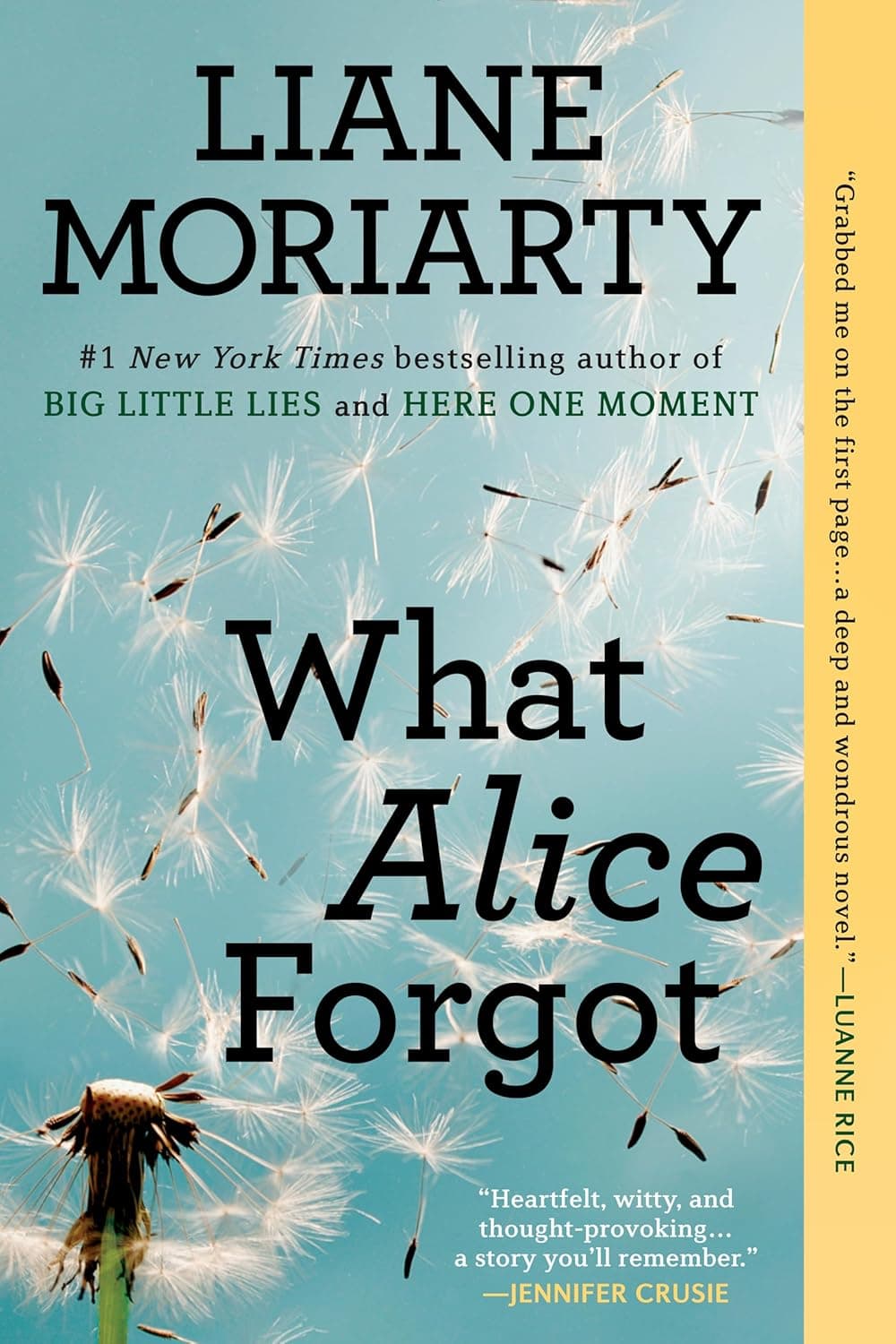
What Alice Forgot — Summary and Analysis
At a Glance
- Genre: Contemporary fiction; domestic drama with psychological depth
- Setting: Sydney, Australia; dual timelines (1998 and 2008)
- Perspective: Alternating forms—Alice’s first-person present, Elisabeth’s therapy journals, and Frannie’s letters
- Tone: Wry, warm, and searching; a blend of humor and heartache
Opening Hook
What if you woke up a decade younger—still in love, still full of hope—only to find your present self has become someone you barely like? In Liane Moriarty’s What Alice Forgot, a freak accident wipes ten years from Alice Love’s life, returning her to the giddy newlywed she once was. The shock is total: three kids she doesn’t recognize, a sister she’s drifted from, and a marriage on the brink of collapse. As Alice hunts her missing memories, she must decide which version of herself to keep—and which to leave behind. The novel turns amnesia into both a mystery and a mirror, asking what truly endures when memory doesn’t.
Plot Overview
Alice’s fall from a spin bike sets the story in motion. Thirty-nine-year-old Alice Love wakes certain it’s 1998: she’s madly in love with Nick Love and pregnant with their first baby. In reality, it’s 2008. She is a mother of three—Madison Love, Tom, and Olivia—embroiled in a bitter divorce, and the once-effortless bond with her sister Elisabeth has become prickly and distant. The woman everyone insists she is—sleek, efficient, perfectionist—is a stranger to the sweet, slightly disorganized Alice she remembers. Through Elisabeth’s raw therapy journals and letters written by their grandmother Frannie to her late fiancé, Alice’s lost decade begins to take shape.
Determined to fix what future-Alice has broken, the younger-minded Alice tries to win back Nick and mend her family. She’s stunned to learn her best friend Gina Boyle has died, that “Mega Meringue Day” (a school fundraiser) was created in Gina’s honor, and that she’s seeing the gentle school principal Dominick Gordon. The pieces don’t make sense: how did she transform from a joyous newlywed into a hyper-competent, controlling “supermum”? Why did she and Nick—once inseparable—become enemies?
At the fundraiser, the scent of a giant lemon meringue pie snaps everything back. In a flood of memory, detailed in Chapter 31-35, Alice relives the night she witnessed Gina’s death, the grief and guilt that followed, and the resentments that calcified between her and Nick: late nights at work, sharp words unspoken and then weaponized, the grind of mortgages and childcare and ambition. With her memory restored, she sees clearly why she fell out of love—and why she hardened.
Yet the amnesia experience lingers. Having briefly seen her life through the luminous eyes of her younger self, Alice recognizes a way forward that neither version of her fully knew. One year later, in the Epilogue, Alice and Nick have reconciled, expecting a fourth child—a quiet, hard-won emblem of Forgiveness and Second Chances. The path back isn’t a reset so much as a remake: remembering, choosing, and changing in full view of their shared past. (For a straight chronological recap, see the Full Book Summary.)
Central Characters
For a complete cast, visit the Character Overview.
-
Alice Love
- Then: A buoyant 29-year-old—romantic, slightly naive, and excited about motherhood.
- A decade later: Polished and relentless, she’s become the woman who can do everything—and enjoys little of it.
- Why she matters: Alice’s amnesia stages a confrontation between who we were and who we’ve become. Her journey blends the open-heartedness of her younger self with the boundaries of her older one.
-
Nick Love
- Then: Easygoing and funny, brimming with plans for their future.
- A decade later: Worn down by work, money, and marital warfare; quick to anger, slower to forgive.
- Why he matters: Nick’s struggle spotlights how love erodes—incrementally—and how memory can revive the man he intended to be.
-
Elisabeth
- Then: Capable, slightly bossy, an anchoring older sister.
- A decade later: Scarred by infertility, fiercely private in her pain, and distant from Alice.
- Why she matters: Through her journals, the book renders grief in unsentimental clarity and shows sisterhood reknit by honesty and luck.
-
Frannie
- Now: Writing to a long-dead fiancé, she offers wry wisdom, loneliness, and late-in-life tenderness.
- Why she matters: Her letters broaden the novel’s scope beyond marriage and motherhood to the constancy—and reinvention—of love.
-
Gina Boyle
- Then and remembered: Charismatic, slightly reckless, catalytic. Her death haunts the Loves’ marriage.
- Why she matters: Gina’s absence is the novel’s invisible pressure system, revealing how grief redirects lives.
-
Dominick Gordon
- Now: Kind, steady, a safe harbor for the pragmatic Alice.
- Why he matters: He represents the comfort of stability—and the question of whether comfort is enough.
Major Themes
A fuller exploration appears in the Theme Overview.
-
Memory and Identity Memory doesn’t just store identity—it edits and curates it. By stripping away a decade, the novel lets Alice judge her present with a past self’s clarity, exposing how small choices and unexamined habits can refashion a person beyond recognition.
-
The Evolution of Love and Marriage Moriarty charts how romantic intensity yields to logistics, fatigue, and unspoken grievance. The book suggests that love can be rebuilt, but only by replacing the myths of early marriage with humility, truth-telling, and chosen daily tenderness.
-
Transformation of the Self Ten years turn Alice from generous to judgmental, from carefree to brittle—changes she barely noticed happening. The novel asks whether growth means hardening or refining, and how to reclaim joy without losing competence.
-
Infertility and the Longing for Family Elisabeth’s journals offer a counterpoint to Alice’s chaotic fertility: grief that is cyclical, isolating, and sometimes corrosive. Her story honors the quiet devastations of trying and failing—and the risky hope of trying again.
Literary Significance
What Alice Forgot elevates domestic fiction with a smart structural gamble: an amnesia premise used not for twists but for moral and psychological excavation. Intercut forms—confused first-person, therapy journals, and elegiac letters—create a prismatic portrait of one family’s decade, revealing how ordinary pressures estrange loving people. Moriarty’s voice threads humor through heartbreak, making the novel both page-turning and reflective, rich with book-club-ready questions and memorable lines (see Quotes). Its enduring appeal lies in a simple, disarming proposition: if you could meet yourself from ten years ago, would you like who you’ve become—and what would you change?