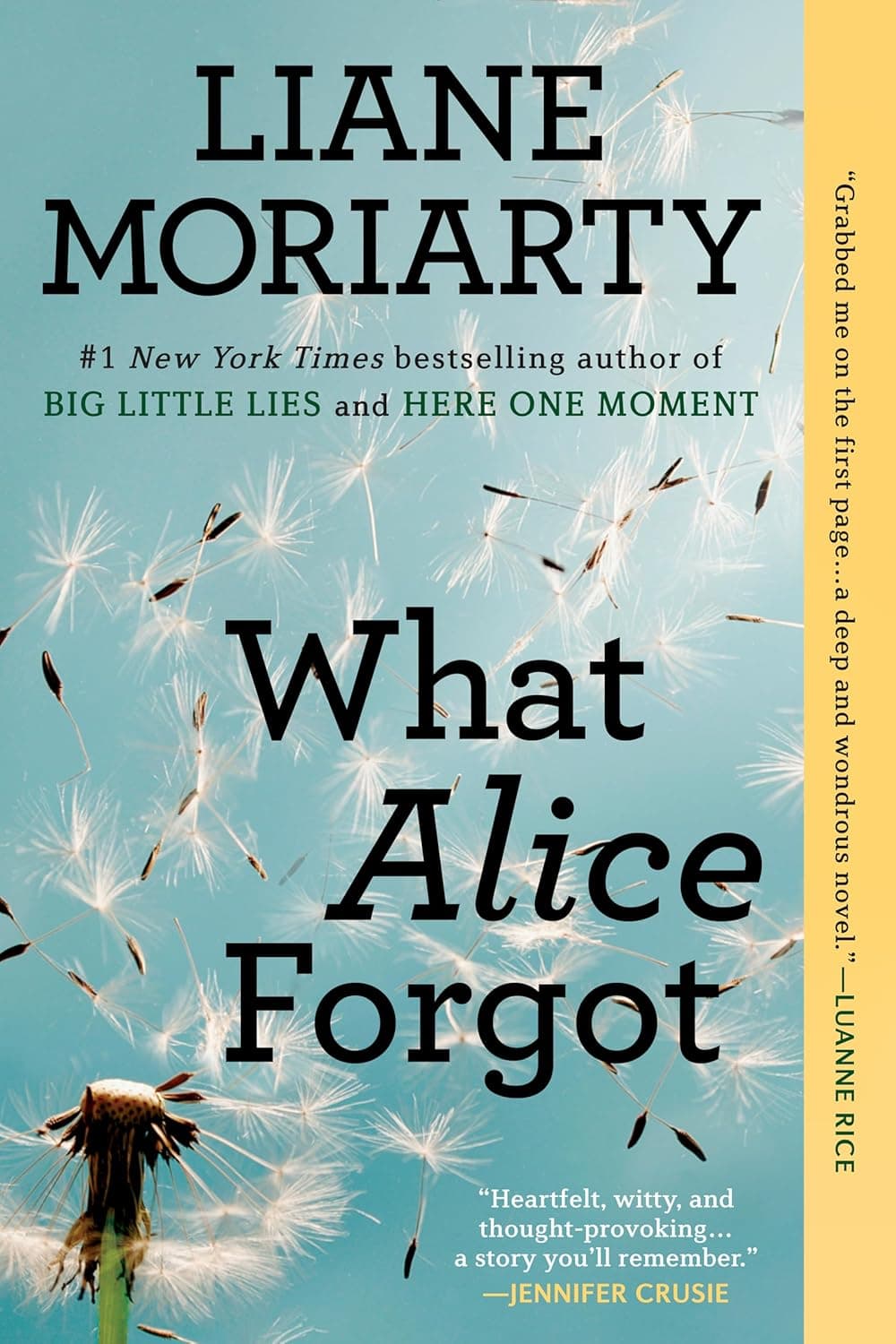
Most Important Quotes
The Moment of Disorientation
"And what year is it?" George didn’t seem too concerned. "It’s 1998," Alice answered promptly. She felt confident about that one. The baby would be born next year, in 1999. Jane pressed her hand over her mouth. George went to speak, but Jane interrupted him. She put her hand on Alice’s shoulder and stared at her intently... "How old are you, Alice?" "I’m twenty-nine, Jane." Alice was irritated by Jane’s dramatic tone. What was she getting at? "Same age as you." Jane sat back up and looked at George Clooney triumphantly. She said, "I just got an invitation to her fortieth birthday."
Speaker: Alice Love and Jane Turner | Context: Chapter 1; immediately after Alice’s fall at the gym, as paramedics assess her orientation
Analysis: This exchange sparks the novel’s central crisis, revealing the gap between Alice’s perceived present and the reality of a vanished decade. The scene is charged with dramatic irony: Alice’s calm certainty collides with Jane’s blunt revelation, jolting both Alice and the reader into the novel’s core question—who is Alice now? Jane’s deadpan “fortieth birthday” functions as a darkly comic punchline that heightens the horror of dislocation. It launches the intertwined themes of Memory and Identity and the Transformation of the Self, inviting us to watch the younger Alice confront the stranger she has become.
The Shock of a Broken Marriage
He said, "Then why the fuck did I need to call you?" Alice felt her head snap back as if she’d been hit. Nick had never, ever spoken to her like that before, not even when they were fighting. He was meant to fix the nightmare, not make it worse. "Nick?" There was a tremor in her voice. She was going to be so mad with him later about this; her feelings were extremely hurt. "What’s the matter?"
Speaker: Nick Love and Alice Love | Context: Chapter 7; Nick calls from Portugal during their separation, assuming the hospital emergency is a ploy
Analysis: This moment delivers the novel’s second seismic shock: the loving husband Alice remembers has become caustic, impatient, and estranged. The violence of Nick’s language stands in brutal counterpoint to the domestic bliss Alice still holds in mind, exposing the chasm between past intimacy and present hostility. Moriarty uses the abruptness of dialogue to puncture nostalgia and foreground the fragility of long-term relationships. The scene crystallizes The Evolution of Love and Marriage, turning Alice’s amnesia into a lens for examining how tenderness erodes into defensiveness and anger.
The Woman She Became
"You’re very busy, though." What was it with that word? "You do a lot of stuff at the school." "The school? What school?" "The children’s school." Oh. Them. The three scary little strangers.
Speaker: Elisabeth and Alice Love | Context: Chapter 7; in the hospital, Elisabeth sketches Alice’s 2008 life for a sister stuck in 1998
Analysis: The refrain of “busy” exposes the extent of Alice’s metamorphosis from relaxed newlywed to hyper-scheduled “North Shore Mum.” Her recoil from the word—and from her own children as “three scary little strangers”—reveals both the alienation of amnesia and a deeper unease with the identity she’s accrued. The humor is edged with heartbreak, underscoring the cost of performing competence and control. The passage embodies the Transformation of the Self, showing how a decade of obligations can recast a personality and redraw the map of home.
The Hope for a Second Chance
"Maybe my old self has been sent from the past to stop the divorce," said Alice only half flippantly. "Maybe I won’t get my memory back until I’ve done that."
Speaker: Alice Love | Context: Chapter 18; talking with Elisabeth, Alice reframes her amnesia as a mission rather than a malady
Analysis: Alice reimagines her condition as purposeful, a narrative that restores agency when memory has stripped her of it. Casting her 29-year-old self as a time-traveling envoy shifts the novel from medical mystery to moral quest, aligning with Forgiveness and Second Chances. The line also hints at a fairy-tale logic—complete the task, break the spell—while acknowledging the adult stakes of divorce and family fracture. It propels the plot and clarifies her motivation: to wield innocence and optimism as tools to heal her life with Nick Love.
Thematic Quotes
Memory and Identity
The Body’s Memory
The doctor stopped and looked at her. "That looks very much like a cesarean scar to me." Alice lifted her head awkwardly and saw that the doctor was pointing a nicely shaped fingernail low down on Alice’s stomach. She squinted and saw what looked like a very pale, purple line just above the top of her pubic hair. "I don’t know what that is," said Alice, mortified.
Speaker: Doctor and Alice Love | Context: Chapter 3; a hospital exam exposes physical evidence of a life Alice can’t remember
Analysis: The C-section scar is a visceral archive, proof that the body keeps score even when the mind cannot. It collapses abstraction into fact, confronting Alice with motherhood inscribed on her skin. The scar becomes a symbol of the split between embodied history and conscious identity, a hinge on which her understanding swings. The scene sharpens Memory and Identity by showing memory as layered—cellular, emotional, and narrative—rather than merely cognitive.
Floating Above Time
The problem was that she couldn’t attach herself to a "today" or a "yesterday" or even a "last week." She was floating helplessly above the calendar like an escaped balloon.
Speaker: Narrator (Alice’s thought) | Context: Chapter 2; in the ambulance, Alice grasps the depth of her temporal dislocation
Analysis: The escaped-balloon simile distills the destabilizing experience of losing time’s tether. By invoking a childlike image, the line marries whimsy to dread, capturing how lightness flips into terror when the string slips away. It suggests that identity is stitched from ordinary continuity as much as from milestone memories. The passage deepens Memory and Identity by showing how chronology itself undergirds the self.
The Evolution of Love and Marriage
The Memory of Bliss
Once, when they were undoing their seat belts, Nick said (in answer to some fishing-for-compliments thing she’d just said), "Don’t be ridiculous, you goose, you know I’m bloody besotted with you." She opened the car door and felt sunshine on her legs and smelled the lavender she’d planted by the front door. Bloody besotted. It was a moment of lavender-scented bliss, after grocery shopping.
Speaker: Narrator (Alice’s memory) | Context: Chapter 1; semiconscious on the gym floor, Alice drifts to an ordinary moment of perfect contentment
Analysis: Domestic detail—seat belts, sunshine, lavender—renders love as a sensory habit woven through everyday life. The colloquial “bloody besotted” captures Nick’s voice and cements the memory’s warmth, making later estrangement feel more tragic. By sanctifying the mundane, the passage supplies a baseline against which marital corrosion is measured. It anchors The Evolution of Love and Marriage in the tension between idealized beginnings and complicated middles.
The Virus of Divorce
"I often think the four of us were too close. We got all tangled up in Mike and Gina’s marriage problems. We caught their divorce. Like a virus."
Speaker: Nick Love | Context: Chapter 26; at Family Talent Night, Nick parses the slow unraveling of their marriage
Analysis: Nick’s contagion metaphor reframes marital breakdown as communal rather than purely private, suggesting proximity to Gina and Mike’s conflict “infected” their bond. The image of “tangled” lives conveys enmeshment, blurred boundaries, and the dangers of vicarious rancor. It complicates blame by acknowledging external pressures that amplify internal cracks. The insight advances The Evolution of Love and Marriage, showing love as permeable to its social ecosystem.
Infertility and the Longing for Family
The Pain of Infertility
I feel like a piece of dried fruit. Yes, that’s it. I AM A DRIED APRICOT, Dr. Hodges. Not one of those nice, soft, juicy ones, but a hard, shriveled, tasteless dried apricot that hurts your jaw.
Speaker: Elisabeth | Context: Chapter 2; in therapy “homework,” Elisabeth gives language to the toll of repeated loss
Analysis: The dried-apricot metaphor is startlingly tactile, translating psychic depletion into texture, taste, and pain. Its capitalized insistence enacts the desperation to be seen, to have suffering acknowledged as embodied reality. Beyond sadness, it speaks to the erosion of sensuality and self-worth. The passage illuminates Elisabeth’s character and the ache at the heart of Infertility and the Longing for Family.
The Weight of Hope
"We’ll be okay," he finally said. No we won’t, I thought. "Yes," I said.
Speaker: Ben and Elisabeth | Context: Chapter 26; Elisabeth’s journal captures the aftermath of another failed IVF cycle
Analysis: The split between Elisabeth’s inner “No” and spoken “Yes” exposes the performance of resilience couples adopt to survive chronic grief. In its brevity, the exchange reveals exhaustion, protective lying, and the loneliness of mismatched hope. The ellipsis of what’s unsaid is the line’s loudest sound. It deepens our sense of Elisabeth’s character and how infertility strains the bonds it is meant to fulfill.
Character-Defining Moments
Alice Love
"I’ll know when you get your memory back... The way you look at me. As soon as you remember, I’ll see it in your eyes." "Will they shoot death rays at you?" said Alice. Nick smiled sadly. "Something like that."
Speaker: Nick Love and Alice Love | Context: Chapter 28; after Madison’s school incident, a fragile truce opens space for honesty
Analysis: Nick’s “eyes” litmus test suggests that memory is not only recollection but attitude—the return of hardness he associates with the later Alice. Alice’s playful “death rays” undercuts the bleakness with humor, a hallmark of her earlier self that makes reconciliation imaginable. The exchange compresses the novel’s identity puzzle into a look: which version of Alice will prevail? It distills the tragedy of estrangement and the fragile hope that tenderness can outlast bitterness.
Nick Love
"I told Nick that you two should get back together, be a family again," said Dino. "I said, What went so wrong you can’t fix? ... He said, ‘I would fix it if I could, mate.’"
Speaker: Dino (quoting Nick Love) | Context: Chapter 24; Dino relays a recent conversation that exposes Nick’s private regret
Analysis: Filtered through a third party, Nick’s admission sheds the armor he wears with Alice and reveals grief without bluster. “I would fix it if I could” carries the helplessness of a man overwhelmed by complexities he can’t untangle. It reframes him not as a villain but as a participant in a mutual collapse, aching for repair. The line expands our view of Nick Love, complicating the anger with sincerity and loss.
Elisabeth
"You want to know the first thing she said to me, Dr. Hodges? She said, 'Oh Libby, what happened to you?' I told you, it defines me."
Speaker: Elisabeth | Context: Chapter 6; in her journal, Elisabeth recalls Alice’s hospital greeting and its sting
Analysis: Alice’s innocent question—temporal slip made literal—mirrors back the transformation Elisabeth believes the world sees first: the face of infertility and grief. “It defines me” is both conclusion and lament, conceding how private sorrow has become public identity. The moment lays bare sibling tension fueled by asymmetrical luck and silent comparisons. It is pivotal for understanding Elisabeth’s character and the novel’s compassion for invisible battles.
Frannie
"I’ve been writing to you now for over three decades? That’s longer than a lot of marriages. Longer than Alice’s marriage."
Speaker: Frannie | Context: Chapter 11; in a letter to her late fiancé, Phil, Frannie measures the endurance of her love
Analysis: Frannie’s epistolary devotion reframes constancy as its own kind of partnership, sustained by ritual and memory rather than reciprocity. The wry comparison to modern marriages underscores the fragility of some unions and the durability of quiet fidelity. Her perspective serves as a counterpoint to the volatility of Alice and Nick, grounding the novel in gentler, steadier forms of love. The line defines Frannie as the keeper of continuity and a witness to love’s many shapes.
Opening and Closing Lines
Opening Line
She was floating, arms outspread, water lapping her body, breathing in a summery fragrance of salt and coconut... Was it a dream or a memory?
Speaker: Narrator | Context: Chapter 1; the novel begins in sensory haze as Alice drifts in and out of consciousness after her fall
Analysis: Lush, tactile imagery invites the reader into Alice’s liminal state where sensation precedes fact. The final question—dream or memory—poses the book’s organizing riddle and primes the exploration of Memory and Identity. By opening in suspension, Moriarty cues a story about re-entry: into time, body, and self. The line’s serenity makes the coming disorientation more poignant.
Closing Line
Each memory, good and bad, was another invisible thread that bound them together, even when they were foolishly thinking they could lead separate lives. It was as simple and complicated as that.
Speaker: Narrator (Alice’s thought) | Context: Epilogue; after reconciliation, Alice reflects on what ultimately held the marriage
Analysis: The “invisible threads” metaphor honors the way accumulated experiences—joys and wounds alike—constitute a durable bond. It resists the fantasy of clean breaks, asserting that shared history exerts a quiet, binding force over time. The cadence of “simple and complicated” captures the paradox at the heart of The Evolution of Love and Marriage. The novel ends with earned clarity: love is ordinary work woven into memory.