What This Theme Explores
Finding Your Voice and Pursuing Passion asks who we are when we stop performing for institutions and start listening to what we love. The novel interrogates a culture that equates grades with worth, showing how that metric can split a person into a public façade and a private self. It also explores the risks of authenticity—exposure, judgment, and conflict—against the profound rewards of joy, community, and self-knowledge. Ultimately, the book argues that passion is not a distraction from life but its organizing principle.
How It Develops
The theme begins with secrecy and self-division. Frances Janvier is “School Frances,” a perfectly engineered high achiever who hides the part of herself that draws fan art late at night. Aled Last, meanwhile, speaks only through the anonymous world of Universe City, a space where he can be strange, sincere, and safe. Their friendship forms at the collision of these secret worlds; when Frances accepts Radio’s invitation (nudged by Frances’s Mum to “do what you want”), the two begin constructing a shared creative identity that makes room for their “weird” clothes, in-jokes, and honest feelings.
Creation becomes liberation. Over a summer of collaboration, Frances and Aled experience the thrill of making something because it matters to them, not because it’s impressive. In that privacy, Aled discloses the abuse he faces from Carol Last, and the podcast’s city of neon streets and lonely broadcasts becomes a refuge they build together. Passion isn’t merely a hobby here; it’s a survival strategy and a language for intimacy.
Then exposure threatens to silence them again. When an episode goes viral, the outside world breaks into their sanctuary with punitive authority and parasitic fandom. Frances’s institutional identity is punished—she loses status and credibility—while Aled is cornered by both obsessive listeners and his controlling mother. Their creative outlet, once a secret lifeline, becomes the very thing used to police and contain them.
Crisis forces redefinition. Aled quits the podcast and unravels at university, smothered by expectations he never chose. Frances, failing her Cambridge interview, realizes her pursuit of prestige was hollow, a script she learned to perform without desire. Finding Carys Last clarifies that there are other futures—messier but freer—and prompts a rescue that’s as much ideological as physical: escaping both a toxic home and an academic path that negates the self.
The resolution is a public claiming of identity. Aled leaves university; Frances turns toward art college. Performing Universe City live transforms a private cry into a communal celebration, proving their voices can survive outside anonymity and still belong to them. The story ends not with conventional accolades but with chosen work, chosen family, and chosen selves.
Key Examples
-
Frances’s “Dirty Secret” Early on, Frances believes her drawings “won’t get [her] into Cambridge,” so they must be hidden. The shame reveals how external metrics distort passion into uselessness—and how secrecy fractures identity.
It didn’t feel like a hobby. It felt like a dirty secret. And my drawings were all pointless anyway. It wasn’t like I could sell them. It wasn’t like I could share them with my friends. It wasn’t like they’d get me into Cambridge.
-
Aled’s Anonymity Aled’s fear that people will think he’s “weird” shows how judgment silences unconventional creativity. Universe City becomes the only place he can speak—proof that voice often emerges first in protected spaces.
"I never told anyone about Universe City," he said, glancing back at me. "I thought they’d think I was weird." "Same," I said.
-
The Cambridge Interview Failure Frances can’t articulate why she wants English, exposing the gap between achievement and desire. The failure is paradoxically freeing: it reveals the lie she’s been living and clears space for art to become a viable future.
-
Miss García’s Encouragement A teacher’s quiet recognition reframes art from hobby to potential vocation. The moment plants a seed that grows into Frances’s decision to abandon the performance of usefulness for the reality of joy.
"Well, I always thought you’d do art. I could be wrong, but you really do seem to enjoy it." "I can’t choose a degree based on what I’d enjoy though."
-
The Final Live!Video Performance Aled stepping onstage turns private authenticity into public authorship. The shift from a microphone held in hiding to one held before a crowd enacts the theme’s end point: a voice owned, not just found.
I watched Aled, or Radio, or whoever that guy was, grasp the microphone and open his mouth, and I whispered the words into the air while he roared them into the crowd. “Hello. I hope somebody is listening …”
Character Connections
Frances Janvier begins as a meticulously curated emblem of academic success, proof that she can play the game perfectly. Her arc dismantles the belief that passion must be justified by utility; by choosing art, she chooses a life organized by meaning rather than optics, and integrates “School Frances” with “Real Frances.”
Aled Last embodies the fragile courage of creativity under pressure. Universe City is not just his project; it is his voice—as vulnerable to exploitation as to erasure. His decision to quit university and keep creating reframes success as self-preservation and self-definition, not compliance.
Carol Last functions as the ideological antagonist, equating obedience and achievement with love. Her destruction of rooms, clothes, and pets externalizes a deeper violence: the attempt to annihilate unsanctioned selves. The theme’s moral stakes sharpen against her insistence that passion is waste.
Carys Last models an alternative timeline. By escaping and building a life in acting, she proves that leaving does not equal failure—it can be the condition of flourishing. She gives Frances and Aled a future to imagine that isn’t gated by prestige.
Frances’s Mum offers a counter-parenting philosophy: care measured by wellbeing rather than status. Her “do what you want” guidance legitimizes desire as a compass, making her support a crucial scaffold for Frances’s eventual choice.
Symbolic Elements
Universe City The podcast is a constructed world where truth can be spoken safely; it literalizes the act of transmitting one’s inner life. For both protagonists, contributing to it transforms private longing into shared meaning.
“Radio Silence” Aled’s pseudonym captures the paradox of being broadcast and unheard at once. It names the gap between his public quiet and his creative loudness, sharpening the book’s critique of environments that mute the self.
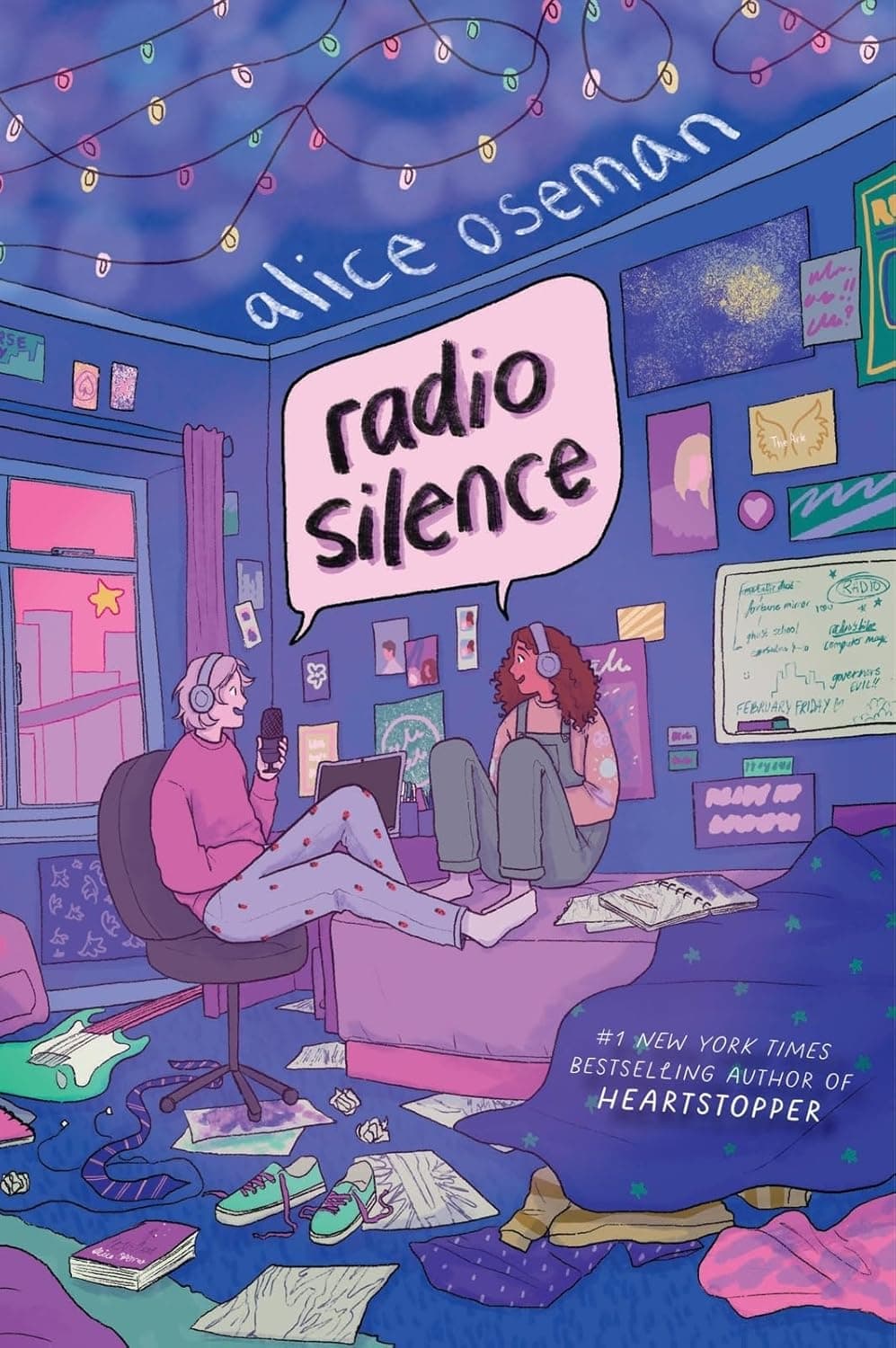
Aled’s Bedroom The fairy lights, posters, and galaxy ceiling are a tactile map of identity. When the room is destroyed, the assault on objects stands in for the assault on voice; Frances’s salvaging of his things enacts her commitment to protecting who he is.
Aled’s “Weird” Clothes Hidden patterned clothes dramatize the fear that authenticity will invite ridicule. Wearing the Babar jacket with Frances marks their shared pact: to be odd together, and therefore safe enough to be honest.
The Live!Video Stage The stage represents the risky, necessary step from anonymity to embodiment. Performing there completes the arc from secrecy to ownership, turning a survival mechanism into a chosen life.
Contemporary Relevance
In an era of rankings, hyper-visibility, and precarious futures, young people are told to optimize themselves into exhaustion. Radio Silence counters with a blueprint for opting out: use online spaces as incubators for identity, gather communities around shared creation, and measure success by alignment, not accolades. The novel speaks to student burnout, the costs of brand-building, and the healing that comes from saying what you love out loud—even when institutions don’t applaud.
Essential Quote
“Hello. I hope somebody is listening …”
Across the book, this refrain shifts from a plea into a proclamation. Early on, it signifies isolation and the fear of speaking into a void; by the finale, it affirms a community that exists because someone dared to speak. The line crystallizes the theme’s promise: when passion is voiced, it doesn’t just find listeners—it creates them.