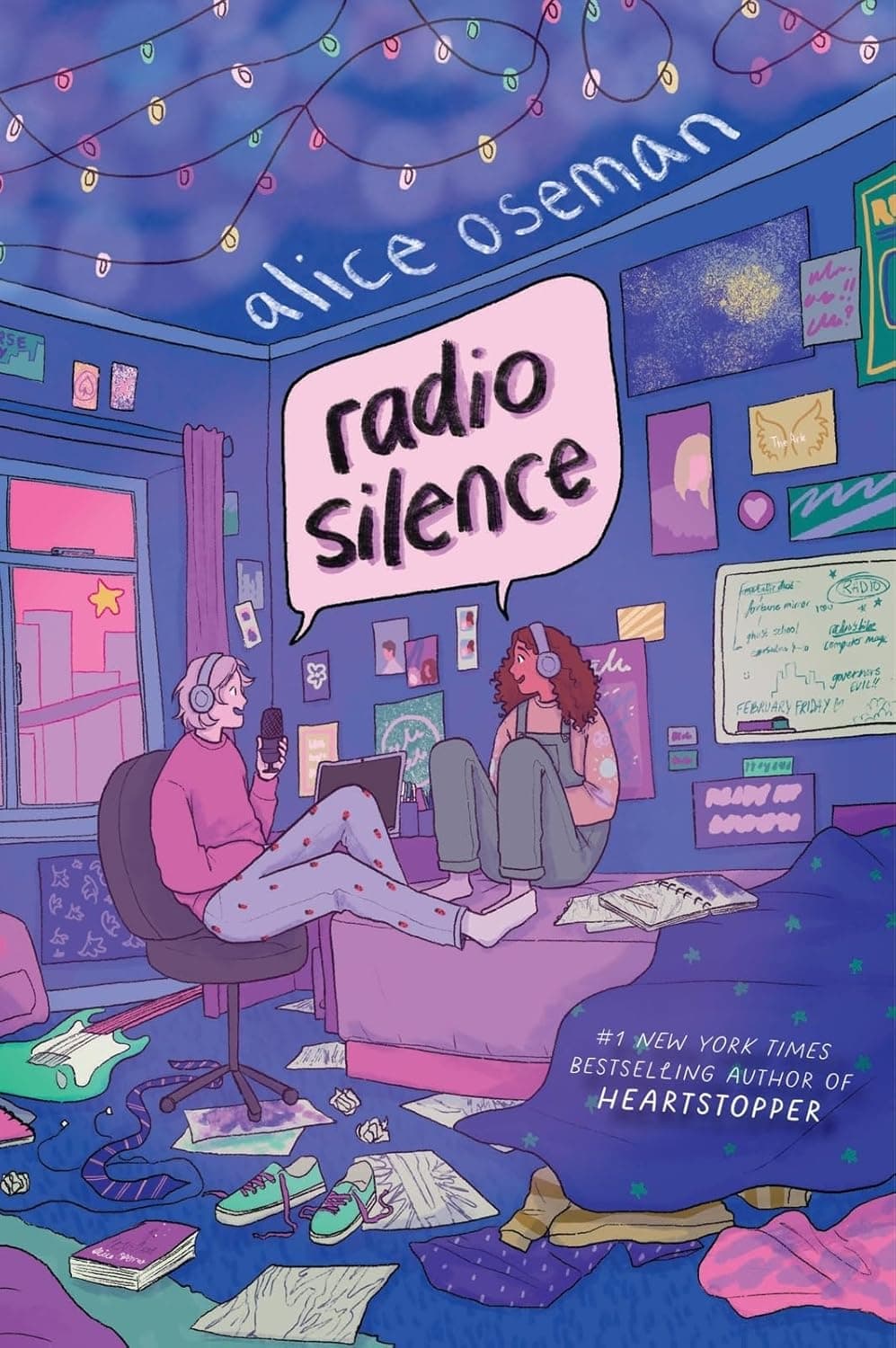
What This Theme Explores
Radio Silence treats LGBTQ+ identity as one strand in a larger tapestry of adolescence, asking what it looks like to live, create, and love while queer without turning identity into a spectacle or a source of trauma. The book explores how sexuality and gender can sit alongside grades, family, art, and friendship—sometimes spoken aloud, sometimes held quietly. It questions who gets to define identity—public labels or private truths—and emphasizes that acceptance often shows up not as grand gestures, but as everyday ease. The novel ultimately argues that representation can be both expansive and ordinary, making space for underrepresented identities while normalizing queer life.
How It Develops
The theme surfaces early through Frances Janvier’s private certainty about her bisexuality and her past crush on the openly gay Carys Last. At the same time, the podcast Universe City introduces an agender protagonist whose shifting voice and ungendered identity give Frances language she finds “literal genius,” reframing gender as creative possibility rather than constraint.
As Frances and Aled Last become close collaborators, the narrative models a queer-friendly world: Frances casually comes out, Aled accepts without fuss, and Frances learns about Aled’s relationship with Daniel Jun. None of these moments hijack the plot; instead, they deepen intimacy and trust, showing identity as integrated into daily life.
In the final stretch, the theme culminates not in a dramatic reveal but in a quiet, clarifying conversation where Aled articulates that he’s on the asexual spectrum, identifying as demisexual. The emphasis rests on communication, mutual education, and choosing language that feels right—an affirming reminder that identity can be discovered relationally and honored gently.
Key Examples
-
Casual, confident disclosure reframes queerness as ordinary when Carys comes out offhandedly on a train. The scene punctures assumptions—not everyone “just knows,” but the tone signals that being gay is neither secret nor scandal. Shock becomes a setup for normalization rather than conflict.
“You know I’m gay, don’t you?”
I did not know.
She raised her eyebrows, probably at my expression of absolute shock.
“Ah, I thought everyone knew that!” -
Frances’s bisexuality exists as a valid truth even when unspoken to others, underscoring that identity does not require an audience. When she does tell Aled, the exchange is brief, slightly awkward, and deeply accepting—an everyday act of trust instead of a melodramatic turning point.
“You know … I’m bisexual.”
Aled’s eyes widened. “What— Are you?”
“Haha, yeah. I told you I kissed Carys, didn’t I?”
“Yeah, you did, but …” Aled shook his head. “I don’t know. I didn’t think about it very hard.” -
Universe City’s agender protagonist expands gender representation through art, letting voice and form do the work of deconstructing binaries. Frances’s admiration captures how creative spaces can validate identities by normalizing ambiguity and resisting categorization.
"Especially Radio, the whole agender thing is literal genius, like, when the girl voice first appeared I listened to the episode, like, twenty times. But it’s so good when you’re not sure whether it’s a boy voice or a girl voice, those are amazing. I mean … none of the voices are girl or boy voices, are they? Radio doesn’t have a gender."
-
Aled’s demisexuality is explored through patient, reciprocal explanation rather than revelation or apology. The scene models how vocabulary can unlock self-understanding, and how a relationship can flourish by making room for difference.
“But asexuality means … erm … someone who doesn’t feel, like, sexually attracted to anyone.”
“Right. Okay.”
“And some people just feel like they’re … like … partly asexual, so … they only feel sexually attracted to people who they know really, really well. People they have, like, an emotional connection with.”
“Okay. And that’s you.”
“Yeah.”
Character Connections
As a bisexual protagonist, Frances treats queerness as one facet of a fuller self—alongside art, ambition, and the performance of “School Frances.” Her story underscores the theme’s insistence that identity can be stable even when still private, and that coming out can be an act of intimacy rather than a plot twist. Her profoundly nonromantic bond with Aled also affirms the dignity of Platonic Friendship and Love, resisting assumptions that proximity and affection must become romance.
Aled’s journey toward naming demisexuality parallels his broader arc of self-expression in Finding Your Voice and Pursuing Passion. The anonymity of Universe City lets him experiment with persona and gendered presentation at a safe remove, while his real-life silence signals how hard it can be to claim language that fits. His eventual clarity shows identity as something articulated through trust—first with Daniel, but also with Frances, who meets his truth without pressure.
Daniel is a gay character whose conflicts primarily orbit The Pressure of Academia and the Education System and the emotional knots of loving someone still figuring themself out. His stability around his sexuality grounds the narrative, while his relationship with Aled dramatizes how different needs and tempos within queer relationships require care rather than blame.
Carys arrives as a model of open, untroubled queerness—someone who left an oppressive home and built a life where identity isn’t debated. Her presence early on gives Frances both a mirror and a horizon: confidence as a possibility, not a mandate.
Raine exemplifies the effortless ally. Her matter-of-fact understanding of her friends’ relationships (“Do I know that Aled and Daniel are fucking on the down low? Yeah, mate.”) collapses stigma through humor, showing how normalization often looks like shared jokes and unstartled listening.
Symbolic Elements
-
Universe City: The podcast functions as a creative refuge where outsiderhood becomes artistry. Its agender lead and dystopian campus setting metaphorize the pressure to conform—and the power of making a world where your voice fits.
-
Aled’s Clothes: His bright, patterned outfits (and those “women’s section” shoes that are “just shoes”) symbolize a self that resists tidy gender coding. The more he lets these tastes surface, the more the book aligns authenticity in style with authenticity in identity.
-
“Radio Silence”: As a name, it captures the gap between having an identity and having words for it. Aled’s quietness is not emptiness but a prelude to articulation, echoing many queer experiences of waiting for language, safety, or both.
Contemporary Relevance
Radio Silence models a representation ethos many readers seek now: queer characters whose lives aren’t reduced to trauma, and identities—like asexuality and demisexuality—rarely centered elsewhere. It shows how normalization isn’t neutrality; it’s deliberate storytelling that puts queer teens at the heart of friendships, creative projects, and futures worth wanting. In a media landscape still tempted by tragedy as shorthand for depth, the novel insists that complexity can also be gentle, funny, and ordinary—and that seeing yourself thrive matters as much as seeing yourself endure.
Essential Quote
“And some people just feel like they’re … like … partly asexual, so … they only feel sexually attracted to people who they know really, really well. People they have, like, an emotional connection with.”
“Okay. And that’s you.”
“Yeah.”
This exchange distills the book’s approach: identity as learned language, offered carefully and received without drama. It reframes coming out as collaborative understanding, privileging consent, clarity, and patience—and, in doing so, normalizes identities on the asexual spectrum within everyday teenage life.